Showing posts with label exploration. Show all posts

Thursday, May 4, 2023

America’s Space Goals and Reputation Rode into Orbit with Explorer I

By Steve Milner
Contributing Writer

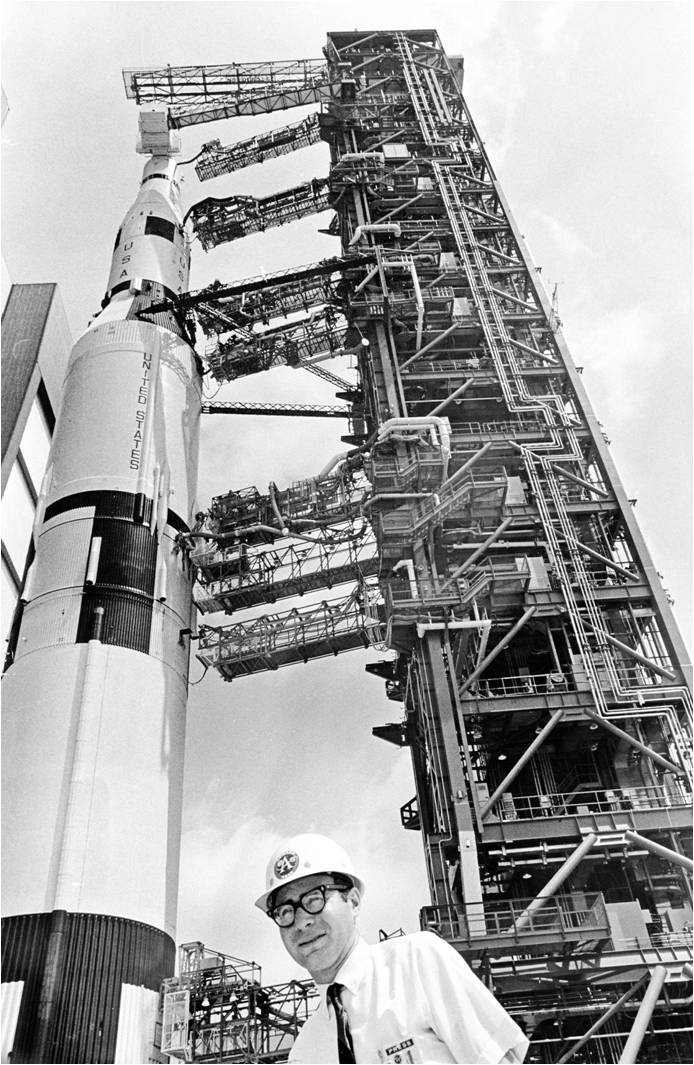
Blog author Steve Milner with a full-scale, non-flyable Apollo/Saturn V space vehicle used to perform fit checks and mobile launcher connections, November 1967.

Sixty-five years ago, on January 31, 1958, the United States entered the space age when it successfully launched and orbited Explorer I, our nation’s first earth satellite. This 30-pound payload was launched by the Army’s Redstone rocket as the first stage of the four-stage vehicle. This payload included scientific instruments that, among other measurements, discovered an inner radiation belt around earth named for its prime researcher, Dr. James Van Allen. And incredibly, less than 11 years later, Neil Armstrong and Buzz Aldrin landed on the moon and returned safely to earth, fulfilling President John Kennedy’s directive issued in May 1961—to achieve this monumental task ahead of the Soviet Union. But we were initially playing catch-up, because the Russians had already dazzled the world by launching Sputnik, the first earth satellite, in October 1957, nearly four months ahead of Explorer I. In doing so the Soviets used a powerful military rocket for the “push” needed to send a satellite into earth orbit.

At that time the U.S. had the rocket hardware and the smarts to beat the Soviets, but President Dwight Eisenhower wanted to show the world we would, instead, pursue space exploration by not using a proven military launch vehicle. Eisenhower’s idea was a noble one but not from a public relations standpoint—and the Soviets capitalized on their beeping Sputnik, orbiting earth every 90 minutes, repeatedly signaling its dominance in space.

Instead, the U.S. tried to launch its Vanguard satellite, using a much less powerful and unproven rocket. I clearly remember watching on live television as Vanguard exploded on its launch pad at Cape Canaveral on December 4, 1957. (The first successful Vanguard was launched from the Cape two months after the Army’s Explorer I launch.)

Three key persons involved in the successful Explorer I launch were, left-to-right: Jet Propulsion Laboratory Director, Dr William Pickering; Dr. James van Allen of the University of Iowa; and Dr. Wernher von Braun of the U.S. Army Ballistic Missile Agency. (U.S. Army)

Finally, the United States switched gears and tasked Dr. Wernher von Braun, the former World War II German rocket engineer, and his Peenemunde team, along with U.S. engineers, to use the Redstone missile as the Jupiter-C’s first stage to launch our first earth satellite.

A modified Jupiter-C used a Restone rocket as its first stage to launch America’s first earth satellite, Explorer I, on January 31, 1958. The UE designation was a once-classified code that designated the specific Redstone used for this mission. (NASA)

Explorer I resembled a rolling pin in shape and was nearly eight feet long and six inches in diameter. It transmitted data to earth and orbited every 115 minutes. At its farthest point from earth, Explorer I’s apogee was more than 1,500 miles. At its closest point, or perigee, it orbited 225 miles above earth.

Explorer I transmitted data for about four months after it was orbited, and remained silently in orbit for another 12 years. It reentered the earth’s atmosphere on March 30, 1970, and burned up.

Artist's concept of Explorer I (U.S. Army)

During the past 65 years, the U.S. has successfully launched a variety of satellites whose contributions we take for granted. These include those used for worldwide communications and weather forecasting, as well as for the global positioning (GPS), a setting we have on our phones. And there have been many spinoff products developed during our U.S. space program, in addition to significant advancements in computer technology.

As a NASA public affairs contractor at Kennedy Space Center and Cape Canaveral (then temporarily renamed Cape Kennedy), I was privileged to have worked with some members of the Explorer I launch team a decade later.


Editor’s Note: In addition to serving as the public affairs officer for 17 years at Norfolk Naval Shipyard, Steve Milner was a NASA public affairs contractor at Kennedy Space Center and Cape Canaveral for nearly a decade, during the manned Gemini, Apollo, and Skylab programs.

Friday, May 27, 2016

One Smaller Ship for Research, One Giant Leap for Exploration: RV Neil Armstrong

This panoramic view shows Research Vessel (RV) Neil Armstrong (AGOR-27) moored near the battleship Wisconsin (BB-64) which is moored on the other side of the National Maritime Center Nauticus and Half Moone Cruise Terminal in downtown Norfolk.  While the era of the battleships might be over, research vessels are as vital to the Navy's mission as they ever were. (Photograph by M.C. Farrington)   
The United States Navy has been a global leader in both carrying out and facilitating oceanographic  research and exploration for most of its history, and ships such as the long-lived USS Bear helped explore the inaccessible wastes of the earth's polar regions, both for scientific research and to stake territorial claims.  After the turn of the last century, the Navy's missions broadened from the surface of the ocean as submersibles and aircraft significantly broadened the battlespace, but with some significant exceptions after the Second World War, such as the record-breaking dives completed off Guam by the bathyscaphe Trieste during Project Nekton in the late-1950s and early 1960s, undersea exploration took a back seat to the beckoning sky.   

The strategic imperatives of the Cold War put a premium on aerospace, ballistic missile and rocketry research.  As an indirect result, breathtaking gains were made in outer space exploration, so much so that by the late-1960s, more was known about the surface of the moon than the floor of the earth's oceans.  The Navy's contribution to oceanographic research did not completely wither away during this time, yet the first ship used by the Office of Naval Research (ONR) to support scientists for non-military research, USNS Josiah Willard Gibbs (T-AGOR-1), was a converted seaplane tender that fought in the Battle of Surigao Strait. 


Neil Armstrong, seen here in his official Apollo
11 portrait taken in 1969, passed away in 2012 at
the age of 82. His name lives on in the US Navy's
newest oceanographic research vessel that is
beginning operational service this summer. 
(NASA/ Wikimedia Commons) 
A decade later, when former naval aviator Neil Armstrong was training in 1967 for the first manned mission to the moon's surface, the keel was laid in Bay City Mich. for a new class of dedicated deep sea research vessel that would reenergize deep sea exploration.  Delivered in 1970 to the Woods Hole Oceanographic Institute  in Woods Hole, Mass., the 244 foot-long Earnest Knorr (AGOR-15), named for the man who led a 25-year effort to chart and survey the world’s oceans a century before, would ultimately prove instrumental in helping oceanographers, geologists, and other scientists form a much greater understanding of plate tectonics and confirm the existence of hydrothermal vents as well as the otherworldly life residing there.


RV Knorr is also popularly known for her role as host to Dr. Robert Ballard and the scientific team that found RMS Titanic in 1985, after completing a classified mission to survey the remains of the ill-fated submarines Scorpion (SSN-589) and Thresher (SSN-593).  Although the discovery was Knorr's greatest brush with fame, the mission was but a small part of her 44-year career, in which she traveled 1.35 million miles (the equivalent of more than two round trips to the moon) on journeys from the Arctic to the southern oceans and hundreds of places in between.   Lessons learned during the decades of Knorr's service were taken into account as plans for a successor began to take shape during the 1990s.

In September 2012, just a few weeks after Neil Armstrong passed away at the age of 82, the Navy announced that the newest class of oceanographic research ship would be named for him. Christened on March 28, 2014, and launched a few days later, RV Neil Armstrong  (AGOR-27) passed her sea trials in August 2015 and was officially delivered to the Navy on September 23, 2015. The 238-foot-long research vessel recently stopped in Hampton Roads on a verification cruise from the shipyard where she was built in Anacortes, Washington, to her new home port in Woods Hole, Mass.  


Kent Sheasley, a 20-year veteran of oceanographic exploration aboard RV Knorr, discusses the vast improvements in navigation and engineering technologies at the helm of RV Neil Armstrong during a recent visit to the downtown Norfolk waterfront. (Photograph by M.C. Farrington)  
"We run everything--[the Navy] holds the pink slip," said Kent Sheasley, a Massachusetts Marine Academy graduate who worked his way up from an able seamen to first mate on RV Knorr over the last two decades and who is now the captain of RV Armstrong.  Sheasley noted that they were nearing the end of their fifth verification cruise, in his words, to "verify that the ship is ready to do real paid service, because at $45,000 a day, you want to be sure."
Completed in 2014, RV Neil Armstrong sports a "Made in USA"
label just below the bridge on her starboard side. (Photograph by
M.C. Farrington)
One of seven ships dedicated to academic research under the consortium of institutions belonging to the University National Oceanographic Laboratory System (UNOLS), Armstrong receives essential funding through ONR as well as a number of other federal agencies such as the National Science Foundation (NSF) and the National Oceanographic and Atmospheric Administration (NOAA), but when her active service starts this summer, scientists from all over the world, funded by research grants from a multitude of foundations, will financially sustain Armstrong on her missions of discovery all around the world.     

Considering that Armstrong was in development for the better part of two decades, it might sound surprising that the research vessel is slightly shorter than her predecessor, her 40-day endurance is approximately two weeks less, and she can embark fewer scientists than RV Knorr could.  Despite this, Armstrong possesses notable advantages over her predecessor such as a more advanced dynamic positioning system, greater fuel economy and cleaner exhaust, and her engines also produce less than half the underwater noise that RV Knorr produced.  This is particularly important because Armstrong also has the most advanced research sonar array the Navy possesses. 

(Left) RV Knorr in Reykjavic, Iceland towards the end of her American service life in 2014 (Woods Hole Oceanographic Institute) and her replacement, RV Neil Armstrong (right), along the Norfolk waterfront during her recent verification cruise from Anacortes Washington to the Woods Hole Oceanographic Institute in Massachusetts, show the dramatic design improvements made to facilitate the deployment of scientific gear and remotely-piloted underwater vehicles, particularly the A-Frame launch-and-recovery system mounted to the stern. (Photograph by M.C. Farrington)
Another improvement in design involves the ability to add modular trailers containing anything from industrial repair equipment to self-contained Remotely Piloted Underwater Vehicle (ROV) control centers that can now be bolted to Armstrong's aft deck.
In front of a group of visitors from the nearby National Maritime Center Nauticus, Captain Kent Sheasley describes how the spacious "dry lab" on Armstrong's starboard side will meet the needs of embarked scientists once the research vessel begins missions this summer.  There is also a slightly smaller "wet lab" and adjoining hangar on the port side that opens to the aft weather deck. (Photograph by M.C. Farrington)


The average stateroom an embarked scientist could expect to use aboard RVArmstrong. (Photograph by M.C. Farrington)
Despite the comparatively cushy surroundings for the 22 crewembers and up to 24 scientists and researchers embarked aboard Armstrong compared to the average Navy vessel, their optempo can exceed that experienced by the average Sailor.  With a years-long waiting list of scientists hoping to utilize the Navy's newest and most advanced oceanographic research platform, Capt. Sheasley expects Armstrong to be kept underway for anywhere between 300 to 320 days per year.
(Top) Just aft of the engineering section of RV Armstrong, 10,000 meters of Electro-Mechanical (EM) wire await use supporting a multitude of different missions including ROV operations, but what Armstrong's EM wire will probably be used for most is for deploying her onboard Conductivity/Temperature/Depth (CTD) Rosette Adaptive Sampling Device (bottom), which Capt. Sheasley calls the "bread and butter of oceanographic research."  It can determine a wealth of data at practically any depth in Earth's oceans such as oxygen level, salinity, and even its horizontal velocity using an Acoustic Doppler Current Profiler, taking 30 to 40 readings per meter of travel.  The CTD can also bring back samples using the Niskin bottles ringing the device's rosette frame. (Photographs by M.C. Farrington)