Showing posts with label CSS Virginia. Show all posts

Thursday, January 12, 2023

HRNM Brick-by-Brick Lego Shipbuilding Event: Building CSS Virginia

By Jim Beute

One of the best things that ever happened to my son Andrew and myself was attending the HRNM Lego Shipbuilding event back in 2014. We had a lot of fun, and it started us on a shared hobby that we’ve enjoyed together for eight years now. As our building skills and our pile of bricks have grown over those years, we challenge ourselves to build bigger and better creations for all the different Lego events that we now attend. The time that I’ve spent as a volunteer docent has sparked my interest in the Battle of Hampton Roads, and in the CSS Virginia as well.

Starting with the goal to “Build a big, cool model of CSS Virginia out of Lego for the HRNM Event!”, my first step is to nail down the scope of the model (how big, how cool) within the design constraints (the actual CSS Virginia design), the budget (my pile of bricks), and the project schedule (4 February deadline). The figure below depicts how my little Systems Engineer brain relates these concepts to each other, and the decisions that I reached for this model.

Jim's thoughts about creating his next big Lego build

Bigger is almost always better with Lego models, since it allows greater precision when making constant compromises of scale when building with Lego bricks. Building at minifigure scale (1:42) allows much more interesting models with lots of small plastic human interaction within the model to bring it alive for the audience.

One guiding principle for Lego kits and for my own models is that there should always be some fun or interesting feature that is a pleasant surprise. I have decided to “cut away” the starboard side to show the interior decks and spaces and to have a working engine room with pistons turning the propeller shaft. This decision quadrupled the complexity of the model, but it should significantly increase human interest and interaction with the model.

The decision to build a cut-away interior made it important to find good, detailed plans and drawings of the Virginia. The resources and helpful staff at HRNM, Portsmouth Naval Shipyard Museum, and the Mariners’ Museum helped me to find the best drawings and books available. Unfortunately, there just aren’t any complete interior drawings for the Virginia, and the available source materials often contradict each other. Carl Park faces this same dilemma in Ironclad Down. To fill in the gaps, he extrapolates from the limited construction drawings by John Porter such as the one shown below, pre-conversion drawings of USS Merrimack, and additional clues from crew memoirs.

This Porter drawing came from a digitized version at Eastern Carolina University (https://digital.lib.ecu.edu/4498)

While Carl Park provides the most complete composite sketch of the Virginia interior available, his efforts are more focused on ship construction than operational use. Even his composite makes extensive use of “Compartment Configuration Unknown” throughout the berth deck. Since I must build something there, I’ve put on my old ship’s ballcap and tried to imagine what a feasible arrangement for messing and berthing would be, extrapolating from the same limited sources. The picture below shows what I came up with. I’m sure there are many errors, but in my research, I’ve learned that every model of the Virginia falls back upon the artist’s imagination at some point.

CSS Virginia (Jim Beute)

Over the years, I have also learned to build modularity into the design of larger models. An 8-foot Lego ironclad looks great on the coffee table, but it needs to fit through doors in order to share it with others. I’ve built the Virginia in five easy pieces for transport. The four sections shown below snap together, and the casement then snaps onto the hull.

CSS Virginia in pieces (Jim Beute)

In addition, there is a bin of accessories (cannon, minifigures, etc.) that are then added to complete the scene. Minifigures and motion turn the static model into a historic scene of Civil War mayhem and chaos as shown below. Hopefully that will bring some of this history alive for the kids at the event. Lego doesn’t make Confederate minifigures, but they do make a variety of rebel scum from the Star Wars universe. This keeps the model from being too serious and allows for “find the Wookie” easter eggs that will lead people into spending a lot more time studying the interior of an ironclad than they would otherwise.

Closeup of the interior (Jim Beute)

Building the Virginia was a fun and educational experience for me. Come out to the HRNM Brick-by-Brick Lego Shipbuilding Event on February 4th for a closer look!

Thursday, September 22, 2022

Correcting the Record: USS Cumberland Lost 123 Sailors at the Battle of Hampton Roads

By Hunt Lewis
HRNM Volunteer
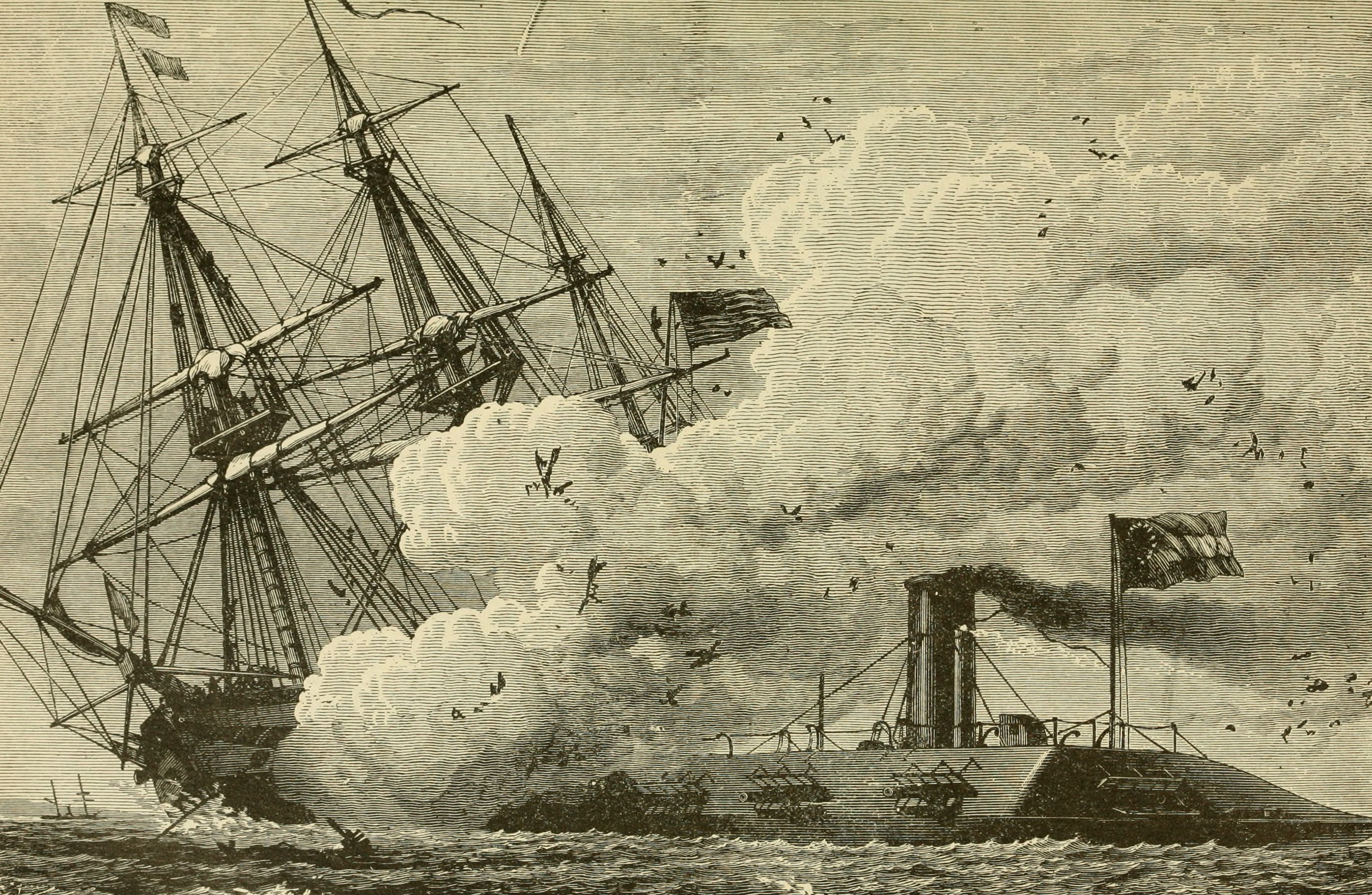
USS Cumberland rammed by CSS Virginia (Library of Congress)

When USS Cumberland was rammed and sunk by CSS Virginia (ex-USS Merrimack) on March 8, 1862, approximately a third of the crew were lost. Lost also were all personnel records. All that was known was the number of officers and men aboard at the start of the battle.

The ship’s commanding officer, Commander William Radford, had to report circumstances of the loss of his ship and number of Sailors killed or drowned. Lacking an accurate muster roll on which names could be called out, and a count made of those who made no response, Commander Radford did the next best thing. He mustered and took a count of the survivors and subtracted that count from the number of men attached to the ship at the beginning of the battle.

Final page of the muster roll, indicating the number of killed and drowned aboard USS Cumberland on March 8, 1862 (Library of Congress)

The muster consisted of 255 handwritten names on six pages. On the last page is the annotation:

            "Officers and men when action commenced          376
                do              do                  do          over               255
                                                       killed or drowned        121

              This is a large number and I am hoping more men will be found.
                                                        (signed) Wm. Radford,
                                                                        Commander”

The 121 fatalities has been reported in official records for 160 years, but this muster roll of survivors contains an error. On the first page of the muster, two officers were listed as having died in the battle, but when we counted up every name on the muster roll, we found that Radford accidentally counted the two men as survivors. Chaplain John Lenhart was listed as drowned and Master’s Mate John Harrington shown as killed. Because these two men were killed but accidentally counted among the survivors, the correct count of survivors should have been 253 rather than 255. Thus, the number of Sailors killed when USS Cumberland sank on March 8, 1862, stands at 123. With that conclusion, the Hampton Roads Naval Museum will begin using the corrected number of 123 in all future historical documents and exhibits. 


First page of the muster roll, listing the officers. When we added up the number of Sailors listed in this entire muster roll, we realized Commander Radford had accidentally counted Lenhart and Harrington as among the living. (Library of Congress)

Thursday, March 24, 2022

Memories of USS Cumberland (Part 3 of 3): A Living Spirit: Cumberland in Song

By William Clarkson
HRNM Educator

In the previous two parts of our March series about USS Cumberland, we have looked at reporting, perceptions, and poems about the Battle of Hampton Roads and sinking of Cumberland. In today’s third and final part, we briefly examine how music has served to keep Cumberland’s memory alive in national consciousness. As we saw in part two, poetry can be set to music, like Longfellow’s “The Cumberland,” but lyrics were also newly composed and brought Cumberland’s tale to audiences both across the nation and time. Today we will focus on two examples that were written within a year after the battle. These songs are titled “The Cumberland’s Crew,” and “The Good Ship Cumberland.” “The Cumberland’s Crew’s” author is unknown, while “The Good Ship Cumberland” is by one E.F.M. whose exact name remains unidentified.

Songwriters produced a wealth of music during the American Civil War. Songs served to entertain, inspire, and sustain the troops as well as the civilian populations. Tunes were sung from the stage to the campfire by professional musician and enthusiast alike. Many of these songs have no known attributable artist, having been written and performed by anonymous sailors, soldiers, and civilians from opposing sides. Many of these songs can be found in two of the larger folk music indexes compiled during the 20th century. The “Laws” Index (named for the creator of the index and folk music scholar, George Malcolm Laws), contains 2,576 unique English language song listings, with many sub-listings for similar songs. A second index called the Roud Folk Song Index (after creator Steve Roud, also a folk music scholar), contains a more comprehensive set at around 25,000 unique listings. Both songs featured here have individual listings on both indexes.
“The Cumberland’s Crew,” Published by H. De Marson, NYC c. 1863 (Library of Congress)
Our first song, “Cumberland’s Crew,”[i] recounts the battle between USS Cumberland and CSS Virginia on March 8, 1862. The opening stanza invites the listener:

Shipmates, come gather and join in my ditty
Of a terrible battle that's happened of late
When each Union tar shed a tear of sad pity
When he heard of the once-gallant Cumberland's fate

O, the eighth day of March told a terrible story
And many brave tars to this world bid adieu,
Our flag it was wrapped in a mantle of glory
By the heroic deeds of the Cumberland's crew

Already, the listener is primed for a tale of struggle and defiance, and the rest of the song plays out much like one might expect. The familiar encouragement from the acting captain, Lieutenant George Morris, is echoed when he says, "’Boys, of this monster, now, don't be dismayed. We've sworn to maintain our beloved Constitution, and to die for our country we are not afraid.'" The battle commences, and Cumberland and Virginia fire on each other, with Virginia’s iron plating largely rendering Cumberland’s guns ineffective. Meanwhile, fire from Virginia takes a terrible toll on Cumberland’s crew, even before the ship is rammed. The song doesn’t specifically mention the ramming and sinking, but the final two stanzas make clear that the crew will not surrender and will go down fighting by saying:

Now, the pride of our Navy can never be daunted,
Though the dead and the wounded our decks they did strew
"We'll die at our quarters or conquer victorious:''
Was answered in cheers by the Cumberland's crew.

"We've fought for the Union, our cause it is glorious.
To the Star Spangled Banner we'll ever prove true.
We'll be wept for by Columbia's brave sons and fair daughters
And never forgotten," sang the Cumberland's crew.

The ending to the song serves two purposes. First, it commemorates the bravery of the crew, who refused to surrender to the ironclad Virginia. Second, it inspires both combatants and civilians to continue to support the “glorious” Union cause. It’s important to note here that different performers and printings of folk songs will include slight variations in the lyrics, as well as a wide variety of instrumentation and musical arrangements, often being set to the tune of other traditional folk music. This is certainly the case with our second song, “The Good Ship Cumberland.”
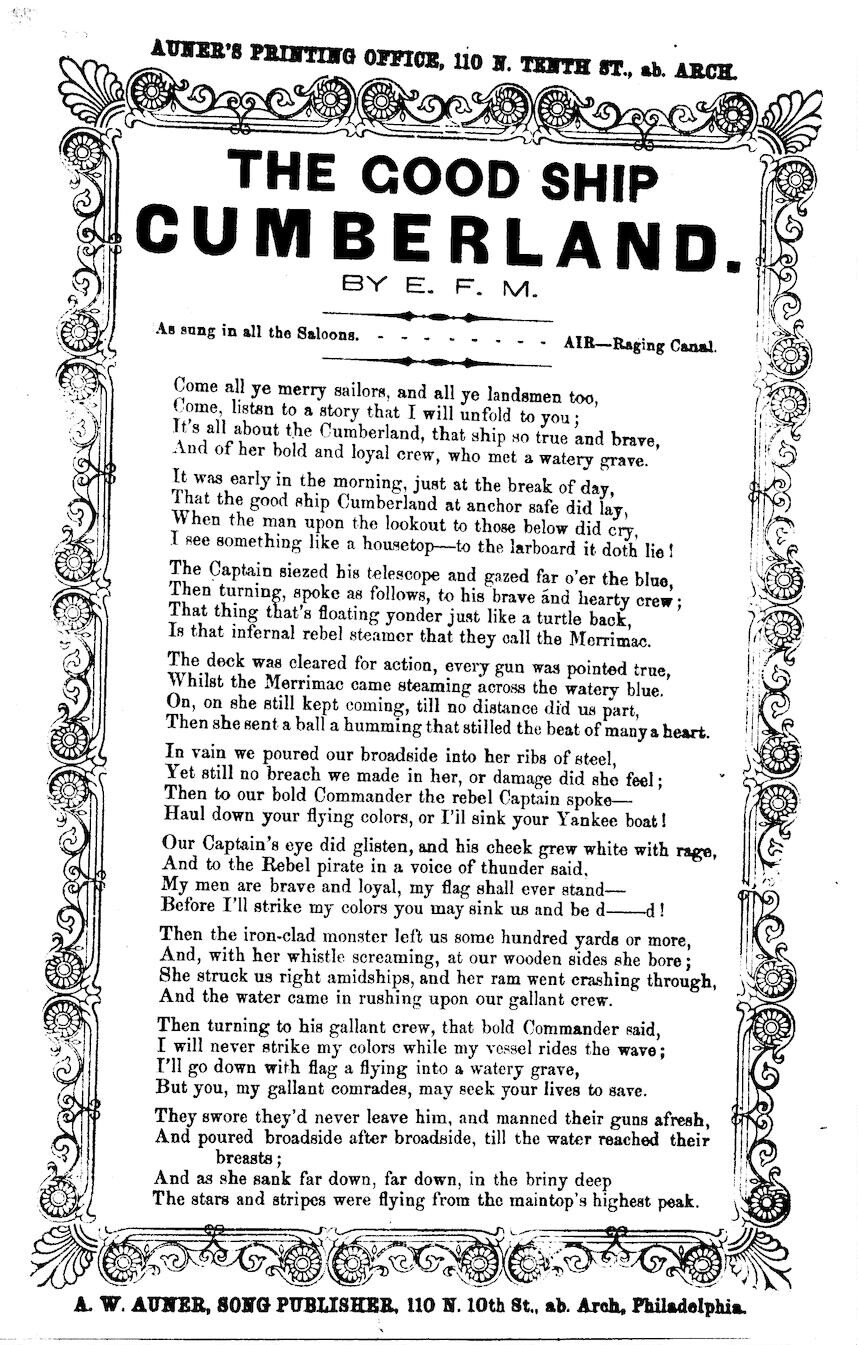
“The Good Ship Cumberland,” Published by A.W. Auner, Philadelphia c. 1863 (Library of Congress)

“Good Ship Cumberland”[ii] is the earliest title for a song that can be more widely found under the names, “The Cumberland and the Merrimac[k],” “The Cumberland,” or even “The Merrimac.” Despite the different title and arrangements, lyrically they are the same song. As with “Cumberland’s Crew,” “Good Ship Cumberland” begins with an invitation to “all ye merry sailors, and all ye landsmen too,” and unfurls the story of battle between Cumberland and Virginia in much the same way as “Cumberland’s crew.” There are a few marked differences, however, between “Good Ship Cumberland,” and “Cumberland’s Crew.” First, “Good Ship” includes the demand for Cumberland’s surrender, and Morris’ alleged reply:

In vain we poured our broadside into her ribs of steel,
Yet still no breach we made in her, or damage did she feel;
Then to our bold Commander the rebel Captain spoke—
Haul down your flying colors, or I'll sink your Yankee boat!

Our Captain's eye did glisten, and his cheek grew white with rage,
And to the Rebel pirate in a voice of thunder said,
My men are brave and loyal, my flag shall ever stand—
Before I'll strike my colors you may sink us and be damned!

Second, the song includes the ramming of Cumberland by Virginia, and third, when it becomes apparent that Cumberland is sinking, Morris offers the crew the opportunity to escape, saying, “I'll go down with flag a flying into a watery grave, but you, my gallant comrades, may seek your lives to save.” Morris did not, in fact, go down with the ship, but the sentiment is conveyed nonetheless. To Morris’ offer the crew replies:

They swore they'd never leave him, and manned their guns afresh,
And poured broadside after broadside, till the water reached their breasts;
And as she sank far down, far down, in the briny deep
The stars and stripes were flying from the maintop's highest peak.

This final line provides the final major difference between the two tunes, presenting the listener with the image of Cumberland’s flag still flying even as the hull and many of the crew rest at the bottom of the James River. As discussed in the two previous posts, this image was a focal point for participants, writers, and the public alike.

 “The Loggers,” an image depicting loggers in Michigan during the 1880s-90s, Detroit Publishing Co. c. 1890 (Library of Congress)
After Union victory in the American Civil War, sailors and soldiers from both sides returned to civilian life and sought employment anywhere they could. They carried with them the stories, memories, and importantly the songs they learned and sang during the war. Printings of songs like “Cumberland’s Crew” were disseminated widely and have been found as far away as England and Ireland. In the United States, these songs were commonly heard in lumber camps in New York, Pennsylvania, Michigan, Minnesota, and Wisconsin, as well as from sailors and shipping laborers throughout the Great Lakes region. As Civil War veterans aged, these songs were passed down and eventually found their way into the repertoire of professional folk musicians. This interest in folk music intensified and reached its zenith between the late 1940s-1960s, during a period known as the American Folk Music Revival. Many renditions of Cumberland songs date from this period; the version found in endnote ii by Warde Ford is off the album Wolf River Songs, released in 1956. Another musically different version was performed by Ellen Stekert and released on the album Songs of a New York Lumberjack in 1958.[iii]
Sketch of USS Cumberland by Alfred R. Waud, c. 1861 (Library of Congress)
Versions of these songs are still performed 160 years after the Battle of Hampton Roads, with some groups giving them a bit of an updated flavor.[iv] Though the sound of more recent recordings might be different, the words and message remain largely the same. Hearing songs from the past that continue to be performed today provides us with a closer connection to what a Civil War contemporary might have felt or believed, and how the battle between USS Cumberland and CSS Virginia took on meaning far beyond the sinking of one ship. Music drives this home, perhaps even more so than articles and poetry. What each of the media we have considered over the past three posts share is the reminder that the Battle of Hampton Roads and sinking of USS Cumberland took root in the contemporary public consciousness. And, like Cumberland’s flag flying on her mast, the legacy of the ship and crew’s struggle is still visible today, 160 years later.


Notes:
[i] A version of “Cumberland’s Crew,” performed by the 97th Regimental String Band, and played on contemporary instruments can be heard at https://www.youtube.com/watch?v=c_tVGoiKOJA.
[ii] A version of “Good Ship Cumberland” Performed by Warde Ford (under the title “The Sinking of the Cumberland”), can be heard at https://www.youtube.com/watch?v=tp8U_ySDEIA. Notice that the first stanza is omitted in this version.
[iii] A version of “Good Ship Cumberland” (under the title “The Cumberland and the Merrimac”), performed by Ellen Stekert can be heard at https://www.youtube.com/watch?v=hb6I_f2pHzw.
[iv] A version of “The Cumberland’s Crew”, performed by Smokey Bastard, 2008 can be heard at https://www.youtube.com/watch?v=gX984Pdl6WM.

Tuesday, March 8, 2022

Memories of USS Cumberland (Part 1 of 3): Perceptions and Observations About the Loss of Cumberland During the Battle of Hampton Roads

By William Clarkson
Educator

Much has been written about the Battle of Hampton Roads and the clash between the ironclads CSS Virginia and USS Monitor during the American Civil War. Few ships captured the popular imagination of the day quite like these two vessels. Accounts and depictions of the events of March 8th and 9th, 1862, began to appear almost immediately. However, another vessel involved in the action stirred nearly as much admiration and inspired a wealth of observations and creative works. USS Cumberland, the first vessel sunk by CSS Virginia on March 8th, 1862, roused the likes of Nathaniel Hawthorne, Herman Melville, and Henry Wadsworth Longfellow, among many others, to pen works about the battle and Cumberland’s demise. In addition to newspaper articles, these works spread the tale of Cumberland’s heroic yet doomed struggle. March 8th, 2022, marks the 160th anniversary of the sinking of USS Cumberland. Throughout the month of March, we will explore some of these works, and how the story of USS Cumberland has been perceived and passed into the annals of U.S. history.

Sketch of USS Cumberland off Newport News, by Alfred R. Waud c. 1861 (Library of Congress)[i]

Interpretations of the Battle of Hampton Roads often were not entirely based in fact. How the story was reported and conveyed depended on which side the individual or organization supported. While various versions about the battle’s details exist across different accounts, USS Cumberland’s ramming and sinking by CSS Virginia is not in dispute. Where accounts do differ is the significance of Cumberland’s loss. The Richmond Enquirer (a Confederate newspaper) of March 11, 1862, proclaims the headline, “Great Success of the Confederate Iron-Clad Steamer Virginia - Large Number of Yankees Shot and Drowned.” The paper continues, “The object in first getting rid of the Cumberland was probably to destroy the very heavy armament which that frigate carried, it being the heaviest in the Yankee Navy.” While Cumberland had been fitted with more powerful guns in 1861, such a claim inflates the perceived victory. Another southern paper, the Staunton Spectator, also in its March 11th, 1862, edition, claims that Virginia sank six ships during the battle (not true), and caused a far greater amount of damage to the surviving vessels, including USS Monitor, than was actually the case.

Conversely, many newspapers supporting the Union sought to downplay the losses of March 8th, preferring to report a more matter-of-fact sequence of events. They focused on Monitor and the engagement of March 9th, even downplaying the loss of Cumberland and Congress. The March 11th, 1862, Chicago Daily Tribune asserts, “Aside from the loss of life attending the loss of the Cumberland and the Roanoke, there is little to regret.” It further proclaims that Cumberland was an old ship, in need of major overhaul and repair, being “…ill-adapted to the requirements of modern warfare.” Note that that the paper mistakenly identifies the second ship sunk as USS Roanoke instead of USS Congress.[ii] Not every pro-Union paper dismissed Cumberland’s loss so readily (more on this later). However, just as the southern papers proclaimed a major victory, so did many northern papers downplay Virginia’s fight with USS Cumberland, Congress, and Minnesota to focus on the appearance and performance of USS Monitor.

Portrait of Nathaniel Hawthorne c. 1861 (Library of Congress)
With such intense focus on the ironclads, Cumberland, as well as Congress, became unwitting symbols of what many considered (and still do), to be a major transition in naval warfare. In July 1862, Atlantic Monthly published an article by Nathaniel Hawthorne titled, “Chiefly About War Matters.” In this article Hawthorne recalls his travels from New England to Washington DC, and then to various points of interest in Virginia. One of these stops was at Fort Monroe, which had recently witnessed the Battle of Hampton Roads. It’s clear from Hawthorne’s account that seeing the aftermath of the battle affected him deeply. In his words, “It was the sight of the few sticks that are left of the frigate Congress, stranded near the shore, — and still more, the masts of the Cumberland rising midway out of the water, with a tattered rag of a pennant fluttering from one of them,” that affected him most of all. Having toured both USS Minnesota and USS Monitor, as well as seeing the carnage wrought by the ironclad CSS Virginia, Hawthorne puts forth a sentiment, echoed by contemporaries and future writers alike, in saying, “[t]hat last gun from the Cumberland, when her deck was half submerged, sounded the requiem of many sinking ships. Then went down all the navies of Europe, and our own…” He further states that, “…human strife is to be transferred from the heart and personality of man into cunning contrivances of machinery, which by and by will fight out our wars with only the clank and smash of iron, strewing the field with broken engines.” No longer would Sailors serve as part of the living whole of a ship, but as pieces in one great machine, at least in Hawthorne’s view.

These opinions were shared widely, including by John Taylor Wood, an officer aboard Virginia during the battle and later commander of the commerce raider CSS Tallahassee. He states some 22 years after the battle, in the Nov. 1884-Apr. 1885 edition of The Century Illustrated Monthly Magazine, “Line-of-battle ships… were at once universally condemned as out of date. Rams and iron-clads were in future to decide all naval warfare.” However, wooden ships and ships of sail continued to serve in various roles far beyond the famous battle of the ironclads. While technology may provide some advantage in a naval engagement, it is still the ship’s crew that provides the knowledge, bravery, and dedication necessary to operate their vessel in combat. In this respect, the crew of USS Cumberland serves as an example of Sailors performing their duty, even in the face of seemingly insurmountable odds, and with the likelihood of injury or death. This example was recognized and extolled by contemporaries and continues into the present.

Events of the battle and sinking of Cumberland were covered internationally, as can be seen in this April 1862 editions of The Illustrated London News, showing CSS Virginia ramming USS Cumberland (Library of Congress)

While some northern papers downplayed the momentous struggle of USS Cumberland, others praised the steadfast determination of its crew. A reporter for the Baltimore American wrote (and their words were reprinted in papers across the north), “She went down with her flag still flying, and it still flies above the mast, above the waters that overwhelmed her, a memento of the bravest, most daring, and yet hopeless defense that has ever been made by any vessel belonging to any navy in the world.” Indeed, even while despairing the future of naval action, Nathaniel Hawthorne, in his article, likened the bravery of Cumberland’s crew to the storied battles between sailing ships past, invoking names like Blake, Nelson, and Trafalgar.

Admiration was not limited to northern sources. On March 20, 1862, the Richmond Christian Advocate reprinted a March 10th article from The Norfolk Day Book which read, “A gallant man fought that ship – a man worthy to have maintained a better cause. Gun after gun he fired, lower and lower sunk his ship, his last discharge comes from his pivot gun, the ship lurches to starboard, now to port, his flag streams out wildly, and now the Cumberland goes down on her beam ends, at once a monument and an epitaph of the gallant men who fought her.” One might presume that the reporter was referring wholly to the ship’s commander, but it was the actions of the whole crew that inspired such recognition, even amongst their enemy. In the words of Virginia officer John Taylor Wood, “The crew were driven by the advancing water to the spar-deck, and there worked her pivot-guns until she went down with a roar, the colors still flying. No ship was ever fought more gallantly.”

Line engraving published in Leslie's Weekly, c. 1862, depicting USS Cumberland continuing to engage CSS Virginia, even as the ship sinks (NHHC)
The image of USS Cumberland continuing to fight, until the ship sank beneath the waves, its flag still flying, became a symbol of inspiration for the Union. Many years after the battle, Cumberland’s surgeon, Dr. Charles Martin, remarked in a speech, “Instead of defeat, it is a victory. The whole camp is rushing to meet them (Cumberland’s crew) with cheers [and] with embraces.” Currier and Ives issued their famous print of the Cumberland’s sinking, with the phrase “Destroyed but not Conquered,” printed below the image. These words and the deeds of Cumberland’s crew would live on throughout the war, with accounts of their heroism printed and reprinted across the nation. The praise and memorializing of Cumberland’s crew wasn’t limited to newspapers, magazines, and speeches. As we shall see in part two of this three-part series, many of the era’s most famous poets put ink to paper to ensure USS Cumberland’s actions and story would not be forgotten.


Notes:
[i] Alfred Rudolph Waud was an artist and illustrator who created hundreds of sketches during his time traveling with the army of the Potomac, including several sketches of USS Cumberland in 1861.
[ii] USS Roanoke was also a Merrimack-class steam frigate that was converted into an ironclad by the Union Navy soon after the Battle of Hampton Roads. To see a model of the ship in person, visit the Hampton Roads Naval Museum, or reference https://hamptonroadsnavalmuseum.blogspot.com/2013/01/ironclad-uss-roanoke-ship-model.html.

Thursday, July 1, 2021

Did Demon Rum Play a Part in the Destruction of CSS Virginia?

By Hunt Lewis
HRNM Volunteer

One of the last survivors of the crew of the CSS Virginia (ex USS Merrimack) said so.

In an interview conducted by B.C. Utecht for the Calvert News, Calvert, Texas in 1923, 85-year-old Andrew Jackson Sharp claimed rum did indeed play a part in the ship's destruction. Sharp was a landsman on CSS Virginia when it was destroyed by the Confederates on May 11, 1862.
Article from the Calvert News
Sharp related:
        "The Merrimac, or Virginia, suffered some damage from the Monitor’s guns, but the damage was easily repaired, and the warship then was in good shape as before. But now about this prohibition; "Our plans were well laid," said the aged veteran as he sat reminiscing on the veranda of his home. "The Merrimac had been thoroughly gone over, and we had plenty of ammunition and were in shape for good work. We were close to the mouth of the James River, and in order to steam upstream it was necessary for us to raise the ship about two feet so that we could cross the bar at that point. To do this it was necessary to throw off ballast.
        "We began the job of lightening the vessel about 9 o’clock that night. Now, as everybody knows, sailors in every navy are, or were, supplied with whisky rations. Both the navies of the North and South were furnished with rum. While throwing off ballast, so we could head up the James to relieve Richmond, members of the crew got hold of a barrel of whisky and drank it down with a large dipper. A little of this was all right, but they kept at it too long and were soon tipsy. No officer was at hand at the time. The men continued to throw off ballast until all of it went overboard. I remonstrated with them, raising quite a row and they argued back at me. I told them of the danger, and we had quite a tilt. Soon I saw our ship, instead of being raised only two feet, was up five feet exposing the wooden sides. This was due to throwing away all our ballast. I hurried to Captain Technor and explained the situation, but by this time it was too late. Federal ships were not far from us, and they could see us plainly because of the five foot difference. A shot from one of them into our wooden sides would have done for us. So the plan to go to the relief of Richmond was abandoned for the lack of ballast control protection on such an undertakings and decided to attack the Union fleet off Newport News instead." 
[1]

Sharp’s memory may have failed him or else the reporter misunderstood the name of the Virginia’s captain. It was Tattnall, not Technor, and the attack was never made.
CSS Virginia's captain, Josiah Tattnall (Naval History and Heritage Command)
There may be an inkling of truth in Sharp’s story, although the presence of Demon Rum is never mentioned in official reports. Commodore Tattnall in his report on May 14, 1862 to Confederate Secretary of the Navy Stephen Mallory stated, "The pilots had assured me they could take the ship with a draft of 18 feet to within 40 miles of Richmond...Confiding in these assurances...I determined to lighten the ship at once and run up the river for the protection of Richmond. 
        "All hands having been called on deck, I stated to them the condition of things, and my hope that by getting up river before the enemy could be made aware of our design we might capture his vessels which had ascended it. And render efficient aid in the defense of Richmond, but to effect this, would require all their energy in lightening the ship.
        "Being quite unwell, I had retired to bed. Between 1 and 2 o’clock in the morning the first lieutenant reported to me that after the crew had worked for five or six hours and lifted the ship so as to render her unfit for action,.. the pilots had declared their inability to carry 18 feet above Jamestown flats, up to a point the shore on each side was occupied by the enemy." [2]

The chief pilot explained that 18 feet could be carried only if the prevailing winds were blowing up-river, but for the last two days the winds had been blowing downriver: "I had no time to lose. The ship was in not in a condition for battle even with an enemy of equal force, and the force was overwhelming. I therefor determined...to save the crew for further service by landing them at Craney Island, the only road for retreat open to us, and to destroy the ship to prevent her falling into the hands of the enemy."
Explosion of the CSS Virginia (Naval History and Heritage Command)

Notes:
[1] The Calvert News story by J.C. Utecht dated Sunday November 25, 1923 is reproduced verbatim on pages14-17 of On the Hills of Home by John Calvin Sharpe. This book can be viewed or downloaded from https://ia800206.us.archive.org/24/items/OnTheHillsOfHome/On_the_Hills_of_Home.pdf

[2] Official records of the Union and Confederate Navies in the War of the Rebellion, Series 1,Volume 7, North Atlantic Blockading Squadron, pp 336-338

Thursday, October 18, 2018

In the Offing: Secrets of Confederate Steam Power

Engines of Rebellion: Confederate Ironclads and Steam Engineering in the Civil War

By Saxon T. Bisbee (Tuscaloosa: University of Alabama Press, 2018)
   
Reviewed by Joseph Miechle
Hampton Roads Naval Museum Educator
A diagram of the Martin vertical watertube marine boiler of CSS Virginia, which was exactly the same as the boiler aboard USS Merrimack, the vessel it was salvaged from, as it appears on page 19 of Engines of Rebellion
Saxon Bisbee has done a thorough and outstanding job of relating the histories behind the construction of 27 Confederate ironclads in his recent monograph, “Engines of Rebellion: Confederate Ironclads and Steam Engineering in the American Civil War.” Mr. Bisbee has combed through archival holdings scattered across the United States in order to compile a fascinating understanding of how the new Confederate States aggressively pursued an ironclad construction program. The book not only draws upon original plans, drawings, journals and previous secondary sources, but also more recent archeological discoveries to produce perhaps the most comprehensive analysis of Confederate ironclad engineering to date. While extremely insightful to those interested in the micro-histories of Civil War engineering, this book may not appeal to the average reader due to the inherent complexities of engineering. It is important to note that this book acknowledges that the Confederacy had some ironclads constructed for them outside the country but deliberately does not include them in discussion.
Plans for the Richmond-class ironclad CSS Savannah as redrawn by Robert Holcombe in 1978, which appear on page 89 of the book.  CSS Richmond, launched in an incomplete state from Gosport Navy Yard (today known as Norfolk Naval Shipyard) on May 6, 1862, was the only other Confederate ironclad besides the more famous CSS Virginia (converted from the remains of the USS Merrimack) to emerge from the shipyard on the Elizabeth River opposite the City of Norfolk, and was the first of six of the class completed at various locations under Confederate control. (Engines of Rebellion)   
The well-supported argument of the book is that despite steam engineering being a relatively new technology, lack of major manufacturing facilities in the south, and starting with no navy at all to begin with, the Confederate ironclad construction program was relatively successful. The ships utilized mostly existing machinery, yet they spurred advancements in propulsion and design for years afterward. The book is not only an exhaustive study on the design and procurement of the machinery of the Confederate ironclads but also draws on some rare primary accounts of Confederate engineers and shipbuilders. The book provides ample insight to the difficulties they faced in adapting under-powered engines for use on ships substantially different than they were originally designed for. 


Plan drawing, including the inboard profile, decks and two hull cross sections, inscribed at the top, "180 Ft. Iron Clad Gun Boat. As Altered July 6th 1863 ... Wm. A. Graves," which appears on page 134 of the book. This plan may represent CSS Virginia II, which was built in Richmond, Virginia, and participated with the other James River Squadron ironclads CSS Richmond and CSS Fredericksburg in the Battle of Trent's Reach. The original is plan # 81-12-2E in Record Group 19 at the U.S. National Archives. (Naval History and Heritage Command image)
There are only a couple of very slight criticisms about this book. As previously mentioned the very nature of writing a book on engineering requires a vocabulary all its own. This makes the book somewhat difficult for a reader with no background in the field to fully appreciate. To be fair, though, a fine glossary has been provided near the end of the book that the lay reader can refer to as necessary. The only other possibly negative aspect of this book is in regards to illustrations. A book about engineering would benefit greatly from numerous detailed illustrations. This book does include a fair amount of illustrations, some previously unpublished, yet presents them in such a small scale it is difficult to comprehend them or really appreciate their intricacies
Although the machinery for the wooden gunboat CSS Chattahoochee was smashed and its hull set afire when Columbus, Georgia was captured by U.S. Army troops in April 1865, this photo taken in Columbus approximately 100 years later (which appears on page 12 of the book) showed that its two horizontal direct-acting engines, which each turned one screw on the opposite side of each cylinder head, survived as a rare example of Civil War steam technology. (Courtesy of the Confederate Salvage Association, Inc./Naval History and Heritage Command image)
If you have ever wondered how the ironclad ships of the Confederacy were constructed and powered, this book will prove to be a phenomenal resource to the serious scholar of the Civil War Navy or those interested in 19th century steam engineering. For the lay reader, while a bit overwhelming, the book still tells the story from construction to disposition of all of the Confederate ironclads that were constructed in the Confederate States. The appendix itself is a fine quick glance resource for understanding the “bare bones” of Confederate Ironclad steam machinery, as well as serving as a great list of the ships by various groupings. As previously mentioned, the glossary certainly helped this reader understand the content, and the notes and bibliography are helpful and complete as well. This book would make a fine addition to a reader’s library.