Showing posts with label Civil War Navy. Show all posts

Thursday, May 16, 2024

The Story So Far: Civil War Naval Events Leading Up to John William Denny’s Diary

By Nick Wieman
HRNM Educator

John William Denny at age 84 (Descendants of Henry Denny)

John William Denny (May 16, 1840 – September 15, 1930), a native of Newark, New Jersey, moved to Jacksonville, Florida for work when he was 17. In April 1862, he enlisted in the Union Navy (likely through nearby Fort Clinch, which had been abandoned by the Confederates the previous March) and was appointed as a Captain’s Clerk to Lieutenant Daniel Ammen, captain of USS Seneca. He followed Lieutenant Ammen to USS Sebago and USS Patapsco, transferred briefly to USS Wabash to serve under Commander Christopher Rodgers, then finished his naval career (as far as we know) as clerk to Major Anthony Ten Eyck at Hilton Head, South Carolina.

According to family history, after the war, he found work as a county treasurer in Columbia, South Carolina, before returning to Newark in 1872. After years of working as a bookkeeper for the family coal and wood business, he would be hired by the James A. Bannister Shoe Manufacturing Company in 1890, serving as the company’s Vice President and Treasurer, a position he would hold until his retirement in 1924. This blog will cover the events leading up to June 12, 1862, the day that Denny began keeping a diary, with successive blogs covering topics that Denny mentions in the diary proper.

Following the bombardment of Fort Sumter, marking the official beginning of the Civil War, General Winfield Scott proposed a total naval blockade of southern ports, cutting off the Confederacy from foreign trade and the South’s ability to sustain the war economically. It was dubbed the “Anaconda Plan” by critics for the imagery of the blockade encircling the South as the anaconda constricts its prey. The Blockade Strategy Board, led by Flag Officer Samuel Francis DuPont, was in charge of translating this lofty goal into action.

Anaconda Plan cartoon (Wikipedia)

Blockading almost 3,000 miles of coastline called for a fleet of small, light-drafted gunboats that were also fully seaworthy, and there was nothing currently in the Union Navy that was capable of fulfilling this task. Modifying a design he had made for the Imperial Russian Navy, Chief Engineer Benjamin F. Isherwood oversaw the construction of the Unadilla-class gunboat, also known as the “90-day gunboat” for how quickly the first four boats were completed from the contract being signed to the first ship, Unadilla, commissioned 93 days later. USS Seneca was one of 23 Unadilla-class gunboats, commissioned on October 14, 1861.

USS Seneca (Wikipedia)

Even if the Union Navy had enough ships to enforce the blockade, it could not feasibly maintain the blockade relying on northern ports for resupply, maintenance, and refueling. For that reason, one of the first offensives that the Union Navy took was the seizure of southern ports to act as reliable bases for the blockade squadrons. Port Royal Sound, part of the Sea Islands between Charleston and Savannah, was chosen for its geographic proximity to the two major Confederate cities and marshy waters hampering any Confederate counterattack. The Sound was protected by Confederate forces at Fort Walker on Hilton Head Island, Fort Beauregard across the Sound on Phillips Island, and a squadron of four small gunboats under Josiah Tatnall (future commander of CSS Virginia). General Thomas Drayton and Colonel Stephen Elliot Jr. commanded forces at Fort Walker and Fort Beauregard respectively.

On November 7, 1861, around 9:30 A.M., a fleet under Flag Officer Samuel DuPont (including USS Seneca) moved into action. The plan was for the fleet to steam right down the middle of the channel, staying in motion while firing on both forts. Turning in succession about midway through the channel, one column of ships led by DuPont aboard USS Wabash would double back along the shore of Hilton Head Island, laying further fire on the more heavily defended Fort Walker, while the other ships would provide cover against the Confederate gunboats.

Port Royal plan of attack (NHHC)

When it came time for the ships to execute the turn-in-succession, however, Sylvanus Godon of USS Mohican took the initiative to break away from the line and enfilade Fort Walker, confusing others in the line into breaking off from Wabash and taking position in the fort’s “blind spot.” While most of the ships continued to concentrate their fire on either fort, USS Seneca charged directly at the Confederate gunboat squadron, which had thus far been prevented from joining the battle by the ships providing cover. Seneca pursued Tattnall’s squadron for over two miles up Skull Creek before the Confederates managed to escape.

Bombardment and Capture of Forts Walker and Beauregard (Mariners' Museum)

General Drayton gave the order to evacuate around 2:00 P.M., the gunners at Fort Walker having depleted almost all of their gunpowder, and having had many of their guns disabled. To add insult to Drayton’s injury specifically, the late-arriving USS Pocahontas had joined the bombardment, a ship commanded by his own brother, Percival Drayton. Captain John Rodgers of Wabash led a landing party ashore under a flag of truce only to find the fort abandoned, and he raised the Stars and Stripes over the fort. The Confederates abandoned Fort Beauregard when Colonel Elliot heard Walker’s guns fall silent and cheers erupt from the Union fleet; John Ammen of USS Seneca had the honors of raising the flag.

Raising the flag over Port Royal (Wikipedia)

The capture of Port Royal allowed the Union to seize control of the rest of the Sea Islands, providing the Atlantic Blockading Squadron a forward operating base in the heart of the Confederacy for all blockade operations from Hampton Roads to Key West. The capture of these islands would also become the site of the “Port Royal Experiment,” a prelude to Reconstruction where former enslaved people received education and worked the land abandoned by their former enslavers.

While Denny enlisted after the Battle of Port Royal, his naval career was shaped by its consequences. Rather than naval warfare defined by opposing warships fighting each other head on, this naval campaign would be characterized by Union ships standing watch, on the lookout for Confederate cargo vessels whose greatest weapon was their speed and stealth. Future entries in this series will examine the life of John William Denny, Captain’s Clerk, as his diary provides a glimpse into not only blockade duty, but other aspects of the Civil War that intersected with his professional and personal life.

Thursday, January 25, 2024

Thomas Frederick Paige, Jr.: Civil War Sailor and Civil Rights Activist

By Bennett White
HRNM Volunteer

Thomas Paige likely served aboard USS Minnesota during the Battle of Hampton Roads. In this painting, USS Minnesota is protected by USS Monitor on March 9, 1862. (Tom Freeman Art)

African Americans have participated in armed conflicts since the American Revolution; however, the Civil War was the first time the Federal Army and Navy officially incorporated free Black men and previously enslaved individuals into their ranks. In his preliminary Emancipation Proclamation, Abraham Lincoln instituted a policy allowing Union military commanders to begin enlisting Black men into the Union military. By May 1863, the Bureau of Colored Troops was established in Washington, D.C., to administer the increasing number of African American units operating in the field.[1] While the Union Army quickly established complex regulations to segregate African Americans into all-Black units, the Navy—desperately short of manpower at the start of the war—fully integrated the decks of its steamboats, supply ships, and war frigates to put together an effective fighting force.[2] Hampton Roads, due to Fort Monroe’s reputation as a refuge for escaping slaves, proved to be a rich recruiting ground for Navy personnel to identify and enlist African Americans into military service. Many of these Black veterans would go on to shape American life after the war through political activism and entrepreneurship.

Thomas Frederick Paige, Jr. was one of these brave men. Born into slavery in 1838, Paige had to combat racism in antebellum Norfolk from an early age. Before the Civil War, enslaved people in Norfolk held the same jobs as free Blacks and less affluent whites, and often developed skillsets necessary for carpentry, barbering, crafting sails, and staging freight along Norfolk’s dockyards. However, economic stagnation made jobs scarce, which prompted white laborers to lash out against African Americans through street brawls and vigilantism.[3] In 1857, seeking freedom, Thomas—along with his brother Richard Paige (who eventually became Virginia’s first Black attorney and a Republican congressman)—escaped aboard a schooner bound for Philadelphia through the help of northern abolitionists. While Richard remained in Boston to study law under abolitionist George Hilliard Steward until 1867, Thomas quickly found himself back in Hampton Roads after enlisting in the Navy in Boston sometime in early 1861.[4]

Thomas Frederick Paige, Jr.'s USN Pension File (National Archives)

According to his pension file, Paige worked as a landsman on four different ships, including USS Minnesota, USS Princeton, USS St. Louis, and USS Macedonian.[5] Although archival records are not definitive, his time spent on Minnesota in late 1861 and early 1862 likely coincided with Minnesota’s famed involvement in the Battle of Hampton Roads on March 8-9, 1862. On March 8, punishing broadsides from the Confederate ironclad CSS Virginia crippled the Federal flotilla blockading southeastern Virginia, sinking USS Congress and USS Cumberland before forcing USS Minnesota to run aground off the coast of Newport News. Immobilized by a thick mud bank, Minnesota’s crew ferociously returned fire from CSS Virginia, CSS Jamestown, and CSS Patrick Henry while tugs worked to pull the steam frigate to safety. As the battle continued, the ironclad USS Monitor defended Minnesota’s crew from CSS Virginia’s attacks long enough for tugs to escort Minnesota back to Fort Monroe. Often overshadowed by the historic showdown between ironclads, Minnesota’s crew heroically withstood artillery barrages and returned fire throughout the two-day ordeal, protecting the Union blockade and ultimately helping USS Monitor neutralize the Confederacy’s most prized naval asset.

After the war, Thomas Paige—through his advocacy for racial equality—embodied the courage exhibited by Minnesota’s crew during the Battle of Hampton Roads. As the smoke cleared from Virginia’s battlefields and waterways, Thomas and Richard Paige immediately began advocating for recently emancipated African Americans. In the summer of 1865, prominent African Americans in Norfolk organized clubs that lobbied for Black political equality. Led by a former slave, dentist Dr. Thomas Bayne, community organizers established the “Colored Monitor Union Club” and gathered nearly 2,000 African American citizens on the steps of Catherine Street Baptist Church to listen to local speakers reflect on issues central to the Black community. The lectures were then published with the help of Thomas and Richard Paige—their Bostonian contacts connected them with E. Anthony and Sons, a Black press located in New Bedford, Massachusetts. The resulting pamphlet, Equal Suffrage: Address from the Colored Citizens of Norfolk, Va, to the People of the United States, called for Black male suffrage in state and local elections in order to obtain legislative representation and to ensure ex-slaveowners would be unable to re-form the Confederacy.[6] The Paige brothers, along with the Colored Monitor Union Club, financed the printing of 5,000 copies dispersed throughout the United States.[7]

Emboldened by his political leadership, Thomas Paige navigated persistent racial discrimination during Reconstruction to become a successful businessman and property owner in Norfolk. By 1872, Norfolk had 74 Black-owned businesses. Black entrepreneurs forged successful law practices, established importation companies, and opened barber shops. All six of the city’s oyster dealers were African American, and four Blacks held positions on the Freedmen’s Bank advisory board. Black social life experienced a renaissance, too. Norfolk’s Black community spent their leisure time attending lectures, hosting weekend picnics, and organizing grand parades complete with veterans in military dress and lively musical bands. By 1880, Thomas opened Paige’s Hotel, a boarding house centrally located on the western side of Market Square, Norfolk’s premier business district in the late nineteenth century. There, an exhausted dockyard worker could pay fifty cents per night for access to a warm bed, eat a hearty meal any time of the day, and play pool in the attached billiards hall while imbibing with “the best wines, liquors, and cigars” in Norfolk.[8]

Advertisement for Paige's Hotel in the Norfolk City Directory, 1880 

The story of Thomas Frederick Paige, Jr. is just one of the many unique narratives that can be uncovered when exploring the archival records of African American service members. For many Black Civil War veterans, serving in the Union Army and Navy meant more than performing their patriotic duty. Rather, it was a deeply personal endeavor to free their own parents, wives, and children from the same plantations from which they escaped. Once free, Black veterans like Thomas Paige built on their military careers by fighting for political rights and economic prosperity during Reconstruction and beyond.


Notes:
[1] Keith P. Wilson, Campfires of Freedom: The Camp Life of Black Soldiers during the Civil War (Kent, OH: Kent State University Press, 2013), 2.
[2] Segregation in the Navy | Naval History Magazine - February 2021 Volume 35, Number 1 (usni.org)
[3] Tommy L. Bogger, The Slave and Free Black Community in Norfolk, 1775–1865 (Ph.D. Dissertation, University of Virginia, 1976), 161–62; 188.
[4] Encyclopedia Virginia, “R. G. L. Paige (1846-1904),” Last modified (n.d.), Accessed Dec. 14, 2023, R. G. L. Paige (1846–1904) - Encyclopedia Virginia.
[5] The National Archives, Washington, DC, USA. U.S., Civil War Pension Index: General Index to Pension Files, 1861-1934; NAI Title: General Index to Civil War and Later Pension Files, Ca. 1949-Ca. 1949; NAI Number: 563268; Record Group Title: Records of the Department of Veterans Affairs, 1773-2007; Record Group Number: 15; Series Number: T288; Roll: 211. U.S., Civil War Pension Index: General Index to Pension Files, 1861-1934 - Ancestry.com
[6] Excerpts from Equal Suffrage: Address from the Colored Citizens of Norfolk, VA, to the People of the United States (1865), 5. Excerpted by the National Humanities Center, accessed September 28, 2023, http://nationalhumanitiescenter.org/pds/maai2/freedom/text5/equalsuffrage.pdf.
[7] Thomas C. Parramore, Peter C. Stewart, and Tommy L. Bogger, Norfolk: The First Four Centuries (Charlottesville, VA: University Press of Virginia, 1994), 227.
[8] Norfolk City Directory (1880), “Paige’s Hotel,” 177. Accessed Dec. 14, 2023. U.S., City Directories, 1822-1995 - AncestryLibrary.com.

Thursday, August 24, 2023

Trade, Freedom, Victory, and Tea: The Dismal Swamp Canal and the American Civil War

By Matt Headrick
Military Educator

The Great Dismal Swamp has a long and contentious history, full of mystique. There are many unanswered questions about this area. What we do know is that it was a nucleus for trade among local Native American tribes. A destination of the Underground Railroad, the Dismal Swamp was a haven for African Americans who escaped slavery. Artifacts show evidence of self-sustained hybrid communities, made up of Native Americans, African Americans, and English deserters who somehow managed to survive in an ecosystem that would appear to be, by most accounts, uninhabitable. However, the historical link that binds Hampton Roads and the Dismal Swamp begins with the country’s oldest operating canal, the Dismal Swamp Canal.

This painting by Thomas Moran depicts enslaved African Americans escaping through the Dismal Swamp. (Wikimedia Commons)

After conducting a border survey in 1728, Colonel William Byrd II was the first to envision a canal between the Chesapeake Bay region in Virginia and the Albemarle Sound in North Carolina. After his first survey of the Dismal Swamp in 1763, George Washington helped form the “Dismal Swamp Land Company” and “Adventurers for Draining the Great Dismal Swamp.” It was Washington who oversaw the construction of the first ditch, rightfully referred to as “Washington Ditch,” which runs from the western end of the swamp to Lake Drummond.

An 1867 map of the Dismal Swamp Canal and branch canals (Wikimedia Commons)

Following the completion of the first ditches, which were primarily used for moving logs out of the swamp, enslaved African Americans began construction on the canal for the Dismal Swamp Canal Company in 1793. After twelve years of hard labor by enslaved peoples, the Dismal Swamp Canal was completed by 1805. The Albemarle & Chesapeake Canal, mainly cut by steam dredges, did not open until 1859. The military importance of control over the Dismal Swamp Canal was first evident in the War of 1812, but its strategic value was never more important than during the American Civil War.

This sketch shows enslaved African Americans moving shingles through the Dismal Swamp (The Dismal Swamp Canal – Splash & Ripple – Moving North Carolina)

On February 7, 1862, Union naval forces attacked Confederate defensive positions at Fort Bartow in Manteo, North Carolina, in what came to be known as the Battle of Roanoke. Under the command of Captain W.F. Lynch, Confederate ships engaged federal forces with little effect. Cut short by darkness and lack of ammunition, Confederate ships withdrew. The next day, under Union Flag Officer Louis Goldsborough, ships shelled Confederate positions on Roanoke Island in support of ground forces led by General Ambrose Burnside. This Union victory on both land and sea allowed President Lincoln to press forward with the Union blockade of the South’s coast. It also allowed for rear access to Norfolk, a key component to the Union blockade, more famously referred to as the Anaconda Plan.

 Lt. Andrews of the 9th N.Y. Regt Map of the Battle of Roanoke, February 8, 1862. (Library of Congress)

As the Confederate Navy withdrew its forces, leaving Roanoke Island and the North Carolina Sound in Union hands, they were pursued by Union ships under Commander S.C. Rowan. Two Confederate ships of the “Mosquito Fleet” escaped north to the Dismal Swamp Canal, attempting to make it to Norfolk. One of them was CSS Appomattox. However, it was too wide to get through the lock at South Mills, south of the Dismal Swamp and slightly northwest of where the canal and the Pasquotank River meet. To avoid the ship falling into Union hands, the Confederates burned Appomattox. The other ship was CSS Beaufort, a Confederate iron-hulled gunboat. It was able to get through the locks and make its way up the canal to Norfolk. Today, a marker stands on the north trailhead of the Dismal Swamp Canal Trail, the site where CSS Beaufort passed on February 10, 1862, on its way to Hampton Roads. The ship escaped successfully and even went on to play a role in the Battle of Hampton Roads on March 8-9, 1862, where it served as a tender for the ironclad CSS Virginia.

Engraving from Harper’s Weekly depicting the destruction of the Mosquito Fleet (NCpedia)

Preceding General Burnside’s North Carolina Expedition, and the unraveling of the “Mosquito Fleet,” the Dismal Swamp Canal had been used as a supply route for the Confederate fleet at Roanoke. The Confederates planned to use the canal system to move ships, including the ironclad CSS Virginia, south from Hampton Roads to Albemarle Sound. To protect the canal, Confederates established defenses around South Mills in Camden County, North Carolina. Fully aware of the threat the canal posed on the Union blockade, General Burnside ordered General J.L. Reno to move his army to South Mills and lay waste to the locks. On April 17, 1862, Reno and 3,000 Union troops embarked from Roanoke Island. On April 19, three miles from the locks, Reno encountered Confederate resistance from Colonel A.R. Wright’s Georgia regiment. Reno’s men were successful at withstanding the 750 southerners who defended the canal, but not the southern heat that is believed to have exhausted federal troops. Reno was unsuccessful at carrying out his mission. However, when Norfolk surrendered the following month, so went the canal. Now, the Union was able to utilize the canal system to transport supplies.

Photograph of the Dismal Swamp Canal looking south (Matthew Headrick)

Despite the abundance of Union activity that took place along the canal, the only visible remnant from the Dismal Swamp Canal Company is the old Superintendent’s House. This prefabricated structure served as the toll house for the canal and stage road in the 19th century.[1] During the Civil War, it was occupied by Union troops. After being vacant for many years, a kitchen was added in the 1930s where tea was served to commuters on the canal. The toll house was abandoned a second time during World War II. The house still stands today, five miles from the north trailhead.

Front view of the toll house (Matthew Headrick)

Today, the canal’s economic role is minor, but its historic relevance is of the utmost importance. You can hike the old State Route 17 road, originally a tow road where barges with goods and materials were pushed up and down the canal until the canal was enlarged in 1896. Along the trail, you will find the old toll house, along with a historical interpretation of the canal's history, from its origins to the present day.

Side view of the toll house (Matthew Headrick)


Notes:
[1] In the 19th century, the delivery of prefabricated structures was slightly different from today. The toll house was built at a different location and then dismantled. The pieces were numbered and then sent down the canal to be rebuilt where it stands today.

Thursday, September 22, 2022

Correcting the Record: USS Cumberland Lost 123 Sailors at the Battle of Hampton Roads

By Hunt Lewis
HRNM Volunteer
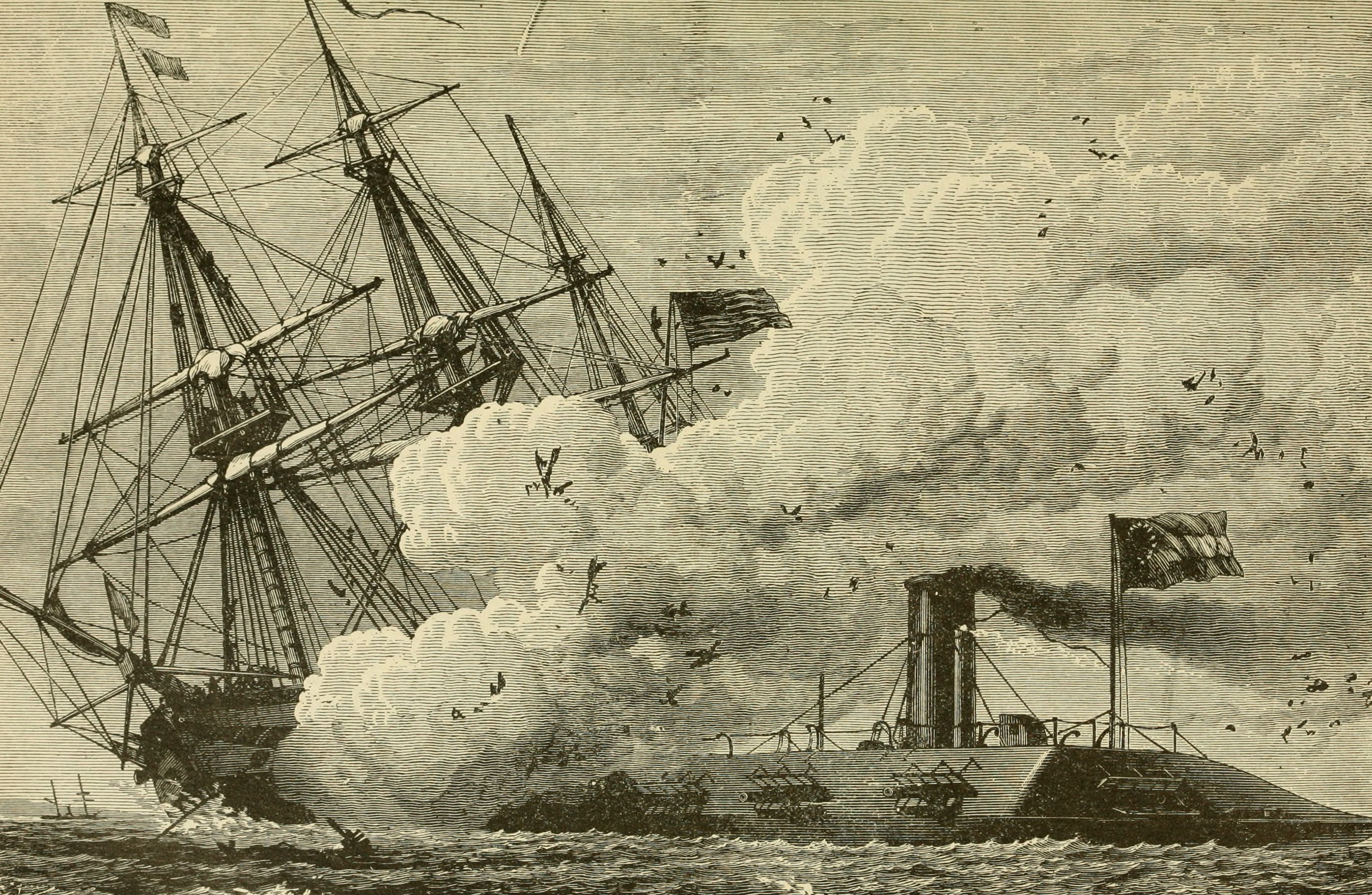
USS Cumberland rammed by CSS Virginia (Library of Congress)

When USS Cumberland was rammed and sunk by CSS Virginia (ex-USS Merrimack) on March 8, 1862, approximately a third of the crew were lost. Lost also were all personnel records. All that was known was the number of officers and men aboard at the start of the battle.

The ship’s commanding officer, Commander William Radford, had to report circumstances of the loss of his ship and number of Sailors killed or drowned. Lacking an accurate muster roll on which names could be called out, and a count made of those who made no response, Commander Radford did the next best thing. He mustered and took a count of the survivors and subtracted that count from the number of men attached to the ship at the beginning of the battle.

Final page of the muster roll, indicating the number of killed and drowned aboard USS Cumberland on March 8, 1862 (Library of Congress)

The muster consisted of 255 handwritten names on six pages. On the last page is the annotation:

            "Officers and men when action commenced          376
                do              do                  do          over               255
                                                       killed or drowned        121

              This is a large number and I am hoping more men will be found.
                                                        (signed) Wm. Radford,
                                                                        Commander”

The 121 fatalities has been reported in official records for 160 years, but this muster roll of survivors contains an error. On the first page of the muster, two officers were listed as having died in the battle, but when we counted up every name on the muster roll, we found that Radford accidentally counted the two men as survivors. Chaplain John Lenhart was listed as drowned and Master’s Mate John Harrington shown as killed. Because these two men were killed but accidentally counted among the survivors, the correct count of survivors should have been 253 rather than 255. Thus, the number of Sailors killed when USS Cumberland sank on March 8, 1862, stands at 123. With that conclusion, the Hampton Roads Naval Museum will begin using the corrected number of 123 in all future historical documents and exhibits. 


First page of the muster roll, listing the officers. When we added up the number of Sailors listed in this entire muster roll, we realized Commander Radford had accidentally counted Lenhart and Harrington as among the living. (Library of Congress)

Thursday, May 5, 2022

In the Collection: Rear Admiral Napoleon Collins' Sword

By Nick Wieman
HRNM Intern
Commander Napoleon Collins, circa 1864 (Wikipedia)
Napoleon Collins was born in Pennsylvania on March 4, 1814, and commissioned as a midshipman in the United States Navy in January 1834. After an “arduous but undistinguished” career in the Navy, then-Commander Napoleon Collins lucked into a chance to make his mark in September of 1864 while in command of USS Wachusett. While re-coaling in the Canary Islands, he was informed that the Confederate commerce raider CSS Florida had recently refueled there as well and was bound for the Port of Salvador in Bahia, Brazil. Intent on destroying the dreaded Confederate commerce raider, Collins set sail for Bahia.

Wachusett beat Florida to Bahia by about two days, anchoring outside the Brazilian harbor on October 2, 1864. In the dead of night on October 4, sentries aboard Wachusett spotted a ship pulling into port, later confirmed to be Florida. Collins messaged Florida’s commander, Lieutenant Charles M. Morris, formally requesting a naval duel outside Brazilian territorial waters. There was established precedent of respecting neutral nations’ territorial sovereignty; Captain John Winslow, of USS Kearsarge, had waited to engage CSS Alabama until after the latter ship had left French waters. Morris rebuffed the invitation, citing Collins’ disrespect of the ship and its crew in addressing the ship as “the sloop Florida” rather than the proper CSS Florida. He announced his intention to stay in Bahia for as long as necessary, and that he would neither “seek nor avoid a contest with the Wachusett” but that at a later date he would “use his utmost endeavors to destroy her.” Morris’ arrogance would prove to be his undoing, as it only served to reinforce Collins’ desire to see Florida sunk, maritime law be damned.

On the evening of October 6, Morris and several officers went ashore to spend the night in Bahia, alongside roughly half the crew who had been granted liberty, leaving Florida under the command of his First Lieutenant. Not anticipating any action from Wachusett and obliging maritime law to disarm in a neutral port, he removed the shot from Florida’s guns and allowed the ship to lose its steam.

At precisely 3:00 am on October 7, Collins made his move. Having pulled out of the harbor to give Wachusett sufficient clearance and time to build up a good head of steam, Collins ordered Wachusett to charge at the anchored Florida at full speed, intending to ram the ship with enough force to sink it. Wachusett struck Florida on the starboard quarter, tearing down the mizzenmast and main yard and crushing the ramparts, but the ship had not received a fatal blow, disabled but otherwise afloat. Rather than finish it off with cannon, Collins instead took the opportunity to seize Florida as prisoner. After securing the surrender of Florida’s remaining crew, he secured a towing hawser to the ship and towed Florida out to sea, briefly pursued by a Brazilian corvette. Captain Morris, running from the hotel where he had been staying, reached the dock just in time to see his ship being towed away over the horizon.
Cutting out the Florida from Bahia, Brazil by USS Wachusett (Frederick Gutekunst)
Collins arrived in Hampton Roads on November 12, 1864, Florida in tow, to a jubilant reception from the public and an awkward reception from Secretary of State William Seward. Collins had broken international law by seizing the ship in neutral waters, and it was feared that to make peace with the Brazilian government, Florida would have to be returned to Bahia, and by proxy the Confederate Navy. When the formal diplomatic protest arrived, Seward assured the Brazilian government that Collins had acted without authorization, and that he would be suspended and court-martialed. However, Florida could not be returned to Bahia as requested, as the ship had been accidentally struck by a transport ship early on November 28, while anchored off Newport News, and sunk. Whether it was an accident or Florida had been intentionally sunk is unknown.

Collins would indeed be court martialed within six months of the incident and sentenced for dismissal. However, the verdict was set aside by Navy Secretary Gideon Welles, and Napoleon Collins was restored to duty. He continued serving in the Navy until his death in 1874, having been promoted to Rear Admiral in command of the South Pacific Squadron in Peru.
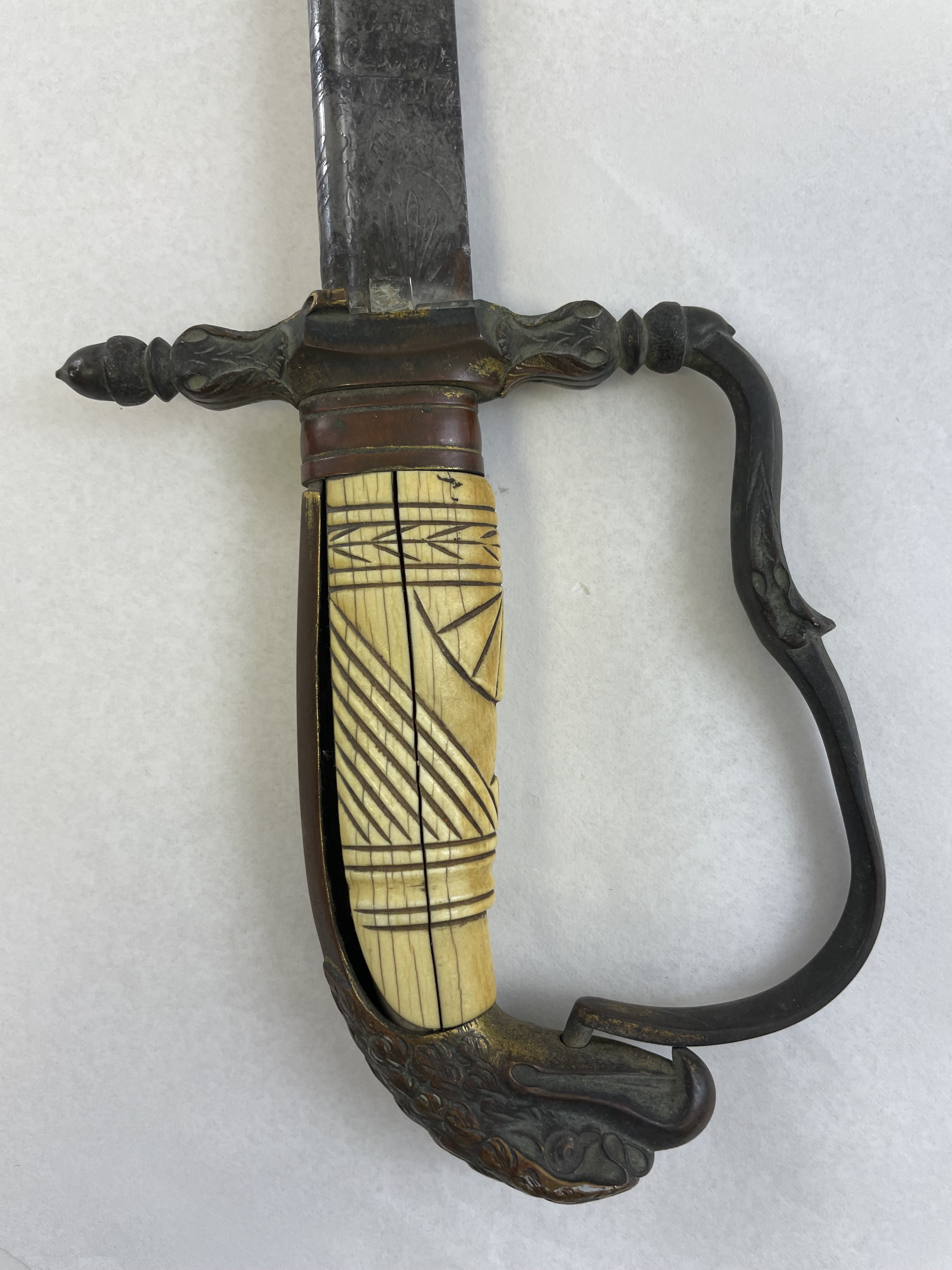
Obverse view of Napoleon Collins’ sword, with included scabbard (HRNM)
Rear Admiral Napoleon Collins' personal effects had remained with his family until recently, when they were donated to the Hampton Roads Naval Museum by his great-grandson Grant Collins. Along with his uniform jacket, naval officer’s fore-and-aft, belt, and epaulets, one of the most striking artifacts is his officer’s sword. Once as essential to a nobleman’s or gentleman soldier’s attire as his uniform, the sword has served as a symbol of military authority for thousands of years worldwide, and the United States is no exception. While the increasing proliferation of firearms in the 18th and 19th centuries restricted the sword’s practical usage on land to the cavalry, it retained its value aboard ships as one of the weapons of choice for boarding parties until the late 19th century, where the close quarters of the ship made it much more practical than a rifle in combat. Even if the sword has been replaced in the hands of the infantry, it remains an essential part of the officer’s uniform for ceremony.
"N.P Ames/Cutler/Cabotville” (HRNM)
Rear Admiral Napoleon Collins’ sword is an N.P. Ames Cutler Model 1841 Naval Cutlass, produced by the Ames Manufacturing Company in Cabotville, Massachusetts. The sword is in very good condition overall, albeit with some discoloration from age.
Liberty pole and eagle with shield (HRNM)
Both sides of the blade feature ornate foliate (leaf patterns) running down its length. Beginning from the tip of the blade going down, we find a bald eagle charged with an escutcheon (heraldic shield) emblazoned with stripes under the chief (upper half of the shield), like the Great Seal of the United States. Below it is a continuation of the foliate, here featuring a trellis crossed with two naval cannons. The center of the blade features a prominent etching of a boy atop a pole, capped with a banner or pennant. This most likely depicts a “liberty pole,” a classic symbol of republicanism dating back to the late Roman Empire, and which was a common sight in the lead-up to the American Revolution as a symbol of protest against British rule. Just above the grip is the manufacturer's inscription, “NP Ames/Cutler/Cabotville,” placing its date of manufacture between 1841 and 1848. Below this inscription, closest to the hilt, is a sunburst-like ray pattern.
“United States Navy” (HRNM)
Beginning just past the tip of the blade, we find more foliate. Then, there’s stylized etching of a ship at sea, with the aft of the ship facing outwards judging by the windows of the cabin, with a prominent wake. After this is a prominent “United States Navy” inscription, flanked on either side by a pair of sunburst-esque ray patterns. After these sunbursts, there is a prominent ship’s anchor nestled in foliate, which continues down the length of the blade to the hilt.
Grip and eagle-head pommel (HRNM)
The grip is made of an off-white material, possibly ivory or whalebone, that has probably yellowed with age. The grip is carved with symmetrical lines on either side, a semi-circle with lines radiating from a central point, and an arrow-like pattern closest to the crossguard. The pommel is carved prominently in the shape of a stylized eagle’s head. Included with the sword is a black leather scabbard with two large brass mounts on the throat of the scabbard and its midsection. Both brass mounts are etched with an anchor design.

Both sword and scabbard are in good condition, albeit affected by the elements and the passage of time. The brass and steel have become discolored with a dark patina, particularly on the edges of the blade and the manufacturer’s inscription. The ivory grip has discolored into a sort of creamy yellow and may be coming unglued from the rest of the hilt; the brass at the base of the blade is also faintly discolored with yellow patches. It should be noted that this sword model was produced with a large folding guard, embossed with a foliate pattern. While it is unknown whether this particular sword was manufactured with a folding guard, the geometric indentations on the base of the hilt seem to indicate that something could have slotted in.

While the sword itself was not used by Collins during the incident, that he retained possession of the sword altogether is a testament to the nation’s support for his actions outweighing legalities. Under other circumstances, the seizure of another nation's vessel in international waters would have spelled the end of his career, perhaps even imprisonment. However, dispatching one of the feared Confederate commerce raiders that had claimed so many Union merchant ships in the Atlantic proved that the government and the public were willing to overlook such transgressions in the pursuit of victory over the secessionists.


Primary Sources
-Report of Lieutenant Morris, C.S. Navy, late command C.S.S Florida, of the seizure of that vessel by U.S.S Wachusett. October 13, 1864, Bahia. Naval History Heritage Command https://www.history.navy.mil/research/library/online-reading-room/title-list-alphabetically/c/capture-of-css-florida-by-uss-wachusett-report-of-lieutenant-morris.html
-Report of Commander Napoleon Collins. U.S. Navy, commanding U.S.S Wachusett, of the seizure by that vessel of C.S.S Florida. October 31, 1864. U.S.S Wachusett. St. Thomas, West Indies. Official Records of the Union and Confederate Navies in the War of the Rebellion. Series 1, vol. 3. Washington. Government Printing Office. 1896.
-"The Capture of the Florida." New York Times (1857-1922), Nov 9, 1864. https://www.proquest.com/historical-newspapers/capture-florida/docview/91834546/se-2?accountid=12967
-"THE FLORIDA CASE.: CORRESPONDENCE BETWEEN MR. SEWARD AND THE BRAZILIAN AUTHORITIES." New York Times (1857-1922), 1865. https://www.proquest.com/historical-newspapers/florida-case/docview/91934907/se-2?accountid=1296

Thursday, March 24, 2022

Memories of USS Cumberland (Part 3 of 3): A Living Spirit: Cumberland in Song

By William Clarkson
HRNM Educator

In the previous two parts of our March series about USS Cumberland, we have looked at reporting, perceptions, and poems about the Battle of Hampton Roads and sinking of Cumberland. In today’s third and final part, we briefly examine how music has served to keep Cumberland’s memory alive in national consciousness. As we saw in part two, poetry can be set to music, like Longfellow’s “The Cumberland,” but lyrics were also newly composed and brought Cumberland’s tale to audiences both across the nation and time. Today we will focus on two examples that were written within a year after the battle. These songs are titled “The Cumberland’s Crew,” and “The Good Ship Cumberland.” “The Cumberland’s Crew’s” author is unknown, while “The Good Ship Cumberland” is by one E.F.M. whose exact name remains unidentified.

Songwriters produced a wealth of music during the American Civil War. Songs served to entertain, inspire, and sustain the troops as well as the civilian populations. Tunes were sung from the stage to the campfire by professional musician and enthusiast alike. Many of these songs have no known attributable artist, having been written and performed by anonymous sailors, soldiers, and civilians from opposing sides. Many of these songs can be found in two of the larger folk music indexes compiled during the 20th century. The “Laws” Index (named for the creator of the index and folk music scholar, George Malcolm Laws), contains 2,576 unique English language song listings, with many sub-listings for similar songs. A second index called the Roud Folk Song Index (after creator Steve Roud, also a folk music scholar), contains a more comprehensive set at around 25,000 unique listings. Both songs featured here have individual listings on both indexes.
“The Cumberland’s Crew,” Published by H. De Marson, NYC c. 1863 (Library of Congress)
Our first song, “Cumberland’s Crew,”[i] recounts the battle between USS Cumberland and CSS Virginia on March 8, 1862. The opening stanza invites the listener:

Shipmates, come gather and join in my ditty
Of a terrible battle that's happened of late
When each Union tar shed a tear of sad pity
When he heard of the once-gallant Cumberland's fate

O, the eighth day of March told a terrible story
And many brave tars to this world bid adieu,
Our flag it was wrapped in a mantle of glory
By the heroic deeds of the Cumberland's crew

Already, the listener is primed for a tale of struggle and defiance, and the rest of the song plays out much like one might expect. The familiar encouragement from the acting captain, Lieutenant George Morris, is echoed when he says, "’Boys, of this monster, now, don't be dismayed. We've sworn to maintain our beloved Constitution, and to die for our country we are not afraid.'" The battle commences, and Cumberland and Virginia fire on each other, with Virginia’s iron plating largely rendering Cumberland’s guns ineffective. Meanwhile, fire from Virginia takes a terrible toll on Cumberland’s crew, even before the ship is rammed. The song doesn’t specifically mention the ramming and sinking, but the final two stanzas make clear that the crew will not surrender and will go down fighting by saying:

Now, the pride of our Navy can never be daunted,
Though the dead and the wounded our decks they did strew
"We'll die at our quarters or conquer victorious:''
Was answered in cheers by the Cumberland's crew.

"We've fought for the Union, our cause it is glorious.
To the Star Spangled Banner we'll ever prove true.
We'll be wept for by Columbia's brave sons and fair daughters
And never forgotten," sang the Cumberland's crew.

The ending to the song serves two purposes. First, it commemorates the bravery of the crew, who refused to surrender to the ironclad Virginia. Second, it inspires both combatants and civilians to continue to support the “glorious” Union cause. It’s important to note here that different performers and printings of folk songs will include slight variations in the lyrics, as well as a wide variety of instrumentation and musical arrangements, often being set to the tune of other traditional folk music. This is certainly the case with our second song, “The Good Ship Cumberland.”
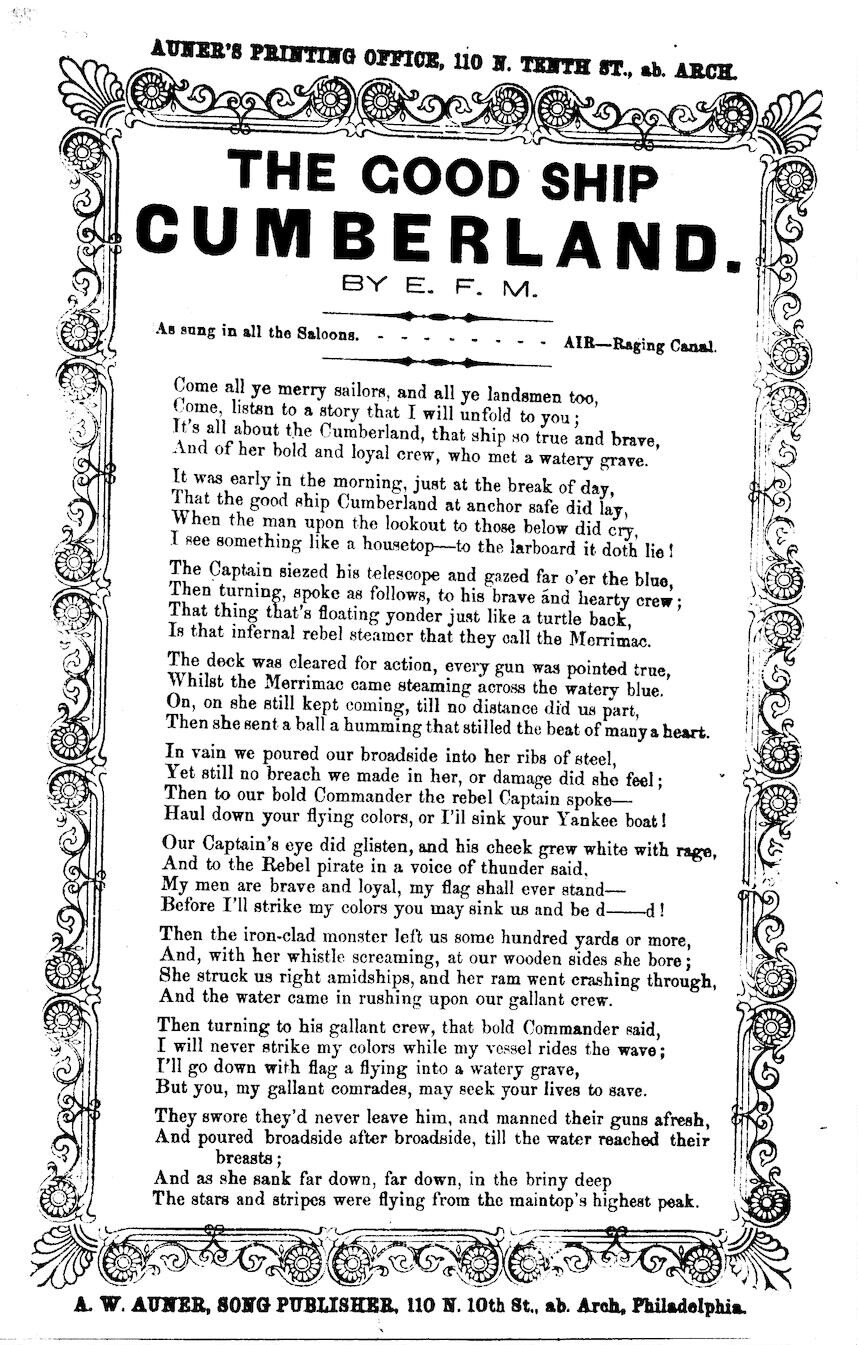
“The Good Ship Cumberland,” Published by A.W. Auner, Philadelphia c. 1863 (Library of Congress)

“Good Ship Cumberland”[ii] is the earliest title for a song that can be more widely found under the names, “The Cumberland and the Merrimac[k],” “The Cumberland,” or even “The Merrimac.” Despite the different title and arrangements, lyrically they are the same song. As with “Cumberland’s Crew,” “Good Ship Cumberland” begins with an invitation to “all ye merry sailors, and all ye landsmen too,” and unfurls the story of battle between Cumberland and Virginia in much the same way as “Cumberland’s crew.” There are a few marked differences, however, between “Good Ship Cumberland,” and “Cumberland’s Crew.” First, “Good Ship” includes the demand for Cumberland’s surrender, and Morris’ alleged reply:

In vain we poured our broadside into her ribs of steel,
Yet still no breach we made in her, or damage did she feel;
Then to our bold Commander the rebel Captain spoke—
Haul down your flying colors, or I'll sink your Yankee boat!

Our Captain's eye did glisten, and his cheek grew white with rage,
And to the Rebel pirate in a voice of thunder said,
My men are brave and loyal, my flag shall ever stand—
Before I'll strike my colors you may sink us and be damned!

Second, the song includes the ramming of Cumberland by Virginia, and third, when it becomes apparent that Cumberland is sinking, Morris offers the crew the opportunity to escape, saying, “I'll go down with flag a flying into a watery grave, but you, my gallant comrades, may seek your lives to save.” Morris did not, in fact, go down with the ship, but the sentiment is conveyed nonetheless. To Morris’ offer the crew replies:

They swore they'd never leave him, and manned their guns afresh,
And poured broadside after broadside, till the water reached their breasts;
And as she sank far down, far down, in the briny deep
The stars and stripes were flying from the maintop's highest peak.

This final line provides the final major difference between the two tunes, presenting the listener with the image of Cumberland’s flag still flying even as the hull and many of the crew rest at the bottom of the James River. As discussed in the two previous posts, this image was a focal point for participants, writers, and the public alike.

 “The Loggers,” an image depicting loggers in Michigan during the 1880s-90s, Detroit Publishing Co. c. 1890 (Library of Congress)
After Union victory in the American Civil War, sailors and soldiers from both sides returned to civilian life and sought employment anywhere they could. They carried with them the stories, memories, and importantly the songs they learned and sang during the war. Printings of songs like “Cumberland’s Crew” were disseminated widely and have been found as far away as England and Ireland. In the United States, these songs were commonly heard in lumber camps in New York, Pennsylvania, Michigan, Minnesota, and Wisconsin, as well as from sailors and shipping laborers throughout the Great Lakes region. As Civil War veterans aged, these songs were passed down and eventually found their way into the repertoire of professional folk musicians. This interest in folk music intensified and reached its zenith between the late 1940s-1960s, during a period known as the American Folk Music Revival. Many renditions of Cumberland songs date from this period; the version found in endnote ii by Warde Ford is off the album Wolf River Songs, released in 1956. Another musically different version was performed by Ellen Stekert and released on the album Songs of a New York Lumberjack in 1958.[iii]
Sketch of USS Cumberland by Alfred R. Waud, c. 1861 (Library of Congress)
Versions of these songs are still performed 160 years after the Battle of Hampton Roads, with some groups giving them a bit of an updated flavor.[iv] Though the sound of more recent recordings might be different, the words and message remain largely the same. Hearing songs from the past that continue to be performed today provides us with a closer connection to what a Civil War contemporary might have felt or believed, and how the battle between USS Cumberland and CSS Virginia took on meaning far beyond the sinking of one ship. Music drives this home, perhaps even more so than articles and poetry. What each of the media we have considered over the past three posts share is the reminder that the Battle of Hampton Roads and sinking of USS Cumberland took root in the contemporary public consciousness. And, like Cumberland’s flag flying on her mast, the legacy of the ship and crew’s struggle is still visible today, 160 years later.


Notes:
[i] A version of “Cumberland’s Crew,” performed by the 97th Regimental String Band, and played on contemporary instruments can be heard at https://www.youtube.com/watch?v=c_tVGoiKOJA.
[ii] A version of “Good Ship Cumberland” Performed by Warde Ford (under the title “The Sinking of the Cumberland”), can be heard at https://www.youtube.com/watch?v=tp8U_ySDEIA. Notice that the first stanza is omitted in this version.
[iii] A version of “Good Ship Cumberland” (under the title “The Cumberland and the Merrimac”), performed by Ellen Stekert can be heard at https://www.youtube.com/watch?v=hb6I_f2pHzw.
[iv] A version of “The Cumberland’s Crew”, performed by Smokey Bastard, 2008 can be heard at https://www.youtube.com/watch?v=gX984Pdl6WM.

Tuesday, March 15, 2022

Memories of USS Cumberland (Part 2 of 3): The Poets

By William Clarkson
HRNM Educator

In part 1 of our series about the sinking of USS Cumberland during the Battle of Hampton Roads, we looked at how the public perceived the loss of Cumberland in the accounts of newspapers, witnesses, and participants. Today, we will explore how writers of the day retold the event in poetry. In addition to many other poets, literary titans Henry Wadsworth Longfellow and Herman Melville produced works about USS Cumberland. The poetry written soon after the battle established the well-known narrative. However, while a few names become synonymous with brave words and actions, every work celebrates the courage and commitment of Cumberland’s crew and seeks to preserve their deeds for future generations. Links will be provided at the end to the full texts of each of the three poems discussed.
Portraits of Henry Wadsworth Longfellow (left) and Herman Melville c. 1860 (Library of Congress)
It is no surprise that the two most famous poets to pen works about the struggle between Cumberland and Virginia are Henry Wadsworth Longfellow and Herman Melville. In fact, both authors titled their pieces “The Cumberland.” Longfellow’s “Cumberland” was first published in the December 1862 edition of Atlantic Monthly. While Longfellow wrote many pieces about the sea, ships, and sailing, he never served aboard a naval vessel. His personal experience of fighting vessels came from his childhood and his proximity to the September 5, 1813, battle between USS Enterprise and HMS Boxer off the coast of Portland, Maine, where he and his family were living at the time. He later penned a poem recounting the event, titled “My Lost Youth.” Longfellow’s “Cumberland” is written from the point of view of a Sailor aboard the ship during the battle. This anonymous Sailor recounts Virginia’s approach up the Elizabeth River with its “feather of snow-white smoke… to try the force of our ribs of oak.” After receiving shots from Virginia, Cumberland “sen[t] her straight defiance back in a full broadside!” The fire from Cumberland’s guns, while able to damage a few of Virginia’s cannons, lifeboats, and smokestack, is unable to penetrate the “iron scale of the monster’s hide.” At this moment, in Longfellow’s telling, a Sailor aboard Virginia demands Cumberland’s surrender:

"Strike your flag!" the rebel cries,
In his arrogant old plantation strain.
"Never!" our gallant Morris replies;
"It is better to sink than to yield!"
And the whole air pealed
With the cheers of our men.


This action becomes a defining moment of the engagement. First, it signals the Cumberland crew’s intent to continue fighting regardless of the circumstances, becoming a rallying cry for Union forces as well as the public. Second, it places Lieutenant George Morris as the central hero in the tale, something that is mirrored in some of the articles and recollections in part 1 of this series, as well as in poetry, song, and prose. Morris was acting commander of the vessel since Cumberland’s captain, William Radford, was not aboard when the battle commenced. Longfellow describes Virginia ramming Cumberland, and Cumberland’s subsequent sinking, continuing to fire until the decks were submerged. The scene is completed with the image of Cumberland’s flag still flying the following morning on the mast, visible above the water. He states, “Every waft of the air was a whisper of prayer, or a dirge for the dead.” Longfellow’s “Cumberland” was well received publicly, and in 1863 composer Francis Boott put his words to music.
Cover of F. Bootts' musical arrangement of Longfellow’s “The Cumberland,” 1863. (Library of Congress)
In contrast, Herman Melville’s “The Cumberland” was first published by Harper’s New Monthly Magazine in March 1866, four years after the battle. Its publication was part of a series of Civil War poems by Melville published in Harper’s as a leadup to the release of his collection of poems titled Battle-Pieces and Aspects of the War. Melville, unlike Longfellow, served over a year in the US Navy, aboard USS United States from 1843 to 1844 (one of the first six frigates authorized by the US Congress in 1794). Where Longfellow and others recount the events and deeds of the battle, Melville uses his poem to eulogize and memorialize USS Cumberland and its crew. He begins by declaring, “Some names there are of telling sound, whose vowelled syllables free are pledge that they shall ever live renowned,” immediately identifying Cumberland as worthy of remembrance. To aid in imprinting the name Cumberland into his reader’s mind, each stanza ends with a sensational description of saying the ship’s name, feeling it, “flowing, rolling on the tongue.” As with other poetry about the battle, Melville invokes the image of Cumberland’s flag still visible and flying on the mast, a symbol for defiance, and states, “Your flag and flag-staff shall in story stand,” as the “dead unconquerable manned the Cumberland.” While Melville is now considered one of the United States’ most celebrated poets, his book Battle-Pieces, which contains “The Cumberland,” only sold 496 of the 1,200 copies printed in the 10 years after its publication. Regardless, the existence of the poem, and the fact that Melville was moved enough by the events of March 8th, 1862, to pen the work four years later, is a testament to the effect the actions of Cumberland’s crew had on the popular consciousness.
Portrait of George Boker, author and later US Diplomat, c. 1860. (Library of Congress)
Somewhat less well-known today, George Boker also wrote a poem titled, “On Board the Cumberland,” which like Longfellow’s verse recounts the events of the battle from a crewmember’s perspective. The poem was published in Boker’s book, Poems of the War, in 1864. Throughout the American Civil War, George Boker was a staunch Unionist and was a foundational member of the Union League Club, supporting the war effort with his writing. During the presidency of Ulysses Grant, he was appointed as a diplomat to the Ottoman Empire, and later served as a representative to the Russian Empire. Boker’s poem focuses on the heroism of acting commander Lt. Morris. He has Morris giving an inspirational speech to the crew as CSS Virginia approached. In this lyrical account of Morris appealing to the crew, Boker ascribes him with great eloquence, stating:

"Remember, boys, this flag of ours
Has seldom left its place;
And where it falls, the deck it strikes
Is covered with disgrace.

"I ask but this: or sink or swim,
Or live or nobly die,
My last sight upon earth may be
To see that ensign fly!"


This moment of foreshadowing primes the reader for the now famous image of Cumberland’s flag still raised off its sunken wreck, having not surrendered even to the last. In his poem, Boker does something that many other works do not; he recounts the actions of other individuals made famous by the battle, most notably future Rear Admiral Thomas O. Selfridge Jr. and Acting Master (later Lieutenant Commander) William Pritchard Randall. To Selfridge, Boker attributes the command to abandon ship, but only once the sinking was imminent, and so that the crew may survive to continue the fight, saying, “’Up to the spar-deck! Save yourselves!’ Cried Selfridge. ‘Up, my men! God grant that some of us may live to fight yon ship again!’" While the crew prepared to leave Cumberland, Boker writes, “We reached the deck. Here Randall stood: ‘Another turn, men – So!’ Calmly he aimed his pivot-gun; ‘Now, Tennery, let her go!’” With this final shot from USS Cumberland, Boker describes the ship finally sinking, coming once more to the image of Cumberland’s flag remaining to wave over the wreck as a “sign that we who live may claim the peerage of the brave; a monument, that needs no scroll, for those beneath the wave!” The inclusion of these men in the poem presents a slightly different narrative than so many other works. While Morris is still the intrepid commander, intent on fighting, regardless of the odds, introducing others into the work reminds the reader that it was actions of the entire crew that fueled the public’s imagination and inspired so many authors to write about this event.
An illustration that accompanies Boker’s “On Board the Cumberland,” depicting a soldier pointing out Cumberland’s mast and flag, still visible, to a rescued Sailor. (A Selection of War Lyrics, by Felix Darley and James Gregory, 1864)
The narrative of “brave Morris” and Cumberland’s struggle, stuck in the public consciousness well after the war, with efforts to recognize and reward Cumberland’s crewmembers led by authors and citizens, including Nathaniel Hawthorne and members of Congress, continued well into the 1870s and‘80s. While we have seen three poets and their interpretations of the battle’s aftermath, many more were produced by authors of various backgrounds and perspectives. Many extol Morris as a singular hero, but there are a few, like Boker, that include the deeds of a wider variety of individuals. What remains true in every case is the admiration and praise from the authors for the crew of USS Cumberland and their desire to preserve this crew’s actions in writing for future generations. Poetry wasn’t the only creative endeavor to give voice to Cumberland’s story. In part 3 of this series, we will look at songs about Cumberland and the Battle of Hampton Roads, and how they passed through time into the present day.

Poem Links:

Henry Wadsworth Longfellow’s “The Cumberland,” 1862

Herman Melville’s “The Cumberland,” 1866

George Henry Boker’s “On Board the Cumberland,” c. 1864