Showing posts with label Napoleon Collins. Show all posts

Thursday, May 5, 2022

In the Collection: Rear Admiral Napoleon Collins' Sword

By Nick Wieman
HRNM Intern
Commander Napoleon Collins, circa 1864 (Wikipedia)
Napoleon Collins was born in Pennsylvania on March 4, 1814, and commissioned as a midshipman in the United States Navy in January 1834. After an “arduous but undistinguished” career in the Navy, then-Commander Napoleon Collins lucked into a chance to make his mark in September of 1864 while in command of USS Wachusett. While re-coaling in the Canary Islands, he was informed that the Confederate commerce raider CSS Florida had recently refueled there as well and was bound for the Port of Salvador in Bahia, Brazil. Intent on destroying the dreaded Confederate commerce raider, Collins set sail for Bahia.

Wachusett beat Florida to Bahia by about two days, anchoring outside the Brazilian harbor on October 2, 1864. In the dead of night on October 4, sentries aboard Wachusett spotted a ship pulling into port, later confirmed to be Florida. Collins messaged Florida’s commander, Lieutenant Charles M. Morris, formally requesting a naval duel outside Brazilian territorial waters. There was established precedent of respecting neutral nations’ territorial sovereignty; Captain John Winslow, of USS Kearsarge, had waited to engage CSS Alabama until after the latter ship had left French waters. Morris rebuffed the invitation, citing Collins’ disrespect of the ship and its crew in addressing the ship as “the sloop Florida” rather than the proper CSS Florida. He announced his intention to stay in Bahia for as long as necessary, and that he would neither “seek nor avoid a contest with the Wachusett” but that at a later date he would “use his utmost endeavors to destroy her.” Morris’ arrogance would prove to be his undoing, as it only served to reinforce Collins’ desire to see Florida sunk, maritime law be damned.

On the evening of October 6, Morris and several officers went ashore to spend the night in Bahia, alongside roughly half the crew who had been granted liberty, leaving Florida under the command of his First Lieutenant. Not anticipating any action from Wachusett and obliging maritime law to disarm in a neutral port, he removed the shot from Florida’s guns and allowed the ship to lose its steam.

At precisely 3:00 am on October 7, Collins made his move. Having pulled out of the harbor to give Wachusett sufficient clearance and time to build up a good head of steam, Collins ordered Wachusett to charge at the anchored Florida at full speed, intending to ram the ship with enough force to sink it. Wachusett struck Florida on the starboard quarter, tearing down the mizzenmast and main yard and crushing the ramparts, but the ship had not received a fatal blow, disabled but otherwise afloat. Rather than finish it off with cannon, Collins instead took the opportunity to seize Florida as prisoner. After securing the surrender of Florida’s remaining crew, he secured a towing hawser to the ship and towed Florida out to sea, briefly pursued by a Brazilian corvette. Captain Morris, running from the hotel where he had been staying, reached the dock just in time to see his ship being towed away over the horizon.
Cutting out the Florida from Bahia, Brazil by USS Wachusett (Frederick Gutekunst)
Collins arrived in Hampton Roads on November 12, 1864, Florida in tow, to a jubilant reception from the public and an awkward reception from Secretary of State William Seward. Collins had broken international law by seizing the ship in neutral waters, and it was feared that to make peace with the Brazilian government, Florida would have to be returned to Bahia, and by proxy the Confederate Navy. When the formal diplomatic protest arrived, Seward assured the Brazilian government that Collins had acted without authorization, and that he would be suspended and court-martialed. However, Florida could not be returned to Bahia as requested, as the ship had been accidentally struck by a transport ship early on November 28, while anchored off Newport News, and sunk. Whether it was an accident or Florida had been intentionally sunk is unknown.

Collins would indeed be court martialed within six months of the incident and sentenced for dismissal. However, the verdict was set aside by Navy Secretary Gideon Welles, and Napoleon Collins was restored to duty. He continued serving in the Navy until his death in 1874, having been promoted to Rear Admiral in command of the South Pacific Squadron in Peru.
Obverse view of Napoleon Collins’ sword, with included scabbard (HRNM)
Rear Admiral Napoleon Collins' personal effects had remained with his family until recently, when they were donated to the Hampton Roads Naval Museum by his great-grandson Grant Collins. Along with his uniform jacket, naval officer’s fore-and-aft, belt, and epaulets, one of the most striking artifacts is his officer’s sword. Once as essential to a nobleman’s or gentleman soldier’s attire as his uniform, the sword has served as a symbol of military authority for thousands of years worldwide, and the United States is no exception. While the increasing proliferation of firearms in the 18th and 19th centuries restricted the sword’s practical usage on land to the cavalry, it retained its value aboard ships as one of the weapons of choice for boarding parties until the late 19th century, where the close quarters of the ship made it much more practical than a rifle in combat. Even if the sword has been replaced in the hands of the infantry, it remains an essential part of the officer’s uniform for ceremony.
"N.P Ames/Cutler/Cabotville” (HRNM)
Rear Admiral Napoleon Collins’ sword is an N.P. Ames Cutler Model 1841 Naval Cutlass, produced by the Ames Manufacturing Company in Cabotville, Massachusetts. The sword is in very good condition overall, albeit with some discoloration from age.
Liberty pole and eagle with shield (HRNM)
Both sides of the blade feature ornate foliate (leaf patterns) running down its length. Beginning from the tip of the blade going down, we find a bald eagle charged with an escutcheon (heraldic shield) emblazoned with stripes under the chief (upper half of the shield), like the Great Seal of the United States. Below it is a continuation of the foliate, here featuring a trellis crossed with two naval cannons. The center of the blade features a prominent etching of a boy atop a pole, capped with a banner or pennant. This most likely depicts a “liberty pole,” a classic symbol of republicanism dating back to the late Roman Empire, and which was a common sight in the lead-up to the American Revolution as a symbol of protest against British rule. Just above the grip is the manufacturer's inscription, “NP Ames/Cutler/Cabotville,” placing its date of manufacture between 1841 and 1848. Below this inscription, closest to the hilt, is a sunburst-like ray pattern.
“United States Navy” (HRNM)
Beginning just past the tip of the blade, we find more foliate. Then, there’s stylized etching of a ship at sea, with the aft of the ship facing outwards judging by the windows of the cabin, with a prominent wake. After this is a prominent “United States Navy” inscription, flanked on either side by a pair of sunburst-esque ray patterns. After these sunbursts, there is a prominent ship’s anchor nestled in foliate, which continues down the length of the blade to the hilt.
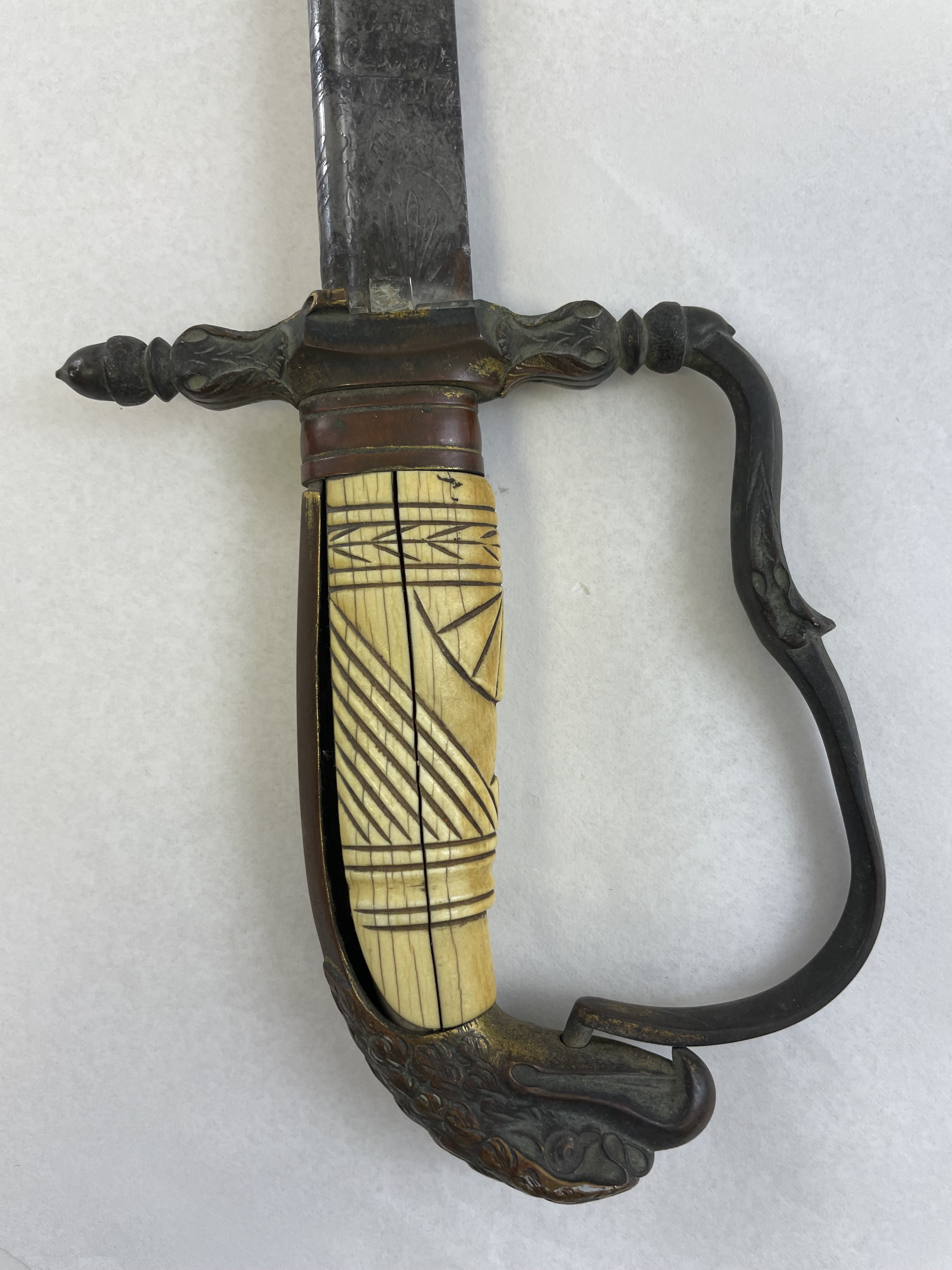
Grip and eagle-head pommel (HRNM)
The grip is made of an off-white material, possibly ivory or whalebone, that has probably yellowed with age. The grip is carved with symmetrical lines on either side, a semi-circle with lines radiating from a central point, and an arrow-like pattern closest to the crossguard. The pommel is carved prominently in the shape of a stylized eagle’s head. Included with the sword is a black leather scabbard with two large brass mounts on the throat of the scabbard and its midsection. Both brass mounts are etched with an anchor design.

Both sword and scabbard are in good condition, albeit affected by the elements and the passage of time. The brass and steel have become discolored with a dark patina, particularly on the edges of the blade and the manufacturer’s inscription. The ivory grip has discolored into a sort of creamy yellow and may be coming unglued from the rest of the hilt; the brass at the base of the blade is also faintly discolored with yellow patches. It should be noted that this sword model was produced with a large folding guard, embossed with a foliate pattern. While it is unknown whether this particular sword was manufactured with a folding guard, the geometric indentations on the base of the hilt seem to indicate that something could have slotted in.

While the sword itself was not used by Collins during the incident, that he retained possession of the sword altogether is a testament to the nation’s support for his actions outweighing legalities. Under other circumstances, the seizure of another nation's vessel in international waters would have spelled the end of his career, perhaps even imprisonment. However, dispatching one of the feared Confederate commerce raiders that had claimed so many Union merchant ships in the Atlantic proved that the government and the public were willing to overlook such transgressions in the pursuit of victory over the secessionists.


Primary Sources
-Report of Lieutenant Morris, C.S. Navy, late command C.S.S Florida, of the seizure of that vessel by U.S.S Wachusett. October 13, 1864, Bahia. Naval History Heritage Command https://www.history.navy.mil/research/library/online-reading-room/title-list-alphabetically/c/capture-of-css-florida-by-uss-wachusett-report-of-lieutenant-morris.html
-Report of Commander Napoleon Collins. U.S. Navy, commanding U.S.S Wachusett, of the seizure by that vessel of C.S.S Florida. October 31, 1864. U.S.S Wachusett. St. Thomas, West Indies. Official Records of the Union and Confederate Navies in the War of the Rebellion. Series 1, vol. 3. Washington. Government Printing Office. 1896.
-"The Capture of the Florida." New York Times (1857-1922), Nov 9, 1864. https://www.proquest.com/historical-newspapers/capture-florida/docview/91834546/se-2?accountid=12967
-"THE FLORIDA CASE.: CORRESPONDENCE BETWEEN MR. SEWARD AND THE BRAZILIAN AUTHORITIES." New York Times (1857-1922), 1865. https://www.proquest.com/historical-newspapers/florida-case/docview/91934907/se-2?accountid=1296

Wednesday, October 8, 2014

The Capture of CSS Florida, October 7, 1864

USS Wachusett rams CSS Florida at daybreak, October 7, 1864 (Century Magazine)
US Navy ships based in Hampton Roads today routinely make port calls around the world, but their journeys in times of war or peace usually begin and end in their home port.  During the Civil War, however, those working aboard Confederate commerce raiders could claim no such luxury; every port in their homeland was sealed off by Union warships.      
The Confederate strategy to attack Union commercial shipping with privateers and commerce raiders, called guerre de course, was often employed by weaker naval powers (including the United States).  But the strategy came with more than its share of vulnerabilities.
The commerce raiders’ dependence upon using the ports of neutral powers for operations not only hobbled their ability to take on essential provisions and make needed repairs, but an adversaries’ disregard of neutrality also made possible the capture of one of the Confederacy’s most important raiders: the cruiser CSS Florida.  Like the famous CSS Alabama, Florida wreaked havoc on Union shipping over two extended cruises, accounting for 60 of more than the 200 merchant ships lost to raiders during the Civil War.  More than just a naval victory, the ship’s capture 150 years ago is also a controversial example of the American diplomatic corps’ role in armed conflict. 
Built as Oreto in a Liverpool shipyard, Florida would have never seen action if American consular authorities had achieved their aims early on.  After its arrival at Nassau in April of 1862, Samuel Whiting, the United States Consul, immediately recognized Oreto as a possible blockade runner and demanded the ship’s seizure, claiming that it was being armed in a neutral British port, and thus was in violation of the Foreign Enlistment Act.  After the Royal Navy briefly complied with the request, the British governor C.J. Bayley intervened and ordered her release, pointing out that Oreto was registered as a British vessel, flew the British flag, and carried no armament.  Nevertheless, the vessel was seized two more times in Nassau as the British civil and military authorities of the colony struggled amongst themselves as to whether the American diplomats were right about the ship.  Bayley finally decided that a trial by an admiralty court was in order. 
Despite a litany of sworn statements from American officials attesting to the nefarious nature of the ship, the British attorney general in Nassau, G.L. Anderson, stuck to the defense throughout the trial that although Oreto was designed like a warship, it was simply not a warship due to the fact that no weapons were aboard.  It was also a fact that Anderson had been quoted in public that his sentiments were with the Confederacy, but no matter.  His nakedly legalistic defense won the day and Oreto was released on August 7, meeting a British schooner loaded with arms and ammunition two days later near deserted Green Cay north of Nassau.  Ten days after that, with guns loaded and ready for action, Oreto was officially christened Florida and commissioned into the Confederate Navy. 
        
During two eventful cruises capturing 38 enemy vessels, CSS Florida paid call on the ports of officially neutral but friendly ports in Cuba, the Bahamas, Barbados, Bermuda, the Portuguese island of Madeira, the French island of Martinique, Spain, and Brazil, and even a lengthy yard period in France, all the while under the vociferous objections of American diplomats, who would simultaneously demand the ship be detained while frantically trying to summon the nearest Union warship.   In almost every case, the US Navy arrived too late.  But after 61 days at sea over the summer of 1864, Florida’s luck ran out in the port of Bahia, Brazil, where it had arrived on October 4 to take on coal and provisions, as well as make some needed repairs to its boilers.  Waiting in the harbor was USS Wachusett, commanded by Napoleon Collins, who dispatched a boat pretending to be from HMS Curlew in order to ascertain the ship’s identity.  He readied the ship for a fight, yet took no immediate action as Florida settled in.
Florida's commanding officer, Confederate Navy Lieutenant Charles Manigault Morris, assured the president of the province that he would respect Brazilian neutrality and take no action against the larger Federal ship across the harbor.  In response, the president told Morris that Thomas F. Wilson, the United States Consul at Bahia, had pledged that Wachusett would also respect the port’s neutrality.  This was a pledge Wilson would later deny making.
The plan to attack Florida while in a neutral port did not originate with the US Navy.  It was actually hatched by US Minister to Brazil J. Watson Webb and Consul Wilson, after securing the advance approval of Secretary of State William H. Seward.  Seward had encouraged Ambassador Webb: “If nations shall in violation of our right suffer their ports to become bases for the operations of pirates against us we shall adopt such remedies as the laws of self defense allow.”  For his part, Collins was just as reluctant at first to violate neutrality as his Confederate adversary and said as much during his first meeting with Wilson.
On October 5, the day after Florida’s arrival, Consul Wilson attempted to deliver two letters challenging Florida to fight Wachusett, but the Confederate lieutenant refused to even read them.  With several tubes being removed from the boilers of his cruiser and half his crew on leave, Morris would have none of this Federal pugnaciousness. 
After a second contentious meeting with Collins on the afternoon of the 6th, the Consul finally persuaded him to summon his officers for a vote, and with the exception of one, all decided that attacking the ship outweighed all other considerations.  After having committed his diplomatic office to the destruction or capture of Florida, Consul Wilson elected to stay aboard for the duration of hostilities.
As it happened, the Confederate commander was not aboard Florida when Wachusett approached at full steam on the morning of October 7, ramming the smaller commerce raider on the starboard quarter, cutting down her bulwarks and carrying away her mizzenmast and main yard.  The most the stunned crew of Florida, only half of whom were aboard, could answer with were a few pistols.  None of her larger Parrott Rifles were even loaded.  Collins thought he might have put Florida in a sinking condition and he backed his ship off.  The crews began to exchange small arms fire and Wachusett delivered two broadsides.
At this point Collins demanded Florida’s surrender.  This left the difficult decision to submit or fight in the hands of Confederate Lieutenant T.K. Porter, commanding the ship in Morris’ absence.  After conferring with the other officers present, Porter boarded Wachusett to present his sword and ship’s ensign to Collins.   
     
Collins took his prize in tow and made his way quickly out of the port.  He was hurried along by the Brazilian gunfire from the harbor forts.  The Brazilians missed their mark and Collins escaped.  Brazilian and international outrage was swift and severe.  Consul Wilson wisely escaped with Wachusett, as the citizens of Bahia sacked the American consulate the next day.  No matter, the captured Florida was on her way to Hampton Roads.
Despite the fact that the American diplomats goaded him into capturing Florida, Napoleon Collins was nevertheless court-martialed under pressure from Brazil and sentenced to be dismissed from the service.  In reality, he rejoined the active Navy and ultimately rose to the rank of rear admiral in 1874.