|
| The abandoned Italian liner SS Venezuela lists off the coast of Cannes, France, on March 17, 1962. One of the Sailors from USS Altair (AKS 32) sent to help keep the vessel from sinking, Interior Communications Electrician 3rd Class Dan Douglas, took the photograph of the stricken vessel, which ultimately could not be saved.
(Courtesy of Dan Douglas) |
By
Captain Alexander G. Monroe, USN (Ret)
HRNM Docent & Contributing Writer
On June 4, 1963, John P. Cann, III, was commissioned an ensign through the Naval Reserve Officers’ Training Corps Unit at the University of Virginia. At 22:55, July 17, 1963, he reported to USS Altair (AKS 32), moored to buoys in the harbor at Naples, Italy.
 |
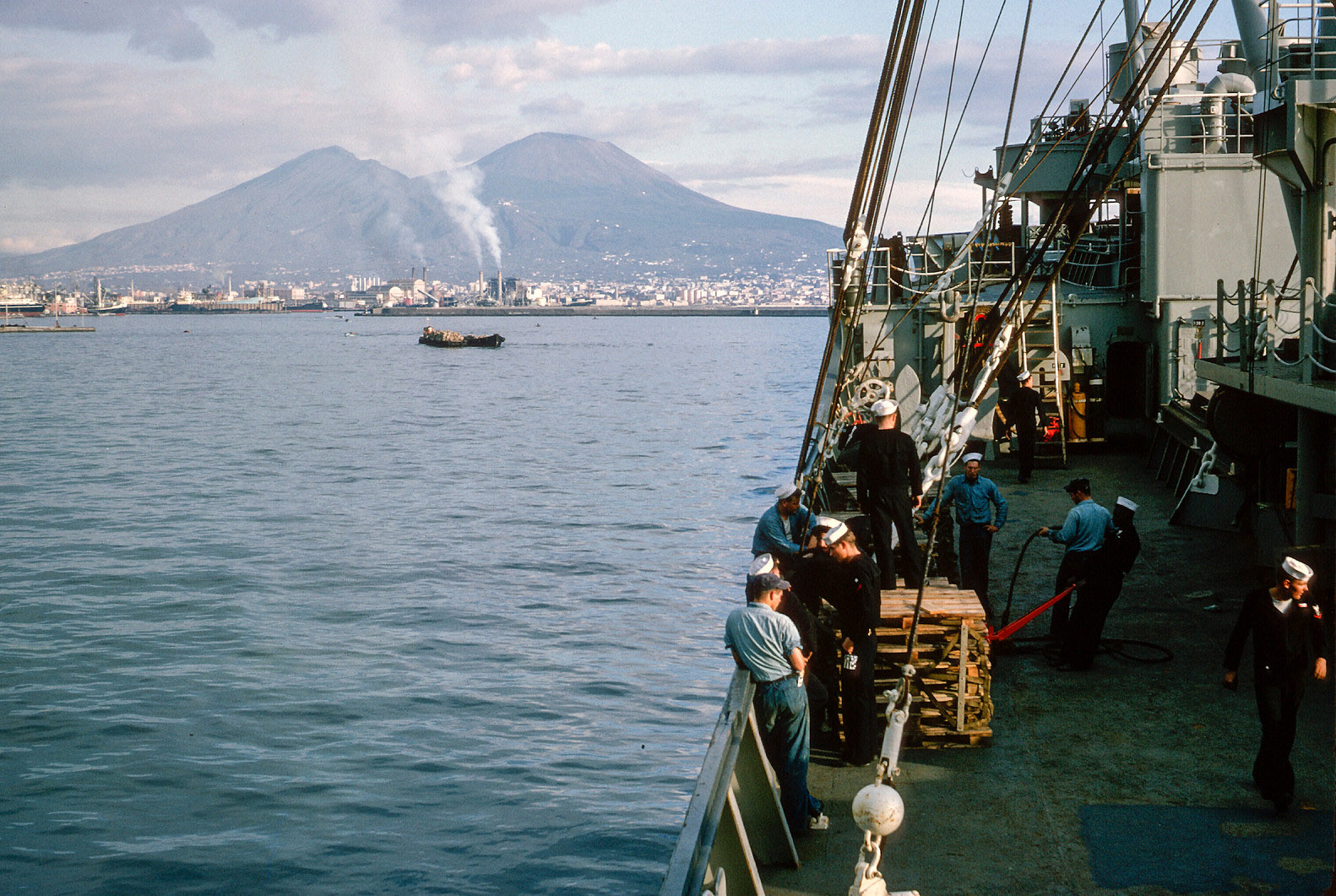
| In late 1963 or early 1964, daily work proceeds aboard USS Altair (AKS 32) while anchored in the Bay of Naples with Mt. Vesuvius in the background. Photographed by Lieutenant Junior Grade Stephen W. Woody (Courtesy of Stephen W. Woody) |
He had little knowledge of the ship’s history. He could not know that in less than a month he would be involved in a rescue mission after a C-117 Dakota aircraft ditched in the Mediterranean about 20 miles south of Capri. That rescue was one of several undertaken by the ship’s crew both before and after his arrival. These show assistance to distressed mariners and other civilians with whom they came in contact who needed assistance in situations beyond their control, in keeping with the Navy’s long tradition of selfless sacrifice.
 |
| USS Altair (AKS 32), photographed by Lieutenant Junior Grade Stephen W. Woody. (Courtesy of Stephen W. Woody) |
The Altair began her life as the SS Aberdeen Victory, a ship laid down on April 20, 1944, at the Oregon Shipbuilding Corp in Portland. She was completed on June 23, 1944, and joined the Waterman Steamship Line. Following service in the Pacific, in part supporting the invasion of Okinawa, she was laid up in the National Defense Reserve Fleet (NDRF) at Suisun Bay, California. She remained there until July 7, 1951. She was then transferred to the Navy, and commissioned as USS Altair (AK 32) in January 1952. Her designation was later changed to Stores Issue Ship (AKS), and she underwent a major conversion and overhaul. She provided logistic support to the fleet, operating from ports in the United States such as Norfolk. By 1953, the ship was given another overhaul to install major accounting systems for displaying stock levels of commodities on board. Between 1953 and 1959, other improvements were made such as construction of a helicopter deck, and installation of cargo moving devices such as conveyor belts and elevators. In 1955, her home port was shifted to Barcelona, Spain and later to Naples, Italy.[1] Except for occasional returns to the United States for overhaul, she remained overseas.
In the early morning of March 17, 1962, Altair was anchored out three miles from Cannes, France, in berth Delta seven, in 38 feet of water with a muddy bottom and 150 fathoms of anchor chain to the port anchor. Ensign M.L. Mulford, the officer of the deck (OOD) noted in the log that other ships present were USS Chikaskia (AO 54), USS Skylark (ASR 20) and USS Corsair (SS 435). There was a freshening northwest wind, and the temperature was 44 degrees.[2] At 01:20, Mulford wrote that an emergency distress call had been received from the passenger liner SS Venezuela, with 800 souls on board, reporting, “it had been holed below the waterline and requested pumping assistance.”
 |
| The stricken Italian liner Venezuela off the coast of Cannes, France, on March 17, 1962. (Courtesy of Dan Douglas) |
The Venezuela was a storied ship that had begun her life as SS DeGrasse in the French line. Captured by the Germans in World War Two and used as an “accommodation ship,” she returned to transatlantic service in 1947 and was sold to the Canadian Pacific Steamship Line and finally to Sicula Oceanica, an Italian line. Ens. Mulford promptly called away the Rescue and Assistance Party, and 25 minutes later was placed in charge of the party and sent to the Venezuela by his relief, Lieutenant Junior Grade D.J. Cullen.
The rescue and assistance efforts were supported by the Altair’s two LCVP6 boats and her motor whaleboat. Tom Planes, a machinist’s mate 2nd class’ aboard Altair, remembered the rescue efforts vividly. He recalled that at 02:30 he was roused from sleep and told, “they need you for the rescue detail.” He and others were sent to the Venezuela, “which had hit a rock and was going down” about one and a half miles from the harbor. He and those involved in locating the source of the water pouring into the stricken ship were told to discard life jackets so that they might easily leave the ship if it rolled over or capsized. [3]
The crew went below to try to find an appropriate place to place the high speed pumps and in so doing encountered ship’s stewards who were looting liquor cabinets in a passenger lounge. They proceeded further below but were unable to connect the submersible pumps to the source of flooding before the frightened captain ordered the Venezuela abandoned. [4] Dan Douglas, who was an interior communications electrician 3rd class aboard Altair at the time, recalled, “([It] was quite a night when you look out the port hole and see nothing but dark green water as the ship was listing to the side.”[5] The rescue crew was able to leave the rapidly sinking liner, and Planes observed that the U.S. Navy was already fulfilling the recruiting slogan it later adopted: “Not just a job but an adventure.” The effort to save the liner[6] was fruitless, and it was noted in the Altair logbook by Lieutenant J. E. McClain at 05:27 that, “the SS Venezuela has been abandoned.”
Just a few weeks after the rescue work in Cannes, Altair carried out another emergency rescue mission en route to Rhodes, this time involving an American citizen, Emanuel G. Kalorezos, described in the ship’s deck log as a “Hellenic National,” and his wife Kalliope. [7] At 13:49 on April 7, Altair’s helicopter landed with the couple on board. Kalliope was critically ill “with a preliminary diagnosis of encephalitis.[8] Comprehensive medical care was not available on Kos, the island from which they were evacuated. Shortly thereafter, while the ship steamed to Rhodes, her helicopter took Kalliope Kalorezos and her husband to Athens for hospitalization. The log for August 19, 1962, shows that Altair made a brief stop at Bone (now known as Annaba), Algeria, where some 200 wall tents were delivered to homeless Algerian refugees. She left the following day. Bob Rati, an ensign aboard Altair during the port visit, described the great unrest in Algeria and being upbraided by a French official for using a pilot provided by the Algerian dissidents.[9] He recalled that he was presented with two bills for trash disposal, each of which seemed legitimate. After conferring with his boss, they concluded that it was best to pay both. Rati reflected that it was the only time as a disbursing officer that he had ever paid a bill twice!
 |
| Daily work proceeds aboard USS Altair
(AKS 32) while anchored just off the Fleet Landing area in Naples. Photographed by Lieutenant Junior Grade Stephen W. Woody (Courtesy of Stephen W. Woody) |
June 13, 1963, began routinely enough for Altair. According to the ship’s log, she was “[m]oored to buoys Alfa 4 and Alfa five in Naples, Italy, with Diga Frontera Filiberto Duca d’Aosta to port.” The OOD, Senior Chief R.O. Bridgeford, noted that “the crew was mustered at 07:45 with no absentees” and that at 09:00, “the daily inspection of magazines was made with normal results.” The morning’s routine was broken at 10:15 when the Consul General of the Department of State made an official call on Captain Gordon K. Nicodemus, Altair’s commanding officer, and departed the ship at 10:50. One more urgent event occurred that morning. Two seamen, T. Z. Hatfield and H. N. Dillingham, noticed that a man had fallen from the seawall. At 11:20, with Hospital Corpsman 1st Class Meredith Brown aboard the captain’s gig, they went to rescue the man who was later identified as Salvatore Mauro, “an Italian National who had fallen from a nearby seawall while fishing.”[10] Mauro, who had been hauled from the water by other Italians and found without a pulse, was given first aid, regained consciousness and was taken to Pier 48, from which he was transported to the Loretto Hospital.[11] The event was favorably and widely reported in all Naples newspapers except Communist-oriented papers. According to Ensign George Kirchner, Altair’s public affairs officer at the time, those would “only cover bad news about Americans.”[12]
The next few weeks went by uneventfully, but that was to change. At 12:30 on August 7, 1963 Lieutenant J. E. McClain noted on the log that, “preparations for getting underway commenced,” and slightly more than one hour later, the ship was, ”underway in accordance with CTF63 [Commander, Task Force 63] Operating Schedule 55-63.” The ship’s next tasking involved an early evening transit of the Strait of Bonifacio in the early evening of the 7th to rendezvous with other replenishment ships, among them USS Mississinewa (AO 144), USS Hyades (AF 28), and USS Nespelen (AOG 55). [13]
 |
| USS Altair with cargo staged for overnight operations Photographed by Lieutenant Junior Grade Stephen W. Woody (Courtesy of Stephen W. Woody) |
The rendezvous was carried out uneventfully at 04:00 on the August 8, and Task Force 63.1 was activated to carry out the replenishment at 04:25. Operations began with CTF63.1 embarked in Mississinewa as the Officer in Tactical Command (OTC). Replenishment operations continued until 15:43, and a number of ships in the Mediterranean Amphibious Ready Group (MARG) were refueled and replenished. Among them were the USS Francis Marion (APA 249), USS Vermillion (AKA 107), USS Yancey (AKA 93), USS Hermitage (LSD 34) and USS Wood County (LST 1178). The operation involved the Altair and her helicopter. Concurrently, Altair refueled. CTF 63.1 was dissolved at 15:43, and Altair set course and speed to return to Naples.
The return to home port began in a standard manner, and there was no hint of the situation to come. The weather was clear but extremely dark, with an obscured moon.[14] The ship was steaming at a bearing of 040 degrees true at a leisurely speed of seven knots to return to homeport. At 21:10, the OOD, Lieutenant Commander J.P. Neyland, sighted Ischia Light at the northern end of the Gulf of Naples. Twenty-three minutes later, the ship received a message from CTF60 advising that a C-117 Dakota aircraft had ditched 15 miles south of Capri, which is near the bay’s southern end.[15]
 |
| U.S. Navy C-117D Super Dakotas based at RAF Mildenhall, UK, in 1967. (RuthAS/ Wikimedia Commons) |
Neyland immediately increased speed to 18.3 knots and altered course to reach the aircraft. [16] Citizens ashore on Capri had reportedly seen the ditching.[17] He estimated that the ship would reach the aircraft at midnight. Those who were on board noted that at that speed the ship “shook.”[18] The shaking and vibration were also noted by Ens. Kirchner and by Bob Rati, who had by then been promoted to lieutenant junior grade.[19] Lieutenant Junior Grade Steve Woody remembered that the guy wires from the body of the ship to the stack “vibrated.” Many in the crew were on deck looking for the survivors in an “all hands” evolution. [20] The darkness made it difficult to see the raft lying low in the water.[21] John Cann, who served as Combat Intelligence Center officer aboard Altair at the time, remembered that the life raft was not detectable by the ship’s radar.
Lt. j.g. Rati observed that, “it took a while to reach the ditched aircraft,” and the logbook shows that a P2V Neptune aircraft named “Bright Star” was observed over the site of the ditching at 23:02.[22] Additionally, a flare was sighted, and the destroyers Barton (DD 722) and Soley (DD 707) joined in the search. The search area was 27 miles southeast of Capri. Signalman 2nd Class Thomas Smith recalled that it was “very late,” and at 01:12 positive identification of the ditching site was made by flares dropped from the P2V.[23] Three minutes later, Altair’s engines were stopped, the rescue boat launched, and at 01:20, six aviators were brought on board. Boat crew member Albert Pizzo notified the ship of the pickup by flashing light because it was feared that a star shell might ignite any residual gasoline on the water. The life raft in which the aviators took refuge was ripped and not fully inflated, and the aircrew members had taken turns holding onto the side of the raft.[24] Lt. Cmdr. Neyland set course and speed to complete the journey to their home port that was interrupted by responding to the emergency, and the destroyers were released.[25] The ship entered Naples at 05:12 on August 10, with the aviators on board.[26]
 |
| Six crew members of a Naval Air Station Sigonella-based Navy C-117 that crashed on August 8, 1963, stand on the deck of USS Altair the following day. Judging from their lack of any uniform insignia, they are probably wearing uniform items procured on the ship after their rescue after seven hours in the water. Photographed by Ens. George Kirchner, Altair's public affairs officer. (Courtesy of George Kirchner) |
There was one final rescue in 1963. On October 18, an Altair utility boat passing nearby was hailed by the crew of the German freighter Tritonious anchored in Naples Harbor. Boat Coxswain Merle Lambert, Boat Engineer Hans Swierski and Bowhook Stanley Fine quickly went to the site and recovered Jurgen Kieser, who had fallen overboard and returned him uninjured to his ship’s accommodation ladder. Swierski, who was born in Germany, was fluent in German and served as an interpreter.[27]
The last years of Altair’s commissioned service were spent, to some extent, in response to emergencies, such as the Cuban Missile Crisis, overhaul and providing logistic support to the Sixth Fleet. In November 1962, she called at Guantanamo Bay, Cuba, and her service awards from that era are the National Defense Service Medal and the Armed Forces Expeditionary Medal.[28] Following an overhaul in Boston, she returned to Naples, where she continued to provide support to the fleet until she returned to Norfolk in June, 1965. She was replaced by USS Sylvania (AFS 2). She operated from Norfolk until December 31, 1968, when she entered the Inactive Ship’s Maintenance Facility (ISMF) in Portsmouth, Virginia. She was finally decommissioned on May 21, 1969, and transferred to the NDRF James River anchorage. She was removed on January 31, 1975, after her sale to Luria Brothers of Cleveland, Ohio, and towed to the shipbreakers in Baltimore.[29]
NOTES
[1] “U.S.S.
Altair/ AKS-32 History,” "USS
Altair web site." http://www.ussaltair-aks32.org.
[2] Deck logbook, Midwatch, USS
Altair (AKS-32), March 17, 1962. Record Group 24:
Records of the Bureau of Naval Personnel, 1798 - 2007, National Archives and Records Administration.
https://catalog.archives.gov/id/79792588.
[3] “Rescue Detail—Tom Planes,” in “Remember When/ Fond Memories of the
Altair," “USS
Altair web site.” http://ussaltair-aks32.org/rember/remb19.html.
[4] According to the deck log, at 03:10 and 04:40, supplemental personnel, boats and equipment were sent.
[5] Former Interior Communications Electrician 3rd Class Dan Douglas, email message to the author, February 18, 2020.
[6] Deck log, Morning watch, USS
Altair (AKS 32), March 17, 1962. About three months later the wreck was towed to La Spezia, Italy, and broken up.
[7] Deck log, Afternoon watch, USS
Altair (AKS 32), April 7, 1962. Record Group 24:
Records of the Bureau of Naval Personnel, 1798 - 2007, National Archives and Records Administration.
https://catalog.archives.gov/id/79792684
[8] Ibid. The logbook carefully notes that Mr. Kalarezos lived at 215 West 108th Street in New York City and that he held United States passport 0017619. The emergency rescue flight was authorized by Commander Sixth Fleet message 071226Z APR.
[9] “Bone, Algeria,” in “Remember When/ Fond Memories of the Altair,” “USS
Altair web site.” http://ussaltair-aks32.org/rember/remb17.html.
[10] Deck logbook, forenoon watch, USS
Altair (AKS 32), June 13, 1963, Record Group 24:
Records of the Bureau of Naval Personnel, 1798 - 2007, National Archives and Records Administration.
https://catalog.archives.gov/id/79794003.
[11] “Altair Aids Fisherman,” The Altair
Star 1, Edition 3 (June 23, 1963): 1.
[12] Ibid.
[13] Deck logbook, evening watch, USS
Altair (AKS 32), August 7, 1963, Record Group 24:
Records of the Bureau of Naval Personnel, 1798 - 2007, National Archives and Records Administration.
https://catalog.archives.gov/id/79794192.
[14] Telephone interview with former Lieutenant Junior Grade Stephen W. Woody, USNR, with the author on March 5, 2020, and email from Captain John P. Cann, III, USN (Ret.).
[15] USS
Altair (AKS 32) Press release dated August 10, 1963. The aircraft developed a fire in the starboard engine. According to the aircraft commander, “there was absolutely no panic, though no one had ditched an aircraft before.”
16: Deck logbook, Evening watch, August 9, 1963. Record Group 24:
Records of the Bureau of Naval Personnel, 1798 - 2007, National Archives and Records Administration.
https://catalog.archives.gov/id/79794192.
[17] Former Lieutenant Junior Grade Stephen W. Woody, telephone interview with the author, hereafter cited as “Woody Interview.”
[18] Ibid.
[19] Email messages from former Ensign George Kirchner and former Lieutenant Junior Grade Bob Rati to the author on February 28, 2020. Bob Rati stated that those in the raft were “down to their last flare.”
[20] George Kirchner, email message to the author, February 28, 2020.
[21] Woody Interview.
[22] Bob Rati, email message to the author, February 28, 2020.
[23] Chief Signalman Thomas M. Smith, USN (Ret.), email message to the author, March 4, 2020.
[24] Woody Interview.
[25] Deck logbook, Midwatch, USS
Altair (AKS-32), August 10, 1963; Deck log, Morning watch, USS
Altair (AKS 32), August 10, 1963. Record Group 24:
Records of the Bureau of Naval Personnel, 1798 - 2007, National Archives and Records Administration.
https://catalog.archives.gov/id/79794192.
[26] “USS
Altair Rescues Fliers of Downed Plane,”
Panorama 8 (U.S. Naval Support Activity Naples), August 16, 1963), 1.
[27] “Altair Makes Third Rescue in Six Months,”
Panorama 8, No.43, (U.S. Naval Support Activity Naples, October 25, 1963), 1.
[28] USS
Altair (AKS 32), Navsource.
http://www.navsource.org/archives/09/13/130257.htm.
[29] USS
Altair II (AK 257), Dictionary of American Naval Fighting Ships, Naval History and Heritage Command, last modified 2004.
https://www.history.navy.mil/research/histories/ship-histories/danfs/a/altair-ii.html.
About the author: Captain Alexander "Sandy" G. Monroe, a retired surface warfare officer, is the author of In Service to Their Country: Christchurch School and the American Uniformed Services (2014) as well as official
histories on U.S. Atlantic Command counternarcotic operational
assistance to civilian law enforcement agencies and the treatment of
Haitian asylum seekers at Naval Station Guantanamo Bay, Cuba. He was
also dispatched to the Arabian Gulf on assignment for the director of
naval history during Operation Earnest Will.
Editor's note: This
and every HRNM blog post by a contributing writer reflects the opinions
and core beliefs of the writer and should not be construed as
representing the official policies or opinions of the museum, the
Department of the Navy, or the United States Government.