Showing posts with label USS Cumberland. Show all posts

Thursday, November 2, 2023

Black Sailors in the Civil War Navy: A Short Profile of Martin F. Becker

By Laura Lawfer Orr
Director of Education

As our staff and volunteers conducted research for our upcoming Battle of Hampton Roads exhibit revamp, we found the name of Martin Becker on USS Cumberland’s muster roll. Becker was a Black Sailor serving aboard Cumberland when the wooden sloop-of-war was sunk by the ironclad CSS Virginia on March 8, 1862. While little is known about Becker’s actual experiences during the Battle of Hampton Roads, his service fits into the larger history of Black Sailors in the U.S. Navy.

Sinking of the Cumberland (James Gurney)

African Americans have served in the U.S. fleet ever since the Revolutionary War. Although they long represented a small minority of America’s sailing navy, Black Sailors participated in all of the nation’s foundational naval engagements. But early integration did not bring equality. Officially, the U.S. Navy did not allow Black Sailors to become officers, nor could Black enlisted personnel rise higher than the lowest rating, Ship’s Boy. From 1839 to the commencement of the Civil War, African Americans could not constitute more than five percent of the fleet’s enlisted force. However, once the slave states declared secession—and their representatives departed Congress—the U.S. government rescinded some of those restrictions. By the summer of 1862, the proportion of Black Sailors serving in the fleet climbed to fifteen percent.

Martin Becker as a young man enlisted in the Navy in his home country of Suriname (Fitchburg Historical Society)

When the Civil War began, 41-year-old Martin F. Becker wanted to fight for his adopted country. Born in South America in Paramaribo, Suriname, Becker moved to the United States in the 1840s. He owned and operated a barber shop in Fitchburg, Massachusetts. During the summer of 1861, Becker chose to enlist. Since the U.S. Army did not allow Black men to enlist at that time, Becker joined the Navy, and on August 3, 1861, he reported aboard USS Cumberland, mustering in as a landsman.

Little is known about Becker’s service aboard Cumberland. He remained on the ship for the next seven months, assisting the crew in its mission to blockade Hampton Roads. Becker participated in the March 8, 1862, battle against CSS Virginia, an engagement that led to Cumberland’s sinking. Although 123 Sailors went down with the ship, Becker and 252 shipmates survived. The following month, Becker was honorably discharged from the U.S. Navy.

Martin Becker with his wife, Caroline, in the 1850s (Fitchburg Historical Society)

A year later, Becker decided to return to combat. By this time, the U.S. Army allowed Black men to serve in segregated units, and on May 16, 1863, Becker joined Company B, 55th Massachusetts Infantry. In June, he received a promotion to commissary sergeant, and in March 1864, he became regimental quartermaster sergeant. On November 30, 1864, the 55th Massachusetts participated in the Battle of Honey Hill, in South Carolina. During this battle, Becker was wounded in his right ankle. In 1865, he secured a commission as second lieutenant—a rarity for Black soldiers—but his regiment mustered out before his commission arrived.

The 55th Massachusetts marching through the streets of Charleston, SC. Harper's Weekly, February 21, 1865 (Library of Congress)

After the war, Becker advocated for equal voting rights. His regiment had campaigned in South Carolina, and he chose to stay there to assist in Reconstruction. In 1868, he joined a Black majority convention that revised the state’s constitution. In 1870, during the first election after the 15th Amendment’s ratification, he served as an election manager. He stepped in when white residents contested the victory of Congressman Robert DeLarge, a bi-racial Republican. Becker’s testimony before the House of Representatives ensured that DeLarge took his seat in 1871.

Martin Becker continued to live in South Carolina until his death in 1880. He was buried in Laurel Hill Cemetery in Fitchburg, Massachusetts. Although little is known about Becker’s naval career, it formed a crucial link in his quest to achieve racial equality. More than anything, Landsman Martin Becker was a bluejacket who fought for the freedom of all men.

Thursday, September 22, 2022

Correcting the Record: USS Cumberland Lost 123 Sailors at the Battle of Hampton Roads

By Hunt Lewis
HRNM Volunteer
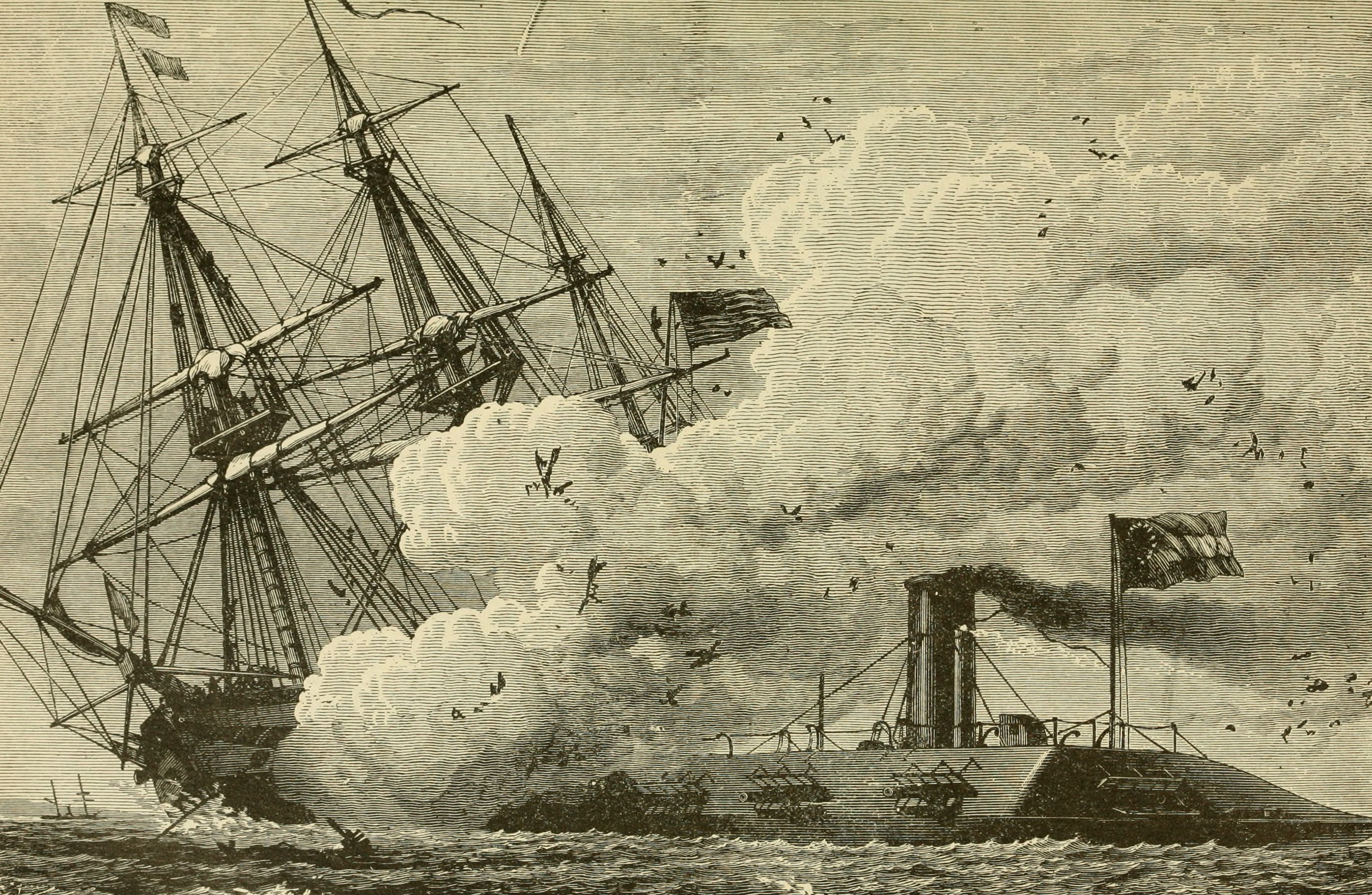
USS Cumberland rammed by CSS Virginia (Library of Congress)

When USS Cumberland was rammed and sunk by CSS Virginia (ex-USS Merrimack) on March 8, 1862, approximately a third of the crew were lost. Lost also were all personnel records. All that was known was the number of officers and men aboard at the start of the battle.

The ship’s commanding officer, Commander William Radford, had to report circumstances of the loss of his ship and number of Sailors killed or drowned. Lacking an accurate muster roll on which names could be called out, and a count made of those who made no response, Commander Radford did the next best thing. He mustered and took a count of the survivors and subtracted that count from the number of men attached to the ship at the beginning of the battle.

Final page of the muster roll, indicating the number of killed and drowned aboard USS Cumberland on March 8, 1862 (Library of Congress)

The muster consisted of 255 handwritten names on six pages. On the last page is the annotation:

            "Officers and men when action commenced          376
                do              do                  do          over               255
                                                       killed or drowned        121

              This is a large number and I am hoping more men will be found.
                                                        (signed) Wm. Radford,
                                                                        Commander”

The 121 fatalities has been reported in official records for 160 years, but this muster roll of survivors contains an error. On the first page of the muster, two officers were listed as having died in the battle, but when we counted up every name on the muster roll, we found that Radford accidentally counted the two men as survivors. Chaplain John Lenhart was listed as drowned and Master’s Mate John Harrington shown as killed. Because these two men were killed but accidentally counted among the survivors, the correct count of survivors should have been 253 rather than 255. Thus, the number of Sailors killed when USS Cumberland sank on March 8, 1862, stands at 123. With that conclusion, the Hampton Roads Naval Museum will begin using the corrected number of 123 in all future historical documents and exhibits. 


First page of the muster roll, listing the officers. When we added up the number of Sailors listed in this entire muster roll, we realized Commander Radford had accidentally counted Lenhart and Harrington as among the living. (Library of Congress)

Thursday, March 24, 2022

Memories of USS Cumberland (Part 3 of 3): A Living Spirit: Cumberland in Song

By William Clarkson
HRNM Educator

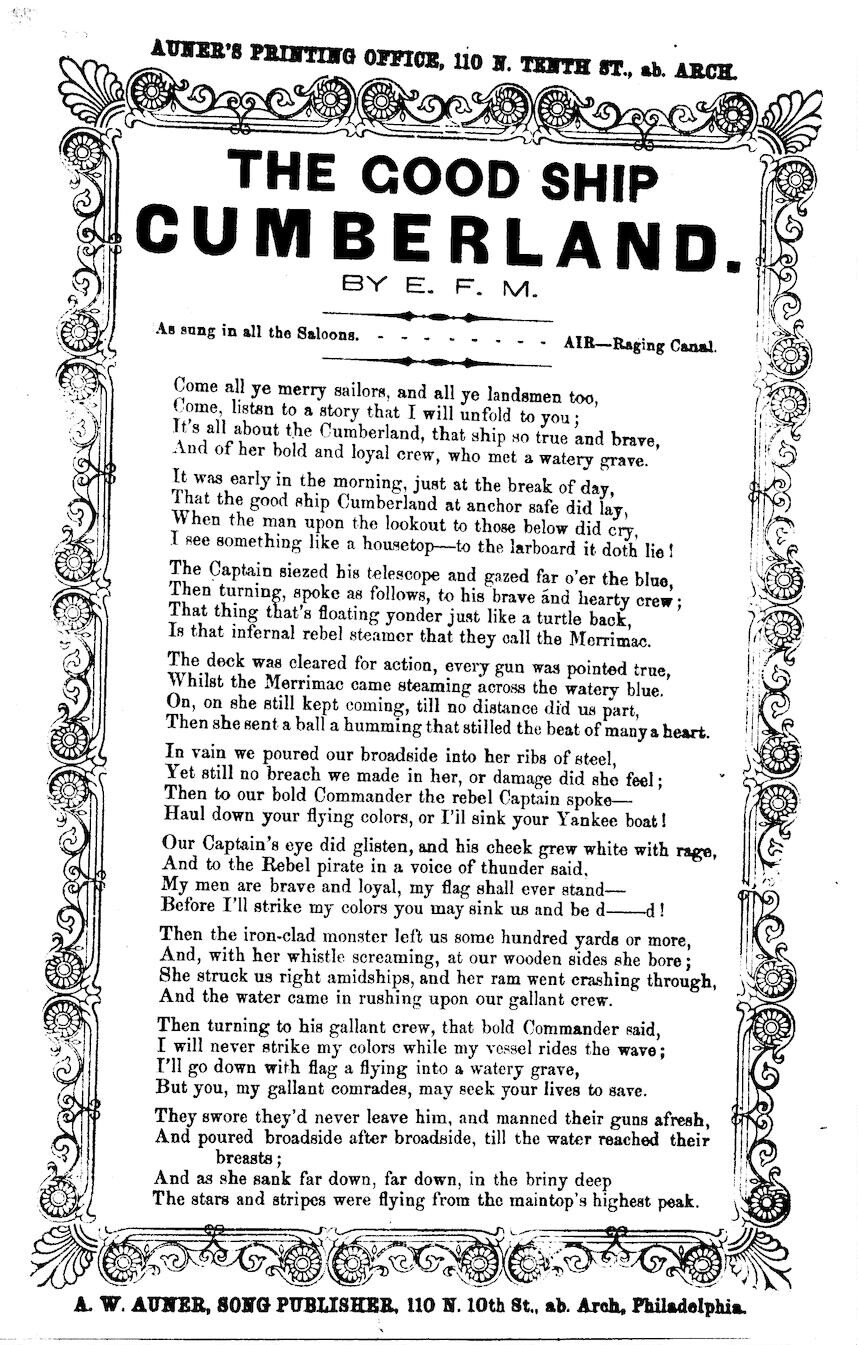
In the previous two parts of our March series about USS Cumberland, we have looked at reporting, perceptions, and poems about the Battle of Hampton Roads and sinking of Cumberland. In today’s third and final part, we briefly examine how music has served to keep Cumberland’s memory alive in national consciousness. As we saw in part two, poetry can be set to music, like Longfellow’s “The Cumberland,” but lyrics were also newly composed and brought Cumberland’s tale to audiences both across the nation and time. Today we will focus on two examples that were written within a year after the battle. These songs are titled “The Cumberland’s Crew,” and “The Good Ship Cumberland.” “The Cumberland’s Crew’s” author is unknown, while “The Good Ship Cumberland” is by one E.F.M. whose exact name remains unidentified.

Songwriters produced a wealth of music during the American Civil War. Songs served to entertain, inspire, and sustain the troops as well as the civilian populations. Tunes were sung from the stage to the campfire by professional musician and enthusiast alike. Many of these songs have no known attributable artist, having been written and performed by anonymous sailors, soldiers, and civilians from opposing sides. Many of these songs can be found in two of the larger folk music indexes compiled during the 20th century. The “Laws” Index (named for the creator of the index and folk music scholar, George Malcolm Laws), contains 2,576 unique English language song listings, with many sub-listings for similar songs. A second index called the Roud Folk Song Index (after creator Steve Roud, also a folk music scholar), contains a more comprehensive set at around 25,000 unique listings. Both songs featured here have individual listings on both indexes.
“The Cumberland’s Crew,” Published by H. De Marson, NYC c. 1863 (Library of Congress)
Our first song, “Cumberland’s Crew,”[i] recounts the battle between USS Cumberland and CSS Virginia on March 8, 1862. The opening stanza invites the listener:

Shipmates, come gather and join in my ditty
Of a terrible battle that's happened of late
When each Union tar shed a tear of sad pity
When he heard of the once-gallant Cumberland's fate

O, the eighth day of March told a terrible story
And many brave tars to this world bid adieu,
Our flag it was wrapped in a mantle of glory
By the heroic deeds of the Cumberland's crew

Already, the listener is primed for a tale of struggle and defiance, and the rest of the song plays out much like one might expect. The familiar encouragement from the acting captain, Lieutenant George Morris, is echoed when he says, "’Boys, of this monster, now, don't be dismayed. We've sworn to maintain our beloved Constitution, and to die for our country we are not afraid.'" The battle commences, and Cumberland and Virginia fire on each other, with Virginia’s iron plating largely rendering Cumberland’s guns ineffective. Meanwhile, fire from Virginia takes a terrible toll on Cumberland’s crew, even before the ship is rammed. The song doesn’t specifically mention the ramming and sinking, but the final two stanzas make clear that the crew will not surrender and will go down fighting by saying:

Now, the pride of our Navy can never be daunted,
Though the dead and the wounded our decks they did strew
"We'll die at our quarters or conquer victorious:''
Was answered in cheers by the Cumberland's crew.

"We've fought for the Union, our cause it is glorious.
To the Star Spangled Banner we'll ever prove true.
We'll be wept for by Columbia's brave sons and fair daughters
And never forgotten," sang the Cumberland's crew.

The ending to the song serves two purposes. First, it commemorates the bravery of the crew, who refused to surrender to the ironclad Virginia. Second, it inspires both combatants and civilians to continue to support the “glorious” Union cause. It’s important to note here that different performers and printings of folk songs will include slight variations in the lyrics, as well as a wide variety of instrumentation and musical arrangements, often being set to the tune of other traditional folk music. This is certainly the case with our second song, “The Good Ship Cumberland.”
“The Good Ship Cumberland,” Published by A.W. Auner, Philadelphia c. 1863 (Library of Congress)

“Good Ship Cumberland”[ii] is the earliest title for a song that can be more widely found under the names, “The Cumberland and the Merrimac[k],” “The Cumberland,” or even “The Merrimac.” Despite the different title and arrangements, lyrically they are the same song. As with “Cumberland’s Crew,” “Good Ship Cumberland” begins with an invitation to “all ye merry sailors, and all ye landsmen too,” and unfurls the story of battle between Cumberland and Virginia in much the same way as “Cumberland’s crew.” There are a few marked differences, however, between “Good Ship Cumberland,” and “Cumberland’s Crew.” First, “Good Ship” includes the demand for Cumberland’s surrender, and Morris’ alleged reply:

In vain we poured our broadside into her ribs of steel,
Yet still no breach we made in her, or damage did she feel;
Then to our bold Commander the rebel Captain spoke—
Haul down your flying colors, or I'll sink your Yankee boat!

Our Captain's eye did glisten, and his cheek grew white with rage,
And to the Rebel pirate in a voice of thunder said,
My men are brave and loyal, my flag shall ever stand—
Before I'll strike my colors you may sink us and be damned!

Second, the song includes the ramming of Cumberland by Virginia, and third, when it becomes apparent that Cumberland is sinking, Morris offers the crew the opportunity to escape, saying, “I'll go down with flag a flying into a watery grave, but you, my gallant comrades, may seek your lives to save.” Morris did not, in fact, go down with the ship, but the sentiment is conveyed nonetheless. To Morris’ offer the crew replies:

They swore they'd never leave him, and manned their guns afresh,
And poured broadside after broadside, till the water reached their breasts;
And as she sank far down, far down, in the briny deep
The stars and stripes were flying from the maintop's highest peak.

This final line provides the final major difference between the two tunes, presenting the listener with the image of Cumberland’s flag still flying even as the hull and many of the crew rest at the bottom of the James River. As discussed in the two previous posts, this image was a focal point for participants, writers, and the public alike.

 “The Loggers,” an image depicting loggers in Michigan during the 1880s-90s, Detroit Publishing Co. c. 1890 (Library of Congress)
After Union victory in the American Civil War, sailors and soldiers from both sides returned to civilian life and sought employment anywhere they could. They carried with them the stories, memories, and importantly the songs they learned and sang during the war. Printings of songs like “Cumberland’s Crew” were disseminated widely and have been found as far away as England and Ireland. In the United States, these songs were commonly heard in lumber camps in New York, Pennsylvania, Michigan, Minnesota, and Wisconsin, as well as from sailors and shipping laborers throughout the Great Lakes region. As Civil War veterans aged, these songs were passed down and eventually found their way into the repertoire of professional folk musicians. This interest in folk music intensified and reached its zenith between the late 1940s-1960s, during a period known as the American Folk Music Revival. Many renditions of Cumberland songs date from this period; the version found in endnote ii by Warde Ford is off the album Wolf River Songs, released in 1956. Another musically different version was performed by Ellen Stekert and released on the album Songs of a New York Lumberjack in 1958.[iii]
Sketch of USS Cumberland by Alfred R. Waud, c. 1861 (Library of Congress)
Versions of these songs are still performed 160 years after the Battle of Hampton Roads, with some groups giving them a bit of an updated flavor.[iv] Though the sound of more recent recordings might be different, the words and message remain largely the same. Hearing songs from the past that continue to be performed today provides us with a closer connection to what a Civil War contemporary might have felt or believed, and how the battle between USS Cumberland and CSS Virginia took on meaning far beyond the sinking of one ship. Music drives this home, perhaps even more so than articles and poetry. What each of the media we have considered over the past three posts share is the reminder that the Battle of Hampton Roads and sinking of USS Cumberland took root in the contemporary public consciousness. And, like Cumberland’s flag flying on her mast, the legacy of the ship and crew’s struggle is still visible today, 160 years later.


Notes:
[i] A version of “Cumberland’s Crew,” performed by the 97th Regimental String Band, and played on contemporary instruments can be heard at https://www.youtube.com/watch?v=c_tVGoiKOJA.
[ii] A version of “Good Ship Cumberland” Performed by Warde Ford (under the title “The Sinking of the Cumberland”), can be heard at https://www.youtube.com/watch?v=tp8U_ySDEIA. Notice that the first stanza is omitted in this version.
[iii] A version of “Good Ship Cumberland” (under the title “The Cumberland and the Merrimac”), performed by Ellen Stekert can be heard at https://www.youtube.com/watch?v=hb6I_f2pHzw.
[iv] A version of “The Cumberland’s Crew”, performed by Smokey Bastard, 2008 can be heard at https://www.youtube.com/watch?v=gX984Pdl6WM.

Tuesday, March 15, 2022

Memories of USS Cumberland (Part 2 of 3): The Poets

By William Clarkson
HRNM Educator

In part 1 of our series about the sinking of USS Cumberland during the Battle of Hampton Roads, we looked at how the public perceived the loss of Cumberland in the accounts of newspapers, witnesses, and participants. Today, we will explore how writers of the day retold the event in poetry. In addition to many other poets, literary titans Henry Wadsworth Longfellow and Herman Melville produced works about USS Cumberland. The poetry written soon after the battle established the well-known narrative. However, while a few names become synonymous with brave words and actions, every work celebrates the courage and commitment of Cumberland’s crew and seeks to preserve their deeds for future generations. Links will be provided at the end to the full texts of each of the three poems discussed.
Portraits of Henry Wadsworth Longfellow (left) and Herman Melville c. 1860 (Library of Congress)
It is no surprise that the two most famous poets to pen works about the struggle between Cumberland and Virginia are Henry Wadsworth Longfellow and Herman Melville. In fact, both authors titled their pieces “The Cumberland.” Longfellow’s “Cumberland” was first published in the December 1862 edition of Atlantic Monthly. While Longfellow wrote many pieces about the sea, ships, and sailing, he never served aboard a naval vessel. His personal experience of fighting vessels came from his childhood and his proximity to the September 5, 1813, battle between USS Enterprise and HMS Boxer off the coast of Portland, Maine, where he and his family were living at the time. He later penned a poem recounting the event, titled “My Lost Youth.” Longfellow’s “Cumberland” is written from the point of view of a Sailor aboard the ship during the battle. This anonymous Sailor recounts Virginia’s approach up the Elizabeth River with its “feather of snow-white smoke… to try the force of our ribs of oak.” After receiving shots from Virginia, Cumberland “sen[t] her straight defiance back in a full broadside!” The fire from Cumberland’s guns, while able to damage a few of Virginia’s cannons, lifeboats, and smokestack, is unable to penetrate the “iron scale of the monster’s hide.” At this moment, in Longfellow’s telling, a Sailor aboard Virginia demands Cumberland’s surrender:

"Strike your flag!" the rebel cries,
In his arrogant old plantation strain.
"Never!" our gallant Morris replies;
"It is better to sink than to yield!"
And the whole air pealed
With the cheers of our men.


This action becomes a defining moment of the engagement. First, it signals the Cumberland crew’s intent to continue fighting regardless of the circumstances, becoming a rallying cry for Union forces as well as the public. Second, it places Lieutenant George Morris as the central hero in the tale, something that is mirrored in some of the articles and recollections in part 1 of this series, as well as in poetry, song, and prose. Morris was acting commander of the vessel since Cumberland’s captain, William Radford, was not aboard when the battle commenced. Longfellow describes Virginia ramming Cumberland, and Cumberland’s subsequent sinking, continuing to fire until the decks were submerged. The scene is completed with the image of Cumberland’s flag still flying the following morning on the mast, visible above the water. He states, “Every waft of the air was a whisper of prayer, or a dirge for the dead.” Longfellow’s “Cumberland” was well received publicly, and in 1863 composer Francis Boott put his words to music.
Cover of F. Bootts' musical arrangement of Longfellow’s “The Cumberland,” 1863. (Library of Congress)
In contrast, Herman Melville’s “The Cumberland” was first published by Harper’s New Monthly Magazine in March 1866, four years after the battle. Its publication was part of a series of Civil War poems by Melville published in Harper’s as a leadup to the release of his collection of poems titled Battle-Pieces and Aspects of the War. Melville, unlike Longfellow, served over a year in the US Navy, aboard USS United States from 1843 to 1844 (one of the first six frigates authorized by the US Congress in 1794). Where Longfellow and others recount the events and deeds of the battle, Melville uses his poem to eulogize and memorialize USS Cumberland and its crew. He begins by declaring, “Some names there are of telling sound, whose vowelled syllables free are pledge that they shall ever live renowned,” immediately identifying Cumberland as worthy of remembrance. To aid in imprinting the name Cumberland into his reader’s mind, each stanza ends with a sensational description of saying the ship’s name, feeling it, “flowing, rolling on the tongue.” As with other poetry about the battle, Melville invokes the image of Cumberland’s flag still visible and flying on the mast, a symbol for defiance, and states, “Your flag and flag-staff shall in story stand,” as the “dead unconquerable manned the Cumberland.” While Melville is now considered one of the United States’ most celebrated poets, his book Battle-Pieces, which contains “The Cumberland,” only sold 496 of the 1,200 copies printed in the 10 years after its publication. Regardless, the existence of the poem, and the fact that Melville was moved enough by the events of March 8th, 1862, to pen the work four years later, is a testament to the effect the actions of Cumberland’s crew had on the popular consciousness.
Portrait of George Boker, author and later US Diplomat, c. 1860. (Library of Congress)
Somewhat less well-known today, George Boker also wrote a poem titled, “On Board the Cumberland,” which like Longfellow’s verse recounts the events of the battle from a crewmember’s perspective. The poem was published in Boker’s book, Poems of the War, in 1864. Throughout the American Civil War, George Boker was a staunch Unionist and was a foundational member of the Union League Club, supporting the war effort with his writing. During the presidency of Ulysses Grant, he was appointed as a diplomat to the Ottoman Empire, and later served as a representative to the Russian Empire. Boker’s poem focuses on the heroism of acting commander Lt. Morris. He has Morris giving an inspirational speech to the crew as CSS Virginia approached. In this lyrical account of Morris appealing to the crew, Boker ascribes him with great eloquence, stating:

"Remember, boys, this flag of ours
Has seldom left its place;
And where it falls, the deck it strikes
Is covered with disgrace.

"I ask but this: or sink or swim,
Or live or nobly die,
My last sight upon earth may be
To see that ensign fly!"


This moment of foreshadowing primes the reader for the now famous image of Cumberland’s flag still raised off its sunken wreck, having not surrendered even to the last. In his poem, Boker does something that many other works do not; he recounts the actions of other individuals made famous by the battle, most notably future Rear Admiral Thomas O. Selfridge Jr. and Acting Master (later Lieutenant Commander) William Pritchard Randall. To Selfridge, Boker attributes the command to abandon ship, but only once the sinking was imminent, and so that the crew may survive to continue the fight, saying, “’Up to the spar-deck! Save yourselves!’ Cried Selfridge. ‘Up, my men! God grant that some of us may live to fight yon ship again!’" While the crew prepared to leave Cumberland, Boker writes, “We reached the deck. Here Randall stood: ‘Another turn, men – So!’ Calmly he aimed his pivot-gun; ‘Now, Tennery, let her go!’” With this final shot from USS Cumberland, Boker describes the ship finally sinking, coming once more to the image of Cumberland’s flag remaining to wave over the wreck as a “sign that we who live may claim the peerage of the brave; a monument, that needs no scroll, for those beneath the wave!” The inclusion of these men in the poem presents a slightly different narrative than so many other works. While Morris is still the intrepid commander, intent on fighting, regardless of the odds, introducing others into the work reminds the reader that it was actions of the entire crew that fueled the public’s imagination and inspired so many authors to write about this event.
An illustration that accompanies Boker’s “On Board the Cumberland,” depicting a soldier pointing out Cumberland’s mast and flag, still visible, to a rescued Sailor. (A Selection of War Lyrics, by Felix Darley and James Gregory, 1864)
The narrative of “brave Morris” and Cumberland’s struggle, stuck in the public consciousness well after the war, with efforts to recognize and reward Cumberland’s crewmembers led by authors and citizens, including Nathaniel Hawthorne and members of Congress, continued well into the 1870s and‘80s. While we have seen three poets and their interpretations of the battle’s aftermath, many more were produced by authors of various backgrounds and perspectives. Many extol Morris as a singular hero, but there are a few, like Boker, that include the deeds of a wider variety of individuals. What remains true in every case is the admiration and praise from the authors for the crew of USS Cumberland and their desire to preserve this crew’s actions in writing for future generations. Poetry wasn’t the only creative endeavor to give voice to Cumberland’s story. In part 3 of this series, we will look at songs about Cumberland and the Battle of Hampton Roads, and how they passed through time into the present day.

Poem Links:

Henry Wadsworth Longfellow’s “The Cumberland,” 1862

Herman Melville’s “The Cumberland,” 1866

George Henry Boker’s “On Board the Cumberland,” c. 1864

Tuesday, March 8, 2022

Memories of USS Cumberland (Part 1 of 3): Perceptions and Observations About the Loss of Cumberland During the Battle of Hampton Roads

By William Clarkson
Educator

Much has been written about the Battle of Hampton Roads and the clash between the ironclads CSS Virginia and USS Monitor during the American Civil War. Few ships captured the popular imagination of the day quite like these two vessels. Accounts and depictions of the events of March 8th and 9th, 1862, began to appear almost immediately. However, another vessel involved in the action stirred nearly as much admiration and inspired a wealth of observations and creative works. USS Cumberland, the first vessel sunk by CSS Virginia on March 8th, 1862, roused the likes of Nathaniel Hawthorne, Herman Melville, and Henry Wadsworth Longfellow, among many others, to pen works about the battle and Cumberland’s demise. In addition to newspaper articles, these works spread the tale of Cumberland’s heroic yet doomed struggle. March 8th, 2022, marks the 160th anniversary of the sinking of USS Cumberland. Throughout the month of March, we will explore some of these works, and how the story of USS Cumberland has been perceived and passed into the annals of U.S. history.

Sketch of USS Cumberland off Newport News, by Alfred R. Waud c. 1861 (Library of Congress)[i]

Interpretations of the Battle of Hampton Roads often were not entirely based in fact. How the story was reported and conveyed depended on which side the individual or organization supported. While various versions about the battle’s details exist across different accounts, USS Cumberland’s ramming and sinking by CSS Virginia is not in dispute. Where accounts do differ is the significance of Cumberland’s loss. The Richmond Enquirer (a Confederate newspaper) of March 11, 1862, proclaims the headline, “Great Success of the Confederate Iron-Clad Steamer Virginia - Large Number of Yankees Shot and Drowned.” The paper continues, “The object in first getting rid of the Cumberland was probably to destroy the very heavy armament which that frigate carried, it being the heaviest in the Yankee Navy.” While Cumberland had been fitted with more powerful guns in 1861, such a claim inflates the perceived victory. Another southern paper, the Staunton Spectator, also in its March 11th, 1862, edition, claims that Virginia sank six ships during the battle (not true), and caused a far greater amount of damage to the surviving vessels, including USS Monitor, than was actually the case.

Conversely, many newspapers supporting the Union sought to downplay the losses of March 8th, preferring to report a more matter-of-fact sequence of events. They focused on Monitor and the engagement of March 9th, even downplaying the loss of Cumberland and Congress. The March 11th, 1862, Chicago Daily Tribune asserts, “Aside from the loss of life attending the loss of the Cumberland and the Roanoke, there is little to regret.” It further proclaims that Cumberland was an old ship, in need of major overhaul and repair, being “…ill-adapted to the requirements of modern warfare.” Note that that the paper mistakenly identifies the second ship sunk as USS Roanoke instead of USS Congress.[ii] Not every pro-Union paper dismissed Cumberland’s loss so readily (more on this later). However, just as the southern papers proclaimed a major victory, so did many northern papers downplay Virginia’s fight with USS Cumberland, Congress, and Minnesota to focus on the appearance and performance of USS Monitor.

Portrait of Nathaniel Hawthorne c. 1861 (Library of Congress)
With such intense focus on the ironclads, Cumberland, as well as Congress, became unwitting symbols of what many considered (and still do), to be a major transition in naval warfare. In July 1862, Atlantic Monthly published an article by Nathaniel Hawthorne titled, “Chiefly About War Matters.” In this article Hawthorne recalls his travels from New England to Washington DC, and then to various points of interest in Virginia. One of these stops was at Fort Monroe, which had recently witnessed the Battle of Hampton Roads. It’s clear from Hawthorne’s account that seeing the aftermath of the battle affected him deeply. In his words, “It was the sight of the few sticks that are left of the frigate Congress, stranded near the shore, — and still more, the masts of the Cumberland rising midway out of the water, with a tattered rag of a pennant fluttering from one of them,” that affected him most of all. Having toured both USS Minnesota and USS Monitor, as well as seeing the carnage wrought by the ironclad CSS Virginia, Hawthorne puts forth a sentiment, echoed by contemporaries and future writers alike, in saying, “[t]hat last gun from the Cumberland, when her deck was half submerged, sounded the requiem of many sinking ships. Then went down all the navies of Europe, and our own…” He further states that, “…human strife is to be transferred from the heart and personality of man into cunning contrivances of machinery, which by and by will fight out our wars with only the clank and smash of iron, strewing the field with broken engines.” No longer would Sailors serve as part of the living whole of a ship, but as pieces in one great machine, at least in Hawthorne’s view.

These opinions were shared widely, including by John Taylor Wood, an officer aboard Virginia during the battle and later commander of the commerce raider CSS Tallahassee. He states some 22 years after the battle, in the Nov. 1884-Apr. 1885 edition of The Century Illustrated Monthly Magazine, “Line-of-battle ships… were at once universally condemned as out of date. Rams and iron-clads were in future to decide all naval warfare.” However, wooden ships and ships of sail continued to serve in various roles far beyond the famous battle of the ironclads. While technology may provide some advantage in a naval engagement, it is still the ship’s crew that provides the knowledge, bravery, and dedication necessary to operate their vessel in combat. In this respect, the crew of USS Cumberland serves as an example of Sailors performing their duty, even in the face of seemingly insurmountable odds, and with the likelihood of injury or death. This example was recognized and extolled by contemporaries and continues into the present.

Events of the battle and sinking of Cumberland were covered internationally, as can be seen in this April 1862 editions of The Illustrated London News, showing CSS Virginia ramming USS Cumberland (Library of Congress)

While some northern papers downplayed the momentous struggle of USS Cumberland, others praised the steadfast determination of its crew. A reporter for the Baltimore American wrote (and their words were reprinted in papers across the north), “She went down with her flag still flying, and it still flies above the mast, above the waters that overwhelmed her, a memento of the bravest, most daring, and yet hopeless defense that has ever been made by any vessel belonging to any navy in the world.” Indeed, even while despairing the future of naval action, Nathaniel Hawthorne, in his article, likened the bravery of Cumberland’s crew to the storied battles between sailing ships past, invoking names like Blake, Nelson, and Trafalgar.

Admiration was not limited to northern sources. On March 20, 1862, the Richmond Christian Advocate reprinted a March 10th article from The Norfolk Day Book which read, “A gallant man fought that ship – a man worthy to have maintained a better cause. Gun after gun he fired, lower and lower sunk his ship, his last discharge comes from his pivot gun, the ship lurches to starboard, now to port, his flag streams out wildly, and now the Cumberland goes down on her beam ends, at once a monument and an epitaph of the gallant men who fought her.” One might presume that the reporter was referring wholly to the ship’s commander, but it was the actions of the whole crew that inspired such recognition, even amongst their enemy. In the words of Virginia officer John Taylor Wood, “The crew were driven by the advancing water to the spar-deck, and there worked her pivot-guns until she went down with a roar, the colors still flying. No ship was ever fought more gallantly.”

Line engraving published in Leslie's Weekly, c. 1862, depicting USS Cumberland continuing to engage CSS Virginia, even as the ship sinks (NHHC)
The image of USS Cumberland continuing to fight, until the ship sank beneath the waves, its flag still flying, became a symbol of inspiration for the Union. Many years after the battle, Cumberland’s surgeon, Dr. Charles Martin, remarked in a speech, “Instead of defeat, it is a victory. The whole camp is rushing to meet them (Cumberland’s crew) with cheers [and] with embraces.” Currier and Ives issued their famous print of the Cumberland’s sinking, with the phrase “Destroyed but not Conquered,” printed below the image. These words and the deeds of Cumberland’s crew would live on throughout the war, with accounts of their heroism printed and reprinted across the nation. The praise and memorializing of Cumberland’s crew wasn’t limited to newspapers, magazines, and speeches. As we shall see in part two of this three-part series, many of the era’s most famous poets put ink to paper to ensure USS Cumberland’s actions and story would not be forgotten.


Notes:
[i] Alfred Rudolph Waud was an artist and illustrator who created hundreds of sketches during his time traveling with the army of the Potomac, including several sketches of USS Cumberland in 1861.
[ii] USS Roanoke was also a Merrimack-class steam frigate that was converted into an ironclad by the Union Navy soon after the Battle of Hampton Roads. To see a model of the ship in person, visit the Hampton Roads Naval Museum, or reference https://hamptonroadsnavalmuseum.blogspot.com/2013/01/ironclad-uss-roanoke-ship-model.html.

Friday, February 28, 2020

Forty Years Ago: Clive Cussler's Contentious Contribution

The image of the ill-fated sloop-of-war USS Cumberland looms large in the logo and front window of the Hampton Roads Naval Museum in downtown Norfolk, Virginia.  Without (M.C. Farrington)
By M.C. Farrington
HRNM Historian
 
Those familiar with the Hampton Roads Naval Museum (HRNM) know of the special status conferred upon the museum with regards to two famous local shipwrecks, USS Cumberland and CSS Florida–the former being the first vessel sunk by an ironclad warship, CSS Virginia, during the Battle of Hampton Roads in March 1862, and the latter being a captured Confederate commerce raider brought to Hampton Roads in November 1864 after her capture in Brazil by USS Wachusett the month before. 

A permanent exhibit devoted to the Confederate raider Florida has been a part of the museum's Civil War gallery since 2011. (M.C. Farrington)
HRNM is the only museum in the world authorized by the United States Government to hold artifacts recovered from both vessels.  Both wrecks rested close to one another on the bottom of the James River not far from Newport News Shipbuilding, which began operations over two decades after the Civil War.  There the two wrecks rested in obscurity for over a century.

That is, until one of the most famous authors in the world, Clive Cussler, set out to find them. 

Novelist and ocean adventurer Clive Cussler (9News Australia)
Cussler, the best-selling adventure novel writer who died last Monday in Arizona at the age of 88, used the proceeds from his first commercially successful book Raise the Titanic (1976) to found an organization dedicated to undertaking the types of undersea adventures he wrote about in his novels. Fittingly, the name for that organization, the National Underwater and Marine Agency (NUMA), began a fictional government organization in his novels.

Cussler and NUMA set out boldly across the Atlantic in 1977 in a quest to find the wreck of John Paul Jones' flagship Bonhomme Richard, the first in a long list of history's lost shipwrecks that they hoped to discover.  According to Cussler's obituary in The New York Times, NUMA ultimately discovered some 60 wrecks over the following decades and that "[v]aluable artifacts raised by his expeditions were given to museums or governments." Considering that the Bonhomme Richard expedition ended in failure (the ship wasn't found until 2018), perhaps Cussler's first experience with artifact giving occurred in Hampton Roads.  But what happened in 1980 when the swashbuckling exploits of Cussler's official-sounding yet private organization brought it to Hampton Roads and attracted the attention of the real by-the-book feds?  Namely, those at the Hampton Roads Naval Museum, which had opened less than a year before? 

Accounts differ.

Patricia Gleeson, the Hampton Roads Naval Museum's first registrar, and Mike Curtin, the museum's first director, stand in front of the historic Pennsylvania House, which was built for the 1907 Jamestown Exposition, after the museum's opening there in 1979.  It moved to join Nauticus, the National Maritime Center, in 1994. (Hampton Roads Naval Museum file)
Retired Vice Admiral Bernard "Beetle" Forbes, who was tasked by the Navy to bring the museum into operation, and founding civilian Director Mike Curtin had practically just begun amassing artifacts from what was then the Naval Historical Center for the museum's collection when they caught wind of what was in the offing. 

NUMA divers had been working on what was left of the remains of CSS Virginia in the shallow waters off Craney Island at the mouth of the Elizabeth River when they decided to cross the roadstead and look for the wrecks of Cumberland and Florida.

"The Rebel Steamer 'Merrimac" running down the frigate 'Cumberland' off Newport News," an illustration of the sloop-of-war's demise after the emergence of the Confederate ironclad in Hampton Roads on March 8, 1862. (Harper's Weekly/ Hampton Roads Naval Museum file)
Long-time HRNM curator Joe Judge wrote an account of the affair in the fortieth anniversary edition of our journal, The Daybook, which was published last year:
The museum’s early years coincided with important developments in the region’s underwater historic sites. In 1980, Clive Cussler, popular novelist best known for his book, Raise the Titanic, pursued a long-standing interest in the two Civil War ships whose remains lie in the James River: USS Cumberland and CSS Florida. Cussler contracted with a local archaeological firm, who in turn called on the knowledge of local watermen to help locate the ships. This knowledge, combined with a remote sensing survey, led archaeologists to the two wrecks. The recovery of numerous artifacts confirmed that these shipwrecks were most likely Cumberland and Florida.

The archaeology team transferred the artifacts to the Virginia Historic Landmarks Commission, where they quickly became a source of contention. The Navy asserted its rights to them with a frosty note from the JAG corps that stated “these vessels and related artifacts are considered the property of the United States … it is therefore requested that these artifacts be transferred to the Hampton Roads Naval Museum.” In November 1983, HRNM received the artifacts, which became a cornerstone of the collection. Director Mike Curtin summed up the swirling debate about who owned the artifacts to a newspaper reporter: “There’s a lot of ego involved.”      

"The sinking of the rebel war steamer Florida, near Fortress Monroe, Nov. 28...,"  an 1864 illustration from Frank Leslie's Illustrated Newspaper. (Hampton Roads Naval Museum file)
For his part, Mr. Cussler was a bit blunter and less magnanimous in his recollection of the affair during their second expedition to Hampton Roads in July 1982, recorded for posterity on the NUMA website.
A display case in the Battle of Hampton Roads section of the museum's Civil War gallery displays artifacts recovered from the sloop-of-war Cumberland, including a caliper (HR83-066-011), a gun site cover (HR83-066-004), and a sabot for one of Cumberland's rifled gun rounds (HR83-066-016). (M.C. Farrington)
In any event its can be said that, despite differing opinions and some hurt feelings, the late, legendary author helped get the HRNM collection off the ground, whether he wanted to or not.

Artifacts from the Confederate screw steamer Florida, from shoes to medicine bottles to Blakely rifle shells, line the exhibit devoted to the ship within the Hampton Roads Naval Museum's Civil War gallery. (M.C. Farrington)
When it comes to the wrecks of the Cumberland and Florida, the Hampton Roads Naval Museum's acquisition of their artifacts was obviously not the kind of ending Clive Cussler would have penned for one of his adventure stories.  Yet in reality, for nearly four decades the public has been able to see the choicest artifacts from both vessels in HRNM's Civil War Gallery in downtown Norfolk, with some of the larger pieces of the wrecks available for view by appointment at the museum's annex near its original home on Naval Station Norfolk.  
The bell of the sloop-of-war Cumberland in the Hampton Roads Naval Museum's Civil War gallery. It was found in 1981 by Underwater Archaeological Joint Ventures of Yorktown, Virginia, working under contract for NUMA. (HR83-066-22/ M.C. Farrington)
Not all of the artifacts from the Cumberland and Florida were accessioned into the HRNM collection from Clive Cussler and affiliated colleagues such as Dr. John Broadwater, then of the Virginia Historic Landmark Commission's Research Center for Archaeology. Many were confiscated later by the U.S. Department of Justice and Naval Investigative Service from looters who dredged the shipwreck sites during the late-1980s, possibly after learning of their existence and location from news stories about their discovery. That story will have to wait until another time.

Until then, suffice to say that all's well that ends well.
 

Wednesday, October 29, 2014

Pulp Fiction in "Civil War News" Trading Cards


In 1962, during the Centennial of the Civil War, the Topps Trading Card company released a set of 88 cards with graphic depictions (very loosely) based on the war.  The set was officially titled "Civil War" but because the back of each card looked like an old newspaper with the heading "Civil War News," this latter name stuck.  Aimed at young boys, the images of battle were done in a very vivid and overtly gory way, sensationalizing the war. Images of stabbing, point blank cannon fire, and blood were fairly commonplace.  In this manner it was a throwback to the popular "Horrors of War" series in 1938 which focused on recent conflicts of that time (Spanish Civil War, Ethiopian War, and Sino-Japanese War).  

Topps enlisted pulp artist Norm Saunders (who also did Mars Attacks) to help with the images, while Topps creative editor Len Brown did the text. In an interview many years afterward, Brown describes the battle cards as "phony."  The disregard for historical accuracy is readily visible when looking at them as many details in the text or pictures are clearly fabrications.  Brown affirmed this when he spoke on making the cards: "We'd dream up a scene, some gory scene...from there it was dreamland...I'm sure kids thought this was the real history.  And we had teachers writing us, thanking us for teaching kids history." 

Of interest to this blog are a few cards that portray naval battles. There are three images that depict the Battle of Hampton Roads, which is more than any other battle in the series, even Gettysburg.  Whether this is owing to the importance of the battle or because the cards are earlier in the set is unclear. 
Card #7 from the series shows USS Cumberland being attacked by CSS Virginia. 121 Cumberland sailors died on March 8, 1862. 
Card #8 inaccurately shows the attack on the USS Congress (Virginia did not ram it). In an uncommon nod to accuracy, the artist placed what appears to be CSS Patrick Henry in the background. 
Card #10- Note the inaccuracies such as the gaping hole torn in the armor and giant gun port. 
Other naval battles are also displayed in pulp fashion.  One humorous example is the CSS Hunley's attack on USS Housatonic seen below (card #59).  The Southern Cross is prominently displayed on the side of the vessel, visible underwater to the viewer.  The text on the back of the card claims that this attack happened in the afternoon (instead of night), and that the submarine rammed the ship when it could not fire its (non-existent) guns.  Truly Brown was not lying when he claimed to be in "dreamland" while developing this trading card set.   

Another example of ignoring facts for the sake of a good picture (and sales) is card #69, showing the aftermath of the battle between USS Kearsarge and CSS Alabama.  Sharks are seen attacking the Alabama's crew as they flounder in the water.  In actuality most survivors were picked up by the Kearsarge, although Capt. Semmes and some other officers escaped on the British yacht Deerhound.  Any that were lost in the water died from drowning, not sharks. 
In contrast the card (#76) depicting Adm. Farragut's USS Hartford fighting CSS Tennessee at Mobile Bay seems fairly tame and loosely based on previous paintings ("August Morning with Farragut" by William Heysham Overend). 
When examining this series, it is important to remember that these cards were ultimately designed to tap into the market created by the Centennial events.  Yet for all of their countless ahistorical shortcomings, the cards probably helped spark interest in the Civil War among the young male segment of the population during the 1960's.  Regarded as collector's items these days, the "Civil War News" series is a very interesting piece of cultural history. 

(Excerpt of Brown's interview can be found in Baetens, Jan. "Civil War News: How Pop Culture Rewrites History." Journal of American Culture, (1997), 1-6.)

Thursday, March 20, 2014

A Few Words from a USS Cumberland Marine, 1861

We are fortunate to have received a copy of the letter book and journal of Charles H. Bunker, a member of the sloop-of-war USS Cumberland's 53-man Marine Corps detachment from 1860-62. A native of Harlem, Bunker enlisted in the Marines as Cumberland prepared for a deployment to Mexico. Bunker's letter book is valuable not just because Civil War letters from enlisted sailors and Marines are rare, but also because Bunker recorded his experiences as a Marine in great detail. From Bunker's letters, we find that the Cumberland's company was quite active even if they were not in combat. Through the letters, we learn about...

War Messes With Your Dreams - April 3, 1861: "The 3rd [dream] was as we lay at Norfolk; I thought I was again in Harlem (after a long cruise) and I happened to go in one of Mrs Liscombs Brick houses on 3rd avenue where there was a young Widow. She proved to be an old schoolmate of mine, and as she made me an offer of marriage, I took up with it as she had a good set of furniture, etc. but I was once more interrupted by the word being passed for all hands to up anchor for the Navy Yard."

War Messes With Your Dreams, Part 2 - April 26, 1861: "I will mention one more dream as a specimen of many of the same sort. A few nights ago I thought the Ship was attacked by a large number of boats with about 50 men in each. I thought the Officer of the Deck gave the order to beat to General Quarters when I was interrupted in my dream by General Quarters in reality, a Steamer coming in with troops."

Creative Ways to Stay Awake on Watch - April 30, 1861: "At night we have General Quarters as soon as a Steamer or large vessel come in sight so we very seldom get more than 2 or 3 hours in our hammocks at one time, getting but little sleep we are in danger of falling asleep on Post. I have on several occasions been obliged to put a grain of tobacco in my eye to keep them open. If we were found asleep on post we would be Court Martial and severely punished."

Best Way to Drink From the Ship's Water Supply - May 6, 1861: "Today a tank of water was opened which we had taken on board at Vera Cruz but it was very bad [editor's note: about six months old and mixed with sea water], we have to drink or go without as we can not get more from the City. With us it is: Shut your eyes-Hold your nose, Open your mouth-And down it goes. But as it is the last tank it will soon be over."

An Unthreaded Needle is the Worst...Thing...Ever - May 8, 1861: "An article in the Providence Journal replies to the suggestion that work bags with pins, needles, thread, scissors and buttons will be useful; to the Soldiers and Sailors, says but thread the needles. Don’t send them to the poor boys unthreaded. There is not a man in the Ship who would not rather undertake to thrash a Secessionist than to thread a Needle. That’s so true."

Charles Heywood-Bunker's commanding officer
on Cumberland shown here as the Marine
Corps' first flag officer. 


Town of Hampton Pillaged...For Its Flowers - May 14, 1861: "Almost all the inhabitants of Hampton which joins the Fort have left for the interior of the State. Some of them have left gardens of the most beautiful flowers and a large variety of them. Every time a Boats Crew goes to the Store in the Fort they take large bunches of them of which the two Lady Passengers get a good share."

Career Path Regret - June 3, 1861: "I would rather be cook, as it pays better, all cooks, receiving $7.50 a month and excused from sentry duty, where a corporal gets but $2.00 more a month."

Stand Up Comedian/Tough Crowd - June 3, 1861 "One night the men would not let me go to sleep, even after 9 o’clock, until I gave them something original. I then asked why a young Lady deserted by her Lover was like a certain US weapon and as none could answer, I told them it was because she was a Cut Lass (Cutlass). The next morning they managed to raise a splendid Leather Medal with a rope yarn to put around my neck, strong enough if I was suspended to break my neck."

Pre 4th of July Fireworks - July 2, 1861 "9 PM a very bright comet was seen for several hours after." Editor's note: This was the "Great Comet of 1861" (since labeled C/1861 J1) that passed very close to Earth and had been witnessed by thousands of observers from Australia, Europe, and the United States.

A sketch of "The Great Comet of 1861" as drawn by European observers
on June 30, 1861. Bunker witnessed it on July 2. More information can be
found at http://cometography.com/lcomets/1861j1.html.
Accounts of Death Were Greatly Exaggerated - August 29, 1861 [Hatteras Expedition]: "If he does not turn up all right (as I hope he will) his shipmates will lose a good friend and comrade. A few days ago he was writing your address on an envelope but getting a blot on it he laid it one side. I picked it up to do some figuring upon thus I got the address as the ship is cruising around. I do not know when or where she will sail next, but it is supposed she will go to Fort Monroe again in a few days so my name is not necessary or to answer this. Hoping for the best. I remain his and your Friend until I write again if necessary. One of C.H. Bunker’s Shipmates."

A Previously Unknown Raid - October 3, 1861: "I am with 12 more of the guard volunteered to go on secret service, which we soon after found out was to destroy a rebel floating battery. We started when the moon went down, in three boats with their crews, but when we got to where the battery was, we found it had been removed... We heard the sergeant of their guard ask the sentry if he did not see that boat; they said yes, but I thought it was our sloop. At this we gave them the contents of our boat--howitzer and muskets, which made them leave their camp fire in a hurry."

No Sport Hunting While on Duty - November 6, 1861: "There is now large flocks of wild ducks here, which would afford fine sport for the sportsman, if it was not for this war. The soldiers are not allowed to shoot them yet for fear of accidents. "


He Tripped, Sir - January 3, 1862: "One of the sailors while ashore, had got whiskey enough to set his tongue a going and 'put him on his muscle'; the Captain ordered him to be gagged and put in double irons. He had also to be tied down to the deck; as he bruised the sergeant and myself with his irons, as we were putting them on, so a little court plaster is very useful 'now and then.'"