Showing posts with label USS Salem. Show all posts

Monday, March 23, 2020

The Big Guns off Vietnam


A propellant bag for an 8-inch, 55-caliber gun from the collections of the Naval History and Heritage Command which is now a part of the Hampton Roads Naval Museum exhibit, The Ten Thousand-Day War at Sea, 1950-1975. (M.C. Farrington)

By Thomas Grubbs
Contributing Writer


Vietnam is a long and narrow country with an extensive coastline along the South China Sea. This geographic shape rendered North Vietnam uniquely vulnerable to two of the most devastating conventional weapons in humanity’s arsenal during the Vietnam War: aerial assault by carrier-based attack planes and shore bombardment delivered by large warships.

The role of shore bombardment

The North Vietnamese were not unaware of the geographic and military vulnerabilities of their country. Hanoi invested heavily in a truly impressive air defense network for their country. A densely packed and interlocking network of anti-aircraft guns, surface-to-air missiles and MiG fighters presented a terrifying challenge for American aircraft to penetrate. The heavy losses of American warplanes, ranging from Korean War-era Skyraider ground attack planes to mighty B-52 heavy bombers during the conflict speak for the effectiveness of the air defense network assembled by the North Vietnamese. This being said, thanks to the dominance of the 7th Fleet in the South China Sea, there was a second avenue of attack available for assaults on North Vietnamese targets: shore bombardment by warships. Unhindered by North Vietnam’s virtually nonexistent navy, American cruisers constructed a generation earlier ranged freely up and down the coast, attacking at will.


An 8-inch/ 55 caliber naval shell along with the propellant bag appears with an assortment of other artifacts, including a 5-inch/ 38 caliber naval shell in the "War at Sea" section of the exhibit. (M.C. Farrington)
The 8-inch shell

The workhorse vessel for shore bombardment along the coasts of North Vietnam was the heavy cruiser. This vessel, an artificial creation of the Washington Naval Treaty more than forty years earlier, was designed as a multipurpose surface ship capable of fulfilling a wide array of tasks ranging from convoy escort to engaging in large scale naval battles. Between 1929 and 1934, a total of 17 of these ships in four different classes were commissioned into the United States Navy.  They saw heavy action throughout the Second World War, especially in the desperate fighting around Guadalcanal. Due to this active service, a total of seven were sunk by the Japanese Fleet and many others sustaining damage.

Eight-inch/ 55 caliber propellant bag, reverse. (M.C. Farrington)
The charge bag label shows, among other things, that it was produced at US Naval Ammunition Depot Hastings, Nebraska. (M.C. Farrington)
All 17 were roughly similar in appearance and physical characteristics: roughly 600 feet long, displacing 10,000 tons and armed with nine 8-inch and eight 5-inch guns in addition to varying numbers of small caliber anti-aircraft weapons. Unfortunately, these ships proved an evolutionary dead end–poorly protected, inadequately designed and unable to be extensively modernized–the survivors went to the scrap yard with the end of the Second World War. This being said, a unique ship was under construction at Philadelphia in the closing days of peace that would become the prototype for some of the most powerful examples of the heavy cruiser to ever set sail. 

Camouflage Measure 32, Design 14D drawing prepared in June 1944 by the Bureau of Ships for a camouflage scheme intended for USS Wichita (CA 45), showing the configuration of the three 8-inch turrets.  Wichita was ultimately not painted in this camouflage design. (Naval History and Heritage Command image 80-G-174774)
On the morning of December 13, 1937, the hull of a new heavy cruiser, christened USS Wichita (CA 45), slid into the Philadelphia River. It was completed in early February 1939 as the last cruiser to be constructed under the restrictions of the London and Washington Naval Arms Control Treaties. Originally intended as the seventh member of the preceding New Orleans class, the Wichita was instead heavily modified into a unique vessel. Built on a modified Brooklyn-class light cruiser hull with additional freeboard and extra armor, the new cruiser was a far more advanced design than its predecessors. It also mounted its nine 8-inch guns higher to give them greater fields of fire, and she was the first ship in the United States Navy to mount eight new and deadly 5-inch/38 caliber dual-purpose guns. Initially assigned to the Atlantic Theater, the cruiser participated in both the Arctic convoys and Operation Torch.
Upon the successful conclusion of that amphibious assault, the blooded vessel transferred to the Pacific as a replacement for lost vessels. There, it participated in the drive across the central Pacific, including the Philippine Sea, Leyte Gulf and Okinawa. At Leyte Gulf, it participated in the gunfire destruction of the light aircraft carrier HIJMS Chiyoda and an escorting destroyer. Having earned some 13 battle stars for its wartime service, the cruiser suffered the same fate as so many of its contemporaries: decommissioned and cut apart for scrap in 1947. But before going under the acetylene torches of Union Metals and Alloys Corporation, it had laid the groundwork for a new and more powerful class of heavy cruisers, free of artificial constraints. These ships would go on to form the backbone of the naval gunline for the Cold War. Their name is shared with one of this nation’s great cities: Baltimore.

USS Baltimore (CA 68), plan view, forward, taken at the Mare Island Navy Yard, California, October 21, 1944, at the end of an overhaul. USS Indianapolis (CA 35) is in the background. Note the two different types of 8-inch/ 55 caliber guns and turrets mounted on these heavy cruisers, and the paravanes aboard Baltimore. Circles mark recent alterations to the ship. Photograph from the Bureau of Ships Collection in the U.S. National Archives. (Naval History and Heritage Command image 19-N-74297)
The Baltimore class as these ships were known, of which 17 would be completed, were intended as the evolutionary successor to the preceding USS Wichita and incorporated significant design elements from the contemporary Cleveland-class light cruisers that they so strongly resembled. They were to take the place of the Washington Treaty ships built during the 1920s as these had reached the end of their useful lives. Their role within the fleet was that of a general-purpose escort, capable of fulfilling a wide array of roles, from carrier escort to shore bombardment and would fulfill these roles within the fleet for decades to come. Despite the heavy losses of Allied heavy cruisers during the Guadalcanal campaign, production priority was granted to the smaller Cleveland class as these could be produced faster than the more complex heavy cruisers could.

The first ships reached the Pacific in 1943 and participated in virtually all naval actions until the Japanese surrender with a total of seven seeing action there with an eighth serving in Europe. Despite being in heavy contact with the Japanese, none were lost in battle. However, USS Canberra (CA 70) was severely damaged by aerial torpedoes during the preliminaries to the Battle of Leyte Gulf while sister ship USS Pittsburgh (CA 72) lost its bow to a typhoon in June 1945. Both returned to service. A total of 13 served in the early years of the Cold War with half of them seeing action off of Korea conducting shore bombardments while the remainder reinforced American fleets around the world.

Due to their size and fairly recent construction, a total of five were converted into missile cruisers with the replacement of part of their nine 8-inch and twelve 5-inch guns with a combination of launchers for Terrier, Tartar, Talos and ASROC missiles depending on the specific vessel. These conversions served as late as 1980 in the case of the USS Albany (CA 123). Due to their ubiquity and combination of both heavy guns and potent self-protective abilities, the class served as the backbone of the gunline off of Vietnam bombarding coastal targets, either in response to requests or opportunistically throughout the Vietnam War. The only heavy resistance that they encountered was from the United States Air Force which mistakenly attacked the USS Boston (CA 69) and escorting destroyer HMAS Hobart (D 39) with AIM7 Sparrow missiles, inflicting minor damage on the latter. As powerful as these ships were, they paled in comparison to their eventual successor, a pocket battleship in all but name. Here be monsters.

The Norfolk-based USS Des Moines (CA 134) while operating as flagship of the Sixth Fleet in the Mediterranean during the later 1950s. USS Saratoga (CVA 60) is in the distance. Her 8-inch/ 55 caliber guns are trained out to starboard, while men work on a 3-inch/ 50 caliber twin in the foreground. (Naval History and Heritage Command image NH 45506)
Intended as the ultimate in heavy cruiser technology, the three ships of the Des Moines class, USS Des Moines (CA 134), USS Salem (CA 139) and USS Newport News (CA 148), were the last and largest of the gun cruisers built for the United States Navy.  Over 700 feet long and displacing 21,000 tons at full load, they were closer to battleships than cruisers. The most impressive aspect of these ships was their main armament: nine fully automatic 8-inch guns capable of hurling a 335-pound shell nearly 20 miles at the rate of 90 to 100 rounds a minute.  Supported by twelve 5-inch and 24 3-inch guns, this main battery represented a concentration of firepower exceeded only by a squadron of B-52s or the battleship USS New Jersey (BB 62) itself. They were designed as a response to fears that existing and planned American heavy cruisers were outclassed by their Japanese counterparts due to the latter’s dominant performance off of Guadalcanal. The size and complexity of the ships prevented them from being commissioned until after the Second World War was over.
USS Des Moines (CA 134) at Pier Five at Norfolk in 1954 beside USS Macon (CA 132) and across from the carrier Randolph (CV 15) (Larry Bohn via Navsource.org)
All three would go on to serve as carrier escorts and on show the flag missions for the first two decades of the Cold War thanks to their combination of size, speed and firepower. Of the three, only USS Newport News would see action in Vietnam.  Between 1967 and 1973, it would complete three separate tours as part of Operation Market Time, the effort to strangle the North Vietnamese seaborne supply efforts.  It also attacked shore positions along the Vietnamese coast in support of American and South Vietnamese forces with artillery batteries, logistical infrastructure such as roads or bridges and coastal radars being favored targets.   Taken under fire by North Vietnamese forces on numerous occasions, the cruiser was never hit by enemy fire.


On May 13 1968, Tugs ease USS Newport News (CA-148) into Pier Five at Norfolk as she arrives home after a nine-month deployment to Vietnam. (Chief Journalist Elliott. Official U.S. Navy photograph now in the collections of the National Archives, 428-GX-K-48701)
Notably, Newport News exchanged pleasantries with as many as 28 separate shore batteries on December 19, 1967 without being hit once despite having had more than 300 shells fired in its direction. This impressive display of agility earned it the nickname of “the grey ghost of the east coast” from shore observers. The cruiser’s most impressive exploit was Operation Custom Tailor in May 1972. Along with light cruisers USS Oklahoma City (CL 91) and USS Providence (CL 82) and two destroyers, the cruiser attacked the crucial North Vietnamese port of Haiphong inflicting heavy damage on the port facilities and defenses in the last multi cruiser shore bombardment in history. Tragically, five months later a bore explosion in the middle gun of number 2 turret killed or wounded 29 sailors on October 1, 1972, and destroyed the turret, ending its final deployment. The last gun armed heavy cruiser in the United States Navy was decommissioned in 1975 and transferred to the mothball fleet before being scrapped in 1993. Sister ship USS Salem, preserved as a museum ship in Quincy, Massachusetts, has an exhibit dedicated to its sister on board that is accessible to the public.

Conclusion

A warship at its most basic is a mobile artillery battery. In Vietnam, standard artillery consisted of 4.1 and 6.1-inch weapons; potent to be sure but lacking in raw destructive power when compared to the 8-inch monsters of the gunline cruisers. Furthermore, they required a great deal of effort from trucks and the presence of adequate roads to maneuver around the countryside: even the self-propelled M109s, M107s and M110s suffered from this handicap. Warships, by comparison, suffered from no such handicaps.

Capable of delivering a weight of explosives rivaled only by an Arc Light strike from B-52 heavy bombers or a battleship and possessing far more staying power, the heavy cruiser was a potent weapon in the American arsenal. A powerful combination of firepower, mobility, speed and endurance, USS Newport News and her cohorts devastated North Vietnamese targets up and down the coast. An impressive performance for ships originally designed for a very different role a generation earlier.       


Editor's Note: Thomas Grubbs earned a master's degree in military history from Southern New Hampshire University and is currently a park ranger interpreter at Vicksburg National Military Park. His research interest is in the history of the dreadnought battleship.

Wednesday, January 29, 2020

Call Sign Thunder: Last of the All-Gun Cruisers

USS Newport News (CA 148) at sea in September 1951, roughly a decade before her extensive modernization into a flagship for the 2nd Fleet. (National Archives and Records Administration, 80-G-442188 via Naval History and Heritage Command Photo Curator/ Flickr)
By M.C. Farrington
HRNM Historian

When USS Newport News (CA 148) was commissioned on January 29, 1949, the war that brought her into existence, the Second World War, had been over for over three years, but the next major conflict for the United States Navy, the Cold War, was in its infancy. The second of three Des Moines-class heavy cruisers to be commissioned (of nine originally ordered), Newport News ultimately served longer than her sister ships through the thick of the Cold War at Sea, from the Cuban Missile Crisis to the Vietnam War.

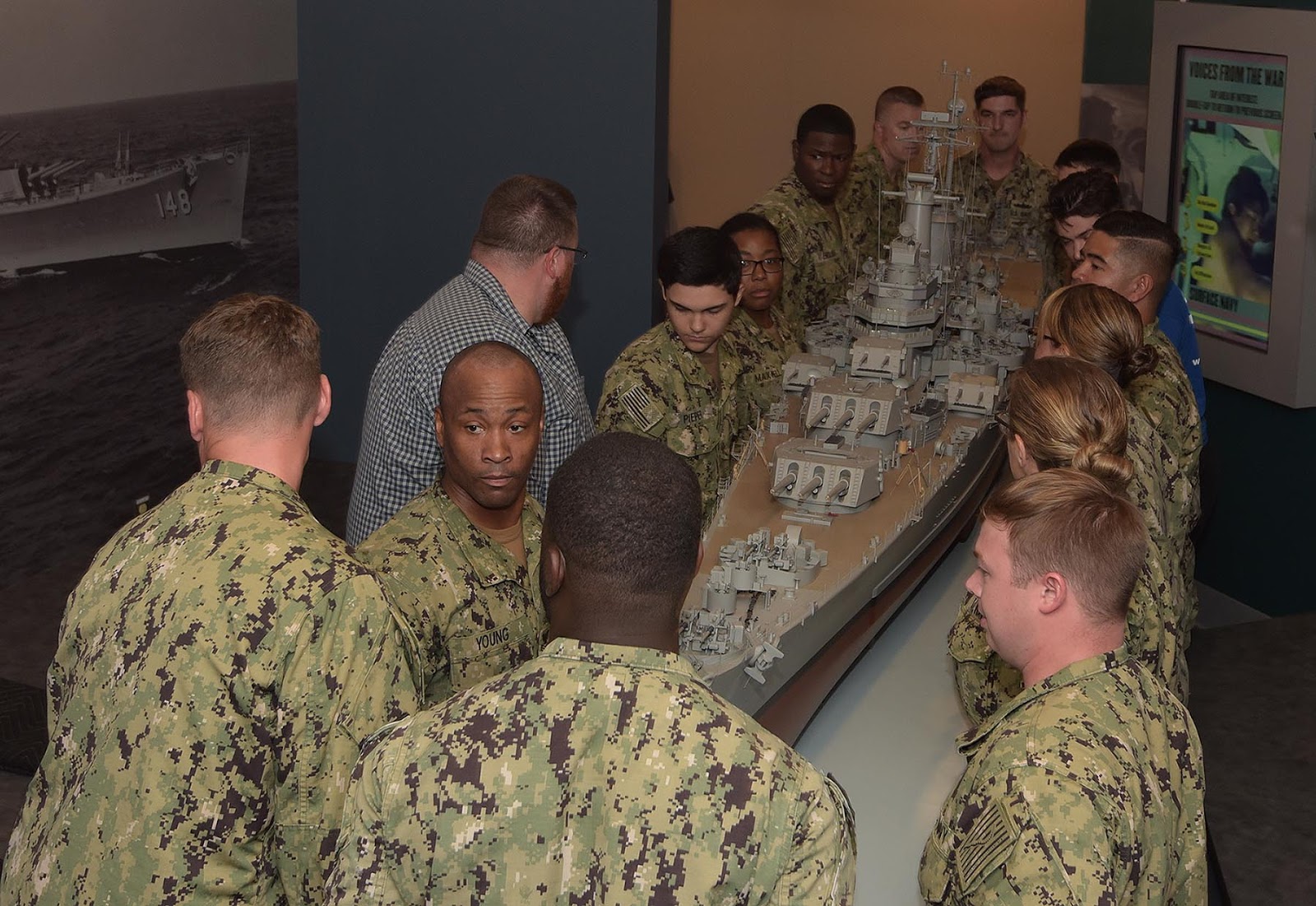
A roughly 15 foot-long model of the heavy cruiser USS Newport News (CA 148) dominates the War at Sea area of the new exhibit, The Ten Thousand-Day War at Sea: The US Navy in Vietnam, 1950-1975, which opened in October 2019. The display also features the heavy cruiser's name plate. (M.C. Farrington)  
Newport News was the 18th and last cruiser constructed at Newport News Shipbuilding and Dry Dock Company, the sprawling shipyard on the banks of the James River, but the battle to name her for the city that the shipyard called home began long before construction began in November 1945. On April 17, 1944, the Peninsula Chamber of Commerce started a petition drive to give the as-yet unnamed vessel the name Newport News, which quickly reached 40,000 signatures. Five days later, a telegram was sent to Navy Secretary Frank Knox requesting Navy Department approval. Less than a week later, however, Knox died, and the decision fell to his successor, James Forrestal. The day of her launching, March 6, 1947, was the birthday of former shipyard president Homer L. Ferguson. It was proclaimed “Newport News Cruiser Day” by Newport News Mayor R. Cowles Taylor, whose wife Elise served as sponsor, and a crowd of 20,000 braved heavy weather to witness the commissioning at Newport News Shipbuilding.

The Name Board of USS Newport News currently on display above the model at the Hampton Roads Naval Museum. (Naval History and Heritage Command 1991-167-A)
Newport News, measuring in at 716 feet, 6 inches in length and displacing 21,500 tons fully loaded, was larger and heavier than any of the battleships of the Great White Fleet four decades before, yet she was a bit smaller than the 887 foot-long Iowa-class battleships that were her contemporaries. When delivered, she was equipped with nine 8-inch/ 55 caliber rapid-fire guns, 12 5-inch/ 38 caliber guns, 24 3-inch/ 50 caliber guns, and 12 20mm antiaircraft guns. This is the configuration shown on the 15 foot, two-inch-long model currently in the HRNM gallery, but the majority of the 3-inch and 20mm guns were removed after her first decade in service.

From its 8-inch rapid fire and 5-inch guns and their fire control systems right down to stanchions, deck gear and boat booms, the Des Moines-class cruiser model depicting USS Newport News (CA 148) is rich in detail.  (M.C. Farrington)
The aft main deck of the model complete with 3-inch/ 50 caliber gun mounts in gun tubs on either side of the fantail. The model also features an aircraft crane similar to those also found on battleships, but by the time the Des Moines-class cruisers were entering the fleet in the late-1940s, there was no necessity to carry floatplanes and the steam catapults they required for launching. (M.C. Farrington) 
The 5-inch gun turrets ahead of and on either side of the bridge remained for the cruiser's service life, yet most  of the 20mm antiaircraft guns mounted around the decks were removed during the first decade after commissioning.  The superstructure aft of the bridge of Newport News was expanded for flag staff and communications spaces between 1961 and 1962. (M.C. Farrington)
The model's starboard side amidships showing 3-inch mounts on either side of a stowed 26-foot motor whale boat. Note the small fire control tub supporting the 3-inch guns on the left and the much larger Mk 37 director on the right capable of supporting either the 5-inch or 8-inch guns.  (M.C. Farrington)
Newport News spent her first decade serving as Sixth Fleet flagship on eight separate occasions, responding to crises such as those in Syria and Lebanon in 1957 and 1958, and steamed more than 1,200 miles in 40 hours to come to the aid of Earthquake survivors in Morocco in 1960. She underwent a modernization program starting in 1961, the superstructure amidships was expanded for flag spaces and enhanced communications equipment, including a large Naval Tactical Data System antenna that loomed over the forecastle, was added, and the cruiser became the Second Fleet flagship in April of the following year. Her first test as a command ship occurred when tactical command over the quarantine of Cuba during the Cuban Missile Crisis was directed from the cruiser. 
The cruiser Newport News (CA 148), which for most of its service left was based at naval Station Norfolk, Virginia, fires a salvo off the coast of South Vietnam in June 1972 during her third combat deployment to Vietnam.  The ship was instrumental in providing gunfire support to Republic of Vietnam forces as they countered the Viet Cong and North Vietnamese regulars during their Easter Offensive earlier that spring. (US Navy Photo 1141898 via Cold War Gallery/ Flickr)

On her first deployment to the waters off Vietnam from October 1967 to April 1968, Newport News participated in Operation Sea Dragon, expending 59,241 rounds of high explosive ammunition and earning the Navy Unit Commendation. The enemy answered with over 300 rounds in response during 17 separate attacks, yet she was never hit. Her second deployment from December 1968 to June 1969 was similarly successful, and the ship garnered the Meritorious Unit Commendation. The most demanding deployment to Vietnam started in April 1972, during which she led the first cruiser-destroyer surface actions against Haiphong Harbor in North Vietnam.

Sailors from the Norfolk-based USS Gettysburg (CG 64), along with Conservator Brian Potter of the Office of the Curator of Models (looking away from the camera) move a 15 foot-long model of USS Newport News (CA 148) into the gallery of the Hampton Roads Naval Museum in September 2019. (M.C. Farrington)
The darkest day of the cruiser’s active service occurred towards the end of her third Vietnam deployment while providing gunfire support off the coast of the DMZ. On October 1, 1972, a faulty fuse within an 8-inch round within the bore of the center gun of the number two turret caused it caused it to detonate at the moment of firing. The force of the explosion vented into the turret itself and caused over 700 pounds of powder on the three hoists leading down to the weapons magazines to also explode. By some miracle the furious flames stopped short of the magazines themselves in time for them to be flooded by the crew. Twenty Sailors were killed and 38 were injured. Despite suffering a catastrophic accident that could very well have destroyed the ship, Newport News continued her deployment until December.

Conservator Brian Potter of the Office of the Curator of Models, located at the Naval Surface Warfare Center in Bethesda, Maryland, calls out instructions as Sailors from USS Gettysburg (CG 64) lower a model of USS Newport News (CA 148) into position at the Hampton Roads Naval Museum in September 2019. (M.C. Farrington)
A few weeks after her final return from Vietnam, a Virginian-Pilot story revealed the Navy’s plans for the cruiser to become a museum ship on display near the Mariners’ Museum located in the City of Newport News. Instead, she remained in active service for two more years. Plans to replace the number two turret with a turret from sister ship Des Moines also came to naught.  Newport News finally officially ended her active service at Naval Station Norfolk, where her commissioning pennant was lowered for the last time on June 27, 1975. 
USS Newport News (CA 148) moored at Southern Scrapping Company, New Orleans, in 1993. (Operations Specialist 2nd Class John Bouvia via Wikimedia Commons)
Newport News was taken to the Inactive Ship Maintenance Facility in Philadelphia, where she spent the following decade slowly wasting away with an uncertain future. Plans emerged during the 1980s for the City of Duluth, Minnesota, to procure Newport News for their own waterfront museum, but those plans too fizzled, and her last journey ended at the Southern Scrapping Company in Louisiana after she was sold in February 1993.


Curator of Models Dana Wegner, Conservator Brian Potter, and Assistant Curator Jennifer Marland from the Office of the Curator of Models, located at the Naval Surface Warfare Center in Bethesda, Maryland, conduct a post-delivery inspection of the ¼-inch to one-foot scale model of the Heavy Cruiser Newport News (CA 148) after it was installed in the Hampton Roads Naval Museum gallery. (M.C. Farrington)  
 
It might come as no surprise that the cruiser Newport News was built at Newport News Shipbuilding. What might surprise some admirers of the finely detailed model is that it was made at the very same shipyard, at the same time, as the ship it represents, but not at Newport News Shipbuilding. It was constructed of wood and brass, with linen and wire lines, by Bethlehem Steel at its Fore River Shipyard in Quincy, Massachusetts, under the same contract as the ship it represents. How can this be? The answer is that the model originally was not of USS Newport News at all, but USS Salem (CA 139). The model today remains as it was configured when that ship was commissioned on May 14, 1949.
The starboard side of the model of USS Newport News while it was still on display at the National Museum of the US Navy at the Washington Navy Yard, showing the extreme detail shipwrights at Fore River Shipyard put into the model when it was built there as USS Salem during the late-1940s. (Cold War Gallery via Flickr)

Although the model does not specifically depict Newport News, the three Des Moines-class cruisers deviated very little in appearance when they were originally commissioned. By the terms of the contract to build Salem, the configuration of the ship had to be shown in exacting detail. “If an object on the ship was six or more inches, it had to be represented on the model,” said Assistant Curator Jennifer Marland of the Office of the Curator of Models in Bethesda, Maryland.
The 1/4-inch to one foot scale model of USS Newport News (CA 148) as it appeared in the "Lion's Den" area in front of a recreation of the cruiser's bridge within the Cold War gallery of the National Museum of the US Navy from 2006 to 2019. (Cold War Gallery via Flickr)

The Salem–Newport News model was first put on display with the Massachusetts Institute of Technology’s NROTC Unit from 1951 to 1968 before starting a southern migration with stops at the Pentagon from 1969 to 1977, the Naval Academy from 1983 to 1987, the Cold War Gallery of the National Museum of the US Navy from 2006 to 2019, and in September 2019, this huge reminder of American firepower that answered to the call sign, "Thunder," moved to its current location at the Hampton Roads Naval Museum to be a signature part of The Ten Thousand-Day War at Sea exhibit.