Showing posts with label USS Wasp. Show all posts

Friday, December 6, 2019

When Caroline Kennedy Last Christened a Ship in the Name of Her Father

A page from the USS John F. Kennedy (CVA 67) christening program contained in the Jacqueline Bouvier Kennedy Onassis Personal Papers held by the John F. Kennedy Presidential Library and Museum.
By M.C. Farrington
HRNM Historian

There have been a number of new aircraft carriers that carried on the names of their predecessors: names such as Yorktown (CV 5 & CV 10), Hornet (CV 8 & CV 12), Lexington (CV 2 & CV 16), Wasp (CV 7 & CV 18) and Enterprise (CV 6 & CVN 65).  These were vessels named to commemorate great American victories or storied vessels of the past.  As time has gone on, the names of presidents and other notable figures in naval history have been added to new American flattops joining the fleet.  However, no president's name has been carried forward from an old carrier to a new one.*

On December 7, 2019, at Newport News Shipbuilding, a new American carrier was christened with the name of a president from a previous carrier for the very first time.  And, in what might be another first, the new carrier was christened by the same person who christened the old one at the same shipyard over 52 years ago.
Another detail of the ceremony turned out to be remarkably consistent with that person's first performance on May 27, 1967.
Caroline Kennedy, President John F. Kennedy's daughter, former ambassador to Japan, and sponsor of the Ford-class aircraft carrier USS John F. Kennedy (CVN 79), christens the ship on December 7, 2019. USS John F. Kennedy (CVN 79) was christened at Huntington Ingalls Industries' Newport News Shipbuilding (HII-NNS) division, in Newport News, Virginia. The aircraft carrier is named after John Fitzgerald Kennedy, the 35th president of the United States, who served in office from January 1961 to November 1963. This is the second U.S. aircraft carrier named for President Kennedy, with the former being the last conventionally powered carrier, CV-67, which served from 1968 to 2007. (U.S. Navy photo 191207-N-PG550-1463 by Mass Communication Specialist 3rd Class Samuel Lee Pederson/Released)
You might have read that Caroline Kennedy didn't quite score a clean break on the first try with a bottle of "American sparkling wine" on the bow of the new ship on December 7.  This was a clear-cut case of history repeating.  But why was she selected to christen USS John F. Kennedy (CVA 67) in the first place, when she was just nine years old?  The decision had as much to do with naval custom as it had to do with tragedy.
Lieutenant John F. Kennedy, USNR, (standing, far right) with other crewmen onboard USS PT-109 at a South Pacific Naval Base, 1943. (U.S. Information Agency Photograph 306-ST-649-9, now in the collections of the National Archives)
As a lieutenant junior grade during World War II, her father John Fitzgerald Kennedy fought bravely in the Pacific, sustaining serious injuries after the PT boat under his command was rammed by a Japanese destroyer in 1943.  After his meteoric rise after the war as a congressman and, later, senator from the state of Massachusetts, he edged out Vice President (and fellow former naval officer) Richard Nixon for the presidency in November 1960.  After a tumultuous tenure as president, during which he authorized naval assets to secretly support Cuban exiles attempting to invade and overthrow the Communist government of Cuba and later ordered a naval quarantine of the island when the Soviets secretly put troops and tactical nuclear missiles there in response, Kennedy was assassinated on November 22, 1963 in Dallas, leaving Vice President Lyndon Baines Johnson (yet another former naval officer) as commander-in-chief.

Kennedy was unquestionably not afraid to put the Navy he led into harm's way, but he was also a strong advocate of the service.  After his death, President Johnson led the effort to name a modified Kitty Hawk-class carrier, authorized for construction during his predecessor's administration, for the fallen leader.  The keel for USS John F. Kennedy (CVA 67) was laid on October 22, 1964.  

As a matter of custom, as the carrier was nearing completion a significant member of President Kennedy's family would be invited to christen the vessel.

(Jacqueline Bouvier Kennedy Onassis Personal Papers/ John F. Kennedy Presidential Library and Museum)
In February 1967, Secretary of the Navy Paul Nitze sent Jacqueline Kennedy an invitation to sponsor the new carrier.  "Traditionally, a lady sponsors only one Navy ship; however, there have been exceptions to this custom," wrote Nitze.  "Though you christened the Polaris submarine, USS  LAFAYETTE, I am sure that I express the sentiment of the entire navy in urging you to christen the new carrier.  Should you prefer, your daughter, Caroline, may be designated."
In happier times: White House naval aide Capt. Tazewell T. Shepard and General Dynamics executive Roger Lewis look on as First Lady Jacqueline Kennedy christens USS Lafayette (SSBN 616) May 8, 1962 at Electric Boat, General Dynamics, in Groton, Connecticut. (Library of Congress via Naval History and Heritage Command/Flickr)
Indeed, Jacqueline Kennedy had christened USS Lafayette (SSBN 616) at General Dynamics Electric Boat shipyard in Groton, Connecticut, May 8, 1962. Less than two years later, however, her life, and the course of the nation's history, had been irrevocably changed by the assassination of her husband.  That tragic change impacted the way she felt towards attending another such event.
(Jacqueline Bouvier Kennedy Onassis Personal Papers/ John F. Kennedy Presidential Library and Museum)
In an early draft of the response Mrs. Kennedy sent Secreatry Nitze, she wrote, "That type of thing [the christening], remembering my husband, is very difficult for me."   But she then assured Nitze that someone from President Kennedy's family would attend the christening.

Overcoming her grief, Mrs. Kennedy decided upon having her daughter Caroline sponsor the ship, and on the morning of May 27, 1967, she accompanied the little girl and her son John F. Kennedy Jr. (along with approximately 15 immediate family members and their families) to the Newport News Shipbuilding and Dry Dock company.   

Writing for the Virginian-Pilot newspaper published in Norfolk, Virginia, reporter William K. Stevens observed, "Not since the 1963 funeral [of John F. Kennedy] had so many New Frontiersmen and relatives of John F. Kennedy been in one place at one time." Richard Cardinal Cushing, Archbishop of Boston, the same man who had blessed John F. Kennedy's marriage to Jacqueline L. Bouvier in 1953, given the invocation during his inauguration in 1961, and celebrated his funeral mass in 1963, was there to give the invocation for the christening.   
Secretary of Defense Robert McNamara escorts Jacqueline Kennedy, her son John Kennedy Jr., and her daughter Caroline (behind her brother) after arriving at Newport News Shipbuilding on May 27, 1967 (Newport News Shipbuilding photograph/ Hampton Roads Naval Museum collection)
Caroline Kennedy was hardly the first in her family to christen a ship at the mammoth shipyard on the James River.  Her paternal grandmother Rose Kennedy had sponsored the Cimarron-class fleet oiler SS Esso Richmond at Newport News Shipbuilding in September 1939 (which was commissioned USS Kaskaskia (AO 27) the following year), and her aunt Patricia Kennedy had sponsored the President Jackson-class attack transport President Polk (AP 103) in June 1941. Another aunt, Ethel Kennedy (wife of then-Attorney General Robert F. Kennedy) had sponsored the Ethan Allen-class ballistic missile submarine John Marshall (SSBN 611) in May 1961.
Caroline Kennedy prepares to swing a bottle of champagne into the bow of the aircraft carrier John F. Kennedy (CVA 67) at Newport News Shipbuilding under the guidance of Shipyard President Donald A. Holden on May 27, 1967 (Newport News Shipbuilding photograph/ Hampton Roads Naval Museum collection)
In a ceremony timed down to the second, three warning whistles were to sound; the first a siren scheduled for 12:25 pm, with a whistle 30 seconds later and another 20 seconds after that.  With each siren or whistle blast, one of JFK's three initials would appear in lights on a giant board affixed to the bow.  Caroline was scheduled to smash the bottle against an angular protuberance affixed to the bow precisely on the third whistle blast scheduled for 12:26.

"Caroline, 9, stood in front of the bow of the mammoth attack aircraft carrier John F. Kennedy like a left-handed little leaguer at home plate," wrote Virginian-Pilot reporter Shirley Bolinaga, who was among the throngs of local and national news media to cover the event. 
As John Kennedy Jr. and Jacqueline Kennedy watch as Newport News Shipbuilding President Donald A. Holden helps Caroline Kennedy christen the carrier John F. Kennedy (CVA 67). (Newport News Shipbuilding photograph/ Hampton Roads Naval Museum collection)
The clock photographed behind the participants on the platform indicates that the event was running ahead of schedule, with Caroline taking her first swing at 12:09 and 55 seconds, and, unless a video of the event accessible online has been edited incorrectly, she attempted to break the bottle after the second blast. 
John Kennedy Jr. and Jacqueline Kennedy seem to react with dismay as Caroline Kennedy appears to have momentary trouble christening the carrier John F. Kennedy (CVA 67). (Newport News Shipbuilding photograph/ Hampton Roads Naval Museum collection)
"She held the bottle of Great Western champagne like a baseball bat and swung from the shoulder," wrote Bolinaga. "It hit with a clunk but it didn't break." 

After the bottle bounced off the angular rail affixed to the bow, Caroline tried again, striking home about three seconds later, sending bubbly in all directions, and sending the great ship into the James River.   
Caroline Kennedy christens the carrier John F. Kennedy (CVA 67) as her brother John Kennedy Jr., mother Jacqueline Kennedy, and Newport News Shipbuilding President Donald A. Holden react. (Newport News Shipbuilding photograph/ Hampton Roads Naval Museum collection)
"On the second try, the bottle, beribboned with red, white, and blue, shattered. Its bubbly contents splashed all over Caroline's aqua and white dress and red shoes, and splattered on her mother as Mrs. Jacqueline Kennedy clapped her gloved hands together in front of her face," wrote Bolinaga.  "The mother and her children watched as the 61,450-ton ship was floated from Shipway 11 into the James River." 
Jacqueline Kennedy, her brother John Kennedy Jr., and daughter Caroline Kennedy watch the carrier John F. Kennedy (CVA 67) as she backs away from the christening platform. Note Newport News Shipbuilding President Donald A. Holden pointing out details to Caroline, who has just christened the vessel. (Newport News Shipbuilding photograph/ Hampton Roads Naval Museum collection)
Watched by thousands of guests and dignitaries such as President Lyndon B. Johnson, Secretary of Defense Robert McNamara and Secretary of the Navy Paul Nitze, the carrier John F. Kennedy (CVA 67) backs away from the christening platform at Newport News Shipbuilding and Dry Dock Company in Newport News, Virginia, on May 27, 1967. Note the board affixed to the bow spelling out the initials "J.F.K.," emulating John F. Kennedy's handwriting in electric lights. (Newport News Shipbuilding photograph/ Hampton Roads Naval Museum collection)
The aircraft carrier John F. Kennedy (CVA 67) backs away from the christening platform at Newport News Shipbuilding and Dry Dock Company in Newport News, Virginia on May 27, 1967, as thousands of guests and dignitaries such as President Lyndon B. Johnson, Senators Robert. F. (Bobby) and Edward M. (Ted) Kennedy as well as Virginia Governor Mills E. Godwin look on. (Newport News Shipbuilding photograph/ Hampton Roads Naval Museum collection)
After her commissioning on September 7, 1968, USS John. F. Kennedy, the Navy's last conventionally-powered carrier, plunged headlong into the Cold War that dominated foreign policy during her namesake's administration, and those of the next four presidential administrations. Caroline Kennedy visited the ship at least once more during its active service, the first time when the carrier visited Boston in 1970.
Seen from an American escort, a Soviet Tu-95 Bear D maritime reconnaissance aircraft makes a close approach to USS John F. Kennedy (CVA 67) during her first foray into the Mediterranean in 1969.  (National Archives and Records Administration via Naval History and Heritage Command/Flickr)
The signing of the Paris Peace Accords in 1973 deprived Kennedy of a scheduled wartime deployment to Southeast Asia and a place in the history of the Vietnam War, but the carrier participated in continuous exercises and operations through war and peace, the last being during Operation Iraqi Freedom, with frequent visits and yard periods in Hampton Roads in between, until her decommissioning in 2007.  
A port bow view of the aircraft carrier USS John F. Kennedy (CV 67) coming down the Elizabeth River after leaving Norfolk Naval Shipyard on August 17, 1987. (Photographer's Mate 1st Class McCoy, National Archives and Records Administration image 330-CFD-DN-SC-88-05873 via Naval History and Heritage Command/Flickr)
Long after CV 67 was struck from the Naval Vessel Register in 2009, Caroline Kennedy was very much in active government service, having been appointed as ambassador to Japan by President Barak Obama, a post she held from 2013 to 2017.

U.S. Ambassador to Japan Caroline Kennedy pilots Naval Beach Unit Seven's Landing Craft, Air Cushion (LCAC) during a visit to NBU-7 Facilities in Sasebo, Japan, on October 7, 2016. The visit is part of a larger trip to Nagasaki Prefecture. (U.S. Navy Photo 161007-N-NY430-042 by Petty Officer 3rd Class Kristopher S. Haley via Naval History and Heritage Command/Flickr)

Although, sadly, her mother Jacqueline Kennedy Onassis, who died of cancer in 1994, and her brother John F. Kennedy Jr., who died while flying his plane to Martha's Vineyard in 1999, were not there to witness it, Ambassador Caroline Kennedy once again visited Hampton Roads to take her place in christening a vessel that will represent her family, her father, and the nation he led, far into the future. 

"Christened by the hand of a child," said Secretary of Defense Robert. S. McNamara in his prepared remarks for the day of the original John F. Kennedy's commissioning over 52 years ago, "it will begin an odyssey whose final landfall we cannot clearly foretell."   


* Two American aircraft carriers were named for aviation pioneer Samuel Pierpoint Langley: USS Langley (CV 1), converted from the collier Jupiter at Norfolk Navy Yard between 1920-22, and USS Langley (CVL 27), an Independence-class light carrier, commissioned in 1943. USS Wright (CVL 49) was another Independence-class carrier constructed during World War II, but she was named for both brothers, whereas the previous USS Wright (AZ 1/AV 1), which served in several different aviation support roles after its commissioning in 1921, was only named for Orville Wright.

USS John F. Kennedy appears as CVA 67 in the early part of the story and CV 67 later on. The designation was changed in 1974.

Thursday, September 7, 2017

Seventy-Five Years Ago: A Fallen Commander's Letter to his Son Inspires the Nation

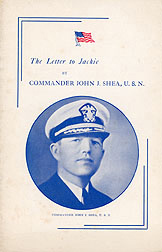
A series of personal letters appeared in a pamphlet entitled Lest We Forget..., printed in 1943 by the Navy's Industrial Incentive Division to bring a sense of perspective to civilian war workers, many of whom were already exhausted by the pace demanded of them during the second full year of the war. 
USS Wasp (CV 7) appears on the Elizabeth River after an overhaul that began in December 1941.  She would operate in the Atlantic and Mediterranean until June, when more antiaircraft guns were installed at Norfolk Naval Shipyard before her departure for the Pacific. Lt. Cmdr. Shea's letter to his son was probably mailed just before Wasp's departure from Hampton Roads.  (National Archives and Records Administration)  

It is true that many of these workers had reason to feel underappreciated or even taken for granted.  Despite the dangers and drudgery of their jobs, however, they did not face imminent death like the end users of the things they were producing for the war effort, men like Lieutenant Commander John Joseph Shea of the USS Wasp (CV 7), the author of perhaps the most famous missive in the collection.  He wrote it to his son, Jackie, as he was leaving Hampton Roads in June 1942, bound for the Pacific.   

This illustration depicting five-year-old Jackie Shea appeared in the 1943 Navy pamphlet Lest We Forget.. (Author's Collection) INSET: A photograph of Lt. Cmdr. John J. Shea and his son, taken before he reported to the aircraft carrier Wasp (CV 7) in March 1942. (John J. Shea Collection, Courtesy of the Boston College University Archives)
June 29, 1942

Dear Jackie,

This is the first letter I have ever written directly to my little son and I am thrilled to know that you can read it all by yourself. If you miss some of the words, I'm sure it will be because I do not write very plainly. Mother will help you in that case I am sure. 
I was certainly glad to hear your voice over the long distance telephone. It sounded as though I were right in the living room with you. You sounded as though you missed your daddy very much. I miss you too, more than anyone will ever know. It is too bad this
war could not have been delayed a few more years so that I could grow up again with you and do with you all the things I planned to do when you were old enough to go to school. 
I thought how nice it would be for me to come home early in the afternoon and play ball with you, and go mountain climbing and see the trees, and brooks, and learn all about woodcraft, hunting, fishing, swimming, and things like that. I suppose we must be brave and put these things off for a little while.

When you are a little bigger you will know why your daddy is not home so much any more. You know we have a big country and we have ideals as to how people should live and enjoy the riches of it and how each is born with equal rights to life, freedom, and
the pursuit of happiness. Unfortunately, there are some countries in the world where they don't have these ideals, where a boy cannot grow up to be what he wants to be with no limits on his opportunities to be a great man, such as a great priest, statesman, doctor, soldier, business man etc.

Because there are people and countries who want to change our nation, its ideals, forms of government, and way of life, we must leave our homes and families to fight. Fighting for the defense of our country, ideals, homes, and honor is an honor and a duty which your daddy has to do before he can come home to settle down with you and Mother. When it is done, he is coming home to be with you always and forever. So wait just a little while longer. I am afraid it will be more than the two weeks you told me on the phone. 
In the meantime, take good care of Mother. Be a good boy and grow up to be a good young man. Study hard when you go to school. Be a leader in everything good in life. Be a good Catholic, and you can't help being a good American. Play fair always. Strive to win but if you must lose, lose like a gentleman and a good sportsman. Don't ever be a quitter either in sports or in your business or profession when you grow up. Get all the education you can. Stay close to Mother and follow her advice. Obey her in everything, no matter how you may at times disagree. She knows what is best and will never let you down or lead you away from the right and honorable things in life. If I don't get back, you will have to be Mother's protector because you will be the only one she has. You must grow up to take my place as well as your own in her life and heart.

Love your grandmother and granddad as long as they live. They too will never let you down. Love your aunts and see them as often as you can. Last of all, don't ever forget your daddy. Pray for him to come back and if it is God's will that he does not, be the kind of a boy and man your daddy wants you to be.

Thanks for the nice sweater and handkerchiefs and particularly for the note and card. Write me very often and tell me everything.

Kiss Mother for me every night.

Goodbye for now.

With all my love and devotion for Mother and you,

Your daddy
 
John J. Shea, born in Cambridge, Massachusetts, on January 30, 1898, earned a scholarship to Boston College at the age of 16.  He enlisted in the Naval Reserve on June 11, 1918, right after graduation, and became a naval aviator after completing training at the Massachusetts Institute of Technology.  Shea had been on active duty since 1930, serving from 1934 to 1940 as executive officer of Naval Air Station Squantum, Massachusetts.  

After a brief stint at the Bureau of Aeronautics in Washington DC, Shea reported aboard Wasp as assistant air officer in March, 1942.  Boston Globe columnist Joseph Driscoll, who sailed aboard Wasp during a convoy run in the Atlantic that spring, called Shea "the softest-spoken man on the ship."  "Only 43," continued Driscoll, "he had the athletic build of a football player, which he had been at Boston College. He was 6 feet tall, and hard and lean and shifty on his feet.  His freckled nose was dented from personal combat, and he had red hair."

Aviation fuel and ordnance fires consume the stricken aircraft carrier Wasp (CV 7) after she was torpedoed by the Japanese submarine I-19 off Guadalcanal on September 15, 1942. (Naval History and Heritage Command Photograph) 
Shea was declared missing after Wasp was struck by three torpedoes in the waters near Guadalcanal on September 15.  The citation of his Navy Cross, awarded posthumously, reads in part:

Lieutenant Commander Shea directed the fight against fires on the flight deck of the U.S.S. WASP, after the carrier had been crippled by the Japanese bombing attack which later caused her to sink. Lieutenant Commander Shea disregarded the danger from the fires, flying debris, and exploding ammunition to carry on his fight. When the water pressure failed, he employed chemical fire-fighting equipment in a desperate effort to extinguish a fire in a ready ammunition locker, and was leading out a fire hose to continue his efforts when a terrific explosion occurred. He was not subsequently seen by his shipmates.
(Boston College University Archives)
On September 16, 1943, Shea was declared legally dead, but by then, "The letter to Jackie" had long since taken on a life of its own. His sisters Dorothea and Cecilia, teachers in the Boston Public School system, had reprinted the letter in pamphlet form shortly after he was declared missing, and on October 27, 1942, the Boston Globe printed it, calling it "an inspiring memorial to American youth."  Newspapers across the country, as well as Life, Look, and Time magazine followed suit.  It also was featured in various government publications such as Lest We Forget... because Elmer Davis and his Office of War Information could never have dreamed up such a simple, powerful message that spread so quickly without governmental prodding. Shea's letter was imbued with a heartfelt authenticity that no government propaganda could match.
"You know," recalled Jackie to a Globe reporter ten years after his father's death, "the best part of the letter is that my father never could have known it would come to light even in the event of his death, so no one can doubt he meant exactly what he wrote."  

Although U.S. naval forces had struck a decisive blow against the Imperial Japanese Navy during the Battle of Midway in June, by September it was by no means apparent to the US Navy, much less the American public, that the tide had turned against them.  On New Guinea, Japanese soldiers were only about 25 miles away from Port Moresby, and closing, while on Guadalcanal in the Eastern Solomons, US Marines were facing stiff resistance in holding Henderson Field.  In the waters nearby, the IJN had sunk three American cruisers and one Australian cruiser during the Battle of Savo Island in August, topped off by the loss of the carrier Wasp and 193 of her men, including Shea, only five weeks later.  The message of honor, duty, dedication, and resolve he left his son became a message to the nation at a critical time.

After Shea's letter was donated to Boston College in 2001, the college's historian, Thomas O'Connor, said of its' impact, "The Allied forces were losing everywhere.  Hitler had invaded Russia. The Japanese were taking over the Pacific.  People were asking, 'where did we go wrong?' Then this letter came out and reaffirmed all the best values people thought we had lost."

The letter and the acclaim it garnered made young Jackie and his mother Elizabeth celebrities of a sort.  They appeared at numerous parades and other events, such as the launching for the new aircraft carrier Wasp (CV 18) on August 17, 1943, and then on May 20, 1944, when the light minelayer Shea (DM 30) was launched at the Bethlehem Steel Company in Staten Island, New York, little Jackie signed the bow.  NAS Squantum's airfield was renamed for Cmdr. Shea in 1946, and Jackie, standing at his mother's side, dutifully laid a wreath at its dedication. 

Elizabeth Shea, widow of Cmdr. John Shea, holds six-year-old Jackie Shea as he signs the bow of the light minelayer Shea (DM 30) at her launching in Staten Island, New York, on May 20, 1944. (Bill Gonyo via Navsource)
The light minelayer Shea (DM 30), seen here in 1946, was heavily damaged during the Okinawa Campaign in late-1944. (Ted Stone Collection, Naval History and Heritage Command Photograph)
After graduating from his father's alma mater in 1958 and earning a doctorate in classical philology at Harvard University, "Jackie" grew up to be Professor of Classics John R. "Jack" Shea, and taught at Boston College for many years. He died on March 14, 2015, at the age of 78.


Friday, August 12, 2011

Sailor's Ditty Box


Ditty boxes were small, lockable containers carried aboard ship by sailors and used to store their most prized possessions. Items might include personal papers such as journals and letters, pocket watches, cigarettes, grooming and writing implements as well as small working and sewing tools. Early boxes came in different sizes and shapes designed to fit the owner’s needs. These were usually constructed from pine with dovetail joinery, and decorated with maritime images. Prior to WWI, the US Navy issued six by six by twelve inch white wooden boxes that contained holders for an ink bottle, pens and pencils. Sometime around WWII the box was exchanged for a small brown suitcase which is no longer issued.

This 19th century folk art sailor’s box is a new addition to the museum’s collection, and was recently examined for conservation needs as part of an award from the Virginia Association of Museums’ assessment grant program. The wooden box is decorated with brass tacks and plates marked “USS Wasp”, ”R”, “M” and “1809”.

The USS Wasp, a sloop of war commissioned in 1807, made her mark during the War of 1812. On October 16, 1812 she went to battle with the HBM Frolic, capturing the brig after a brief fight. However, the victory was short lived as the nearby British 74-gun ship-of-the-line Poictiers overwhelmed the Wasp forcing her commanding officer Master Commandant Jacob Jones to surrender. USS Wasp was briefly put into service as the Peacock with the Royal Navy, but went down off the capes of Virginia in 1813.