Showing posts with label artifacts. Show all posts

Thursday, April 20, 2023

Artifact Spotlight: Conserving Commodore Samuel Barron’s Sword – Part 2

By Karl Knauer
NHHC Conservator

Today’s blog is part two of our spotlight on the recently conserved Commodore Samuel Barron Sword (yataghan), now back in HRNM’s collection. We are excited to have our colleague, NHHC Conservator Karl Knauer, share with us the conservation process, as well as his work on this artifact. To read part 1 of this blog, click here.
---

As conservators in the NHHC Conservation Branch (“COBRA”), we work on artifacts in the NHHC’s varied collections, including those of the Navy’s museums.[i] After receiving an initial inquiry from HRNM about potential conservation treatment of this Ottoman sword we were intrigued. In any conservation process we assess many aspects of the artifact, including materials and the historical context of its creation and use, to determine the best course for treatment. At first sight it was clear that this yataghan was of exquisite craftsmanship and would be a challenging yet rewarding conservation experience.
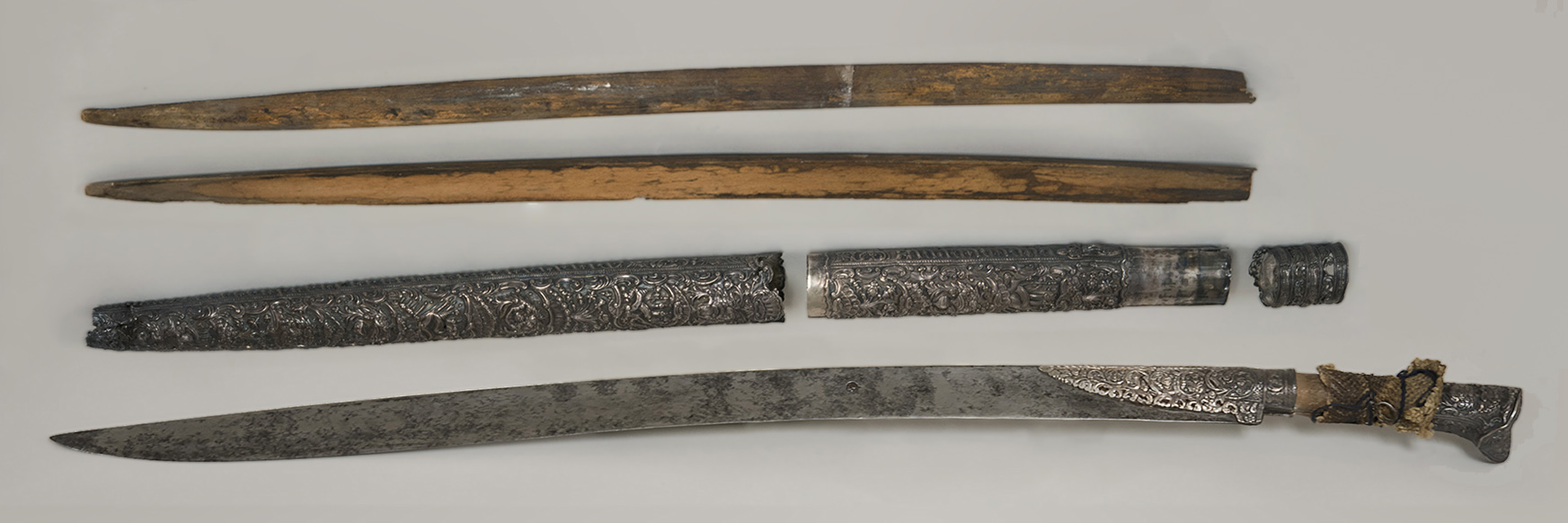
Barron yataghan and scabbard before conservation, disassembled for evaluation and treatment (Conservation Branch NHHC)

The assessment started with a thorough visual examination before other methods of analysis. Here we carefully handled the sword and scabbard to look closely from all angles. I noted a few loose and missing components, unraveling grip-wrapping, and fingerprints etched into its blade. The dark overall tarnish suggested “benign neglect,” which was potentially good news. Excessive polishing over the years could have dulled and worn away the exceptional detail of both sword and scabbard. I also examined the wooden liners of the scabbard. These components, typically hidden from view, are integral to the assembly of the ornate silver sections.[ii] A conservator’s main objective is to stabilize artifacts, not just treating its surfaces, but also making sure that the artifact won’t fall apart, and that any overall deterioration is slowed. This could involve simply providing recommendations on the best environment and preventive measures to prolong its preservation but typically involves at least some sort of cleaning to remove potentially damaging surface grime or other contaminants. For this sword and scabbard, the condition justified more interventive treatments for stabilization.

Here we can see a portion of the scabbard before cleaning (left) and after cleaning (right) (Conservation Branch, NHHC)

For structural stabilization of the scabbard and “compensation for loss” in missing areas, we aim to make these repairs reversible and “not falsely modify the known aesthetic.”[iii] However, cleaning the tarnish off the scabbard and reducing the etched fingerprints on the blade are irreversible courses of action and should be undertaken with deliberate caution. Polishing the silver was straightforward and gentle, albeit time consuming.[iv] On the steel blade, the dark, disfiguring corrosion products and etched fingerprints were more challenging and resistant to gentle cleaning methods. Such marring cannot be fully reversed and, in some respects, comprises a part of the sword’s history and age. At a minimum, we try to degrease the blade of any residual oils from past handling and make sure that such corrosive etching doesn’t further rust the surface. With careful testing I devised a form of localized electrolytic reduction that allowed for removal of the darkest corrosion products without immersing the whole blade.

Using low voltage current applied to the artifact through a mild electrolyte, rusted areas slowly yielded to selective cleaning. This process is seen here. (Conservation Branch, NHHC)

Once cleaned, I applied a stable wax paste to the steel surfaces, which slows the formation of any new rust and protects the surface from any potential contamination. Similarly, I coated the silver surfaces with a protective acrylic lacquer to help slow the rate of tarnishing in the future. I carefully stitched the fragile textile on the grip with very fine, reversible threads and filled its losses with pieces of hemp-fiber cloth. I also stabilized the wooden scabbard inserts using archival adhesive and fitted pieces of painted archival paperboard. Addressing the most notable losses on the silver scabbard was the final step. The areas around these losses were fragile and vulnerably prone to snagging and bending, so we needed to add some form of stabilization. Because these areas are so ornate, it was important to “aesthetically integrate” (or appropriately blend-in) whatever I would use to fill these voids. Fortunately, the ornate patterning on the scabbard often repeated, providing ample sources for motifs that could be copied with silicone molds. I took impressions of the required areas to subsequently cast them out with appropriate materials—but the trick in this instance was using a suitable substance that was not visually disruptive. Tests with a variety of conventional restoration materials yielded unsatisfactory results. However, recently another conservator used a nearly 200-year-old technique known as electrotyping to fabricate missing metal components in copper with excellent results.[v] Electrotyping is a technique whereby metal is deposited into a mold from an electroplating solution (something like a 19th century version of 3D printing). Experiments using this method were much more successful.

Original “filigree” collar located below the scabbard opening (left) and an electrotyped silver facsimile (right) used in creating fills to aesthetically compensate for lost areas. (Conservation Branch, NHHC)

Scaling up this technique, I was able to make repairs to the intricately detailed “filigree” areas at the opening of the scabbard, as well as the lost scabbard tip. This last section proved somewhat tricky because of the taper towards the scabbard’s end. Fortunately, I was able to use the same method as the other silver work and made a mold using the repeated patterns from the rest of the scabbard. Although the repeating pattern was easy enough to replicate, the very end was left somewhat vague, as the shape of yataghan scabbard tips can vary and I wanted to avoid falsifying the appearance. The electrotype tip was then fitted with a plastic sleeve that would allow it to be secure but easily removable from the end of the scabbard.

Here you can see the conserved sword and where new material was added to present a visually complete artifact. Replacement elements are documented and labeled so they are distinguishable from the existing historic materials. (Conservation Branch, NHHC)

As a final step, we constructed an archival housing (fitted box) to safely transport the piece back to HRNM, as well as serve as an interim storage container. It was a privilege to be able to work on such a cool piece of history and remarkable craftsmanship! Hopefully this amazing sword will serve as a touchstone to the history of the Barbary Wars for many museum visitors to come.


Notes:
[i] For more information about NHHC’s Conservation Branch visit: https://www.history.navy.mil/our-collections/conservation-branch.html and https://www.dvidshub.net/news/385745/cafeteria-conservation-lab-nhhcs-conservation-branch-five-years
[ii] Sampling miniscule slivers of this wood and looking at them under a microscope revealed characteristics typical of the hardwood known as hornbeam (Carpinus betulus or the related Carpinus orientalis). Examination of the textile wrapping on the grip under the microscope also revealed that they are plant fibers.
[iii] Conservators follow a code of ethics and guidelines that help us choose the best and most appropriate methods in undertaking conservation treatments. This code can be read here: https://www.culturalheritage.org/about-conservation/code-of-ethics
[iv] I made slurries of calcium carbonate (chalk) in water or solvents and gently applied these to the surface and buffed them with soft cloths and more locally with miniature cotton swabs (like mini Q-tips that we make ourselves), the residues of which were finally cleared by rinsing.
[v] Erdmann, Mark (2017). "Copper Electroforming: An Alternative to Casting for Metal Replication." AIC Objects Specialty Group Postprints, Vol. 24, 2017. pp. 445-453 http://resources.culturalheritage.org/osg-postprints/wp-content/uploads/sites/8/2021/11/osg024-2017.pdf

Thursday, April 6, 2023

Artifact Spotlight: Commodore Samuel Barron’s Sword from the First Barbary War – Part 1

By William Clarkson
HRNM Educator

Visitors to military museums are likely to encounter a variety of edged weapons on display. Some are great examples of the development of arms, fighting styles, and doctrines over time. Others are associated with important events or individuals. Today we look at one unique example in the collection at the Hampton Roads Naval Museum. In this two-part blog we will discuss an early 19th century sword from North Africa. This first part will focus on the context and association of the sword and why it is in the collection. Part two will consider the conservation process, undertaken by our colleagues at Naval History and Heritage Command’s Conservation Branch.

Commodore Samuel Barron Sword (Yataghan) in HRNM’s collection, shown here with scabbard. (HRNM)

This type of sword is called a yataghan, or yatagan, and is of Turkish origin. The sword features a single edged recurved blade, without a guard, and a distinctive flared pommel. The pommel’s shape is reminiscent of the end of a bone and harkens back to earlier yataghans, some of which used sheep thigh bones for their hilt. They were used widely in areas under Ottoman control and influence, which by the mid-17th century extended from the Caucasus to Anatolia and the Arabian Peninsula, and west into the Balkans, Egypt, and North Africa. While a functional and effective weapon, as firearms began to supplant other combat arms, many yataghans became more ceremonial and decorative, like the example above.

Here we see an illustration of an Ottoman Janissary with a sword (yataghan) thrust through the belt in the traditional fashion. This early 19th century illustration is by artist and archaeologist Otto Magnus von Stackelberg. (Wikimedia Commons)

HRNM’s yataghan is approximately 30 inches long and fits within a 26-inch scabbard. As noted previously, the single edged blade curves forward, giving the sword its distinctive shape. The blade bears a stamped seal, possibly a maker’s mark, or denoting the original owner. The grip of the sword is wood wrapped in textile, and the flared pommel covered with decorative silverwork. Likewise, the base of the blade is ornamented with silverwork extending a short distance from the hilt. The scabbard is made of wood (which you will see in part 2 of this spotlight) and sheathed in sections of ornate silverwork. While some yataghans are adorned with religious or mythological imagery or text, the decorative elements of this sword are primarily a foliate motif with garlands, flowers, and palmettes. However, it is this sword’s presumed personal association that places it in the realm of U.S. naval history and in the HRNM collection.

Details of the decorative work of the pommel (left), hilt and lower blade (center) and scabbard (right) (HRNM)

The sword was donated by members of the Truxton-Barron family (two names well known in U.S. naval history), who maintain that it was gifted to Commodore Samuel Barron by the Bey of Tripoli in the closing stages of the First Barbary War, sometime in late 1804 or early 1805. Samuel Barron was born in Hampton, Virginia, in 1765 and served in the Virginia Navy during the latter stages of the American Revolution. He then served the young United States Navy in the Caribbean during the Quasi-War with France between 1798 and 1800. In September 1804, Commodore Barron arrived in the Mediterranean (on the orders of President Thomas Jefferson) aboard the frigate USS President to take command of the squadron in operations against hostile forces operating out of Tripolitania. Unfortunately for Barron, he was continuously unwell and spent much of his command bedridden in Syracuse. Before he relinquished command of the squadron to Captain John Rodgers on May 22, 1805, he authorized diplomat Tobias Lear to conduct and conclude peace negotiations with the Bey (Pasha) of Tripoli. These negotiations ended hostilities and resulted in a peace treaty signed in June 1805.

U.S. Navy ships under Commodore Edward Preble bombarding Tripoli in August 1804. Painting by Michael Felice Corne. (NHHC)

After turning over command, and the end of the war, Commodore Barron returned to the United States. He was not active in naval service again until July 1810, when he was appointed to command Gosport Navy Yard (now Norfolk Naval Shipyard) and oversee the construction and outfitting of gunboats for the U.S. Navy. However, his tenure was cut short by his untimely death on October 29, 1810, at the age of 45. Despite the death of Commodore Samuel Barron, artifacts like this yataghan highlight an important period in the early history of the U.S. Navy. The intersection of the Navy, individuals, and global events illuminate the times and experiences that such individuals took part in and shaped. Part two of this series explores the methods by which artifacts, such as this sword, are conserved and prepared for display. Stay tuned to read about the processes and methods our colleagues at NHHC’s Conservation Branch employ to protect and maintain these artifacts for HRNM and our fellow NHHC Museums.

Thursday, January 27, 2022

What's So Special About a Brick? HRNM Gets a "Piece" of Old Athens

By Matthew Headrick
Military Educator

Advertisement and order form for the remaining 473 bricks recovered from Effie’s after the building was demolished (HRNM)
The historic building from which this unassuming red clay brick came “served” the Athens, Georgia, community for many years. Effie's was a notorious brothel. For many years, Athens was home to two infamous places: Effie’s and the Naval Supply Corps School. While we don’t know how often Sailors from the school patronized Effie’s, clearly the proximity to such an establishment affected Navy personnel and the surrounding community. Why a museum collection would contain such an artifact speaks to the lasting influence such establishments can have on military communities. It is not just a brick from an old brothel that no longer exists; it is a piece of naval history and a symbol of military culture from a bygone era.
An official Effie’s brick, as advertised, with title and address (HRNM)
The story of how this unique and unconventional artifact came to be part of the Hampton Roads Naval Museum's collection begins with this letter dated April 17, 1987, written by Rear Admiral Daniel McKinnon, who at that time was Commander of the Naval Supply Systems Command and the Navy’s 36th Chief of Supply Corps. It is addressed to Mr. James L. LaBoon Jr, who was Chairman of the Board and President of Athens Federal Savings Bank. In the letter, RADM McKinnon expresses his gratitude for Mr. Laboon’s gift. One has a sense that this was not the first time Effie's had been brought to the Admiral’s attention. He knew about Effie's and understood its evocative nature.
A copy of the letter from Rear Admiral Daniel McKinnon to the President of Athens Federal Savings Bank, thanking him for the brick. (HRNM)
Like the city of Athens, GA, the Navy Supply Corps School (NSCS) has an interesting history. From 1954 to 2010, the NSCS was in Athens. But in 2011, after 56 years, the NSCS relocated to Newport, Rhode Island. The 58-acre Athens campus dated back to the 1860s, when it was a university high school for the University of Georgia. It was also a military institute for the Confederacy, but after the Civil War, it exchanged hands and titles numerous times before it became what many referred to as the “Cradle of the Corps.”[1] Since 2012, the site has operated as the University of Georgia Health and Sciences Campus.
Formation at Winnie Davis Hall, Navy Supply Corps School, Athens, Georgia (Navy Supply Corps School)
The March/April 1991 issue of The Supply Line recounts Admiral McKinnon’s final visit to Athens before he retired that year. Admiral McKinnon, who was described as being a “history buff,” had an obvious attachment to certain items, and he held on to a few tangibles until the end of his tour of duty.[2] The Supply Line article states that he “had been holding on to some treasures that he decided best belonged in the Supply Corps Museum.”[3] One of the items mentioned was “a reproduction of the first reimbursement check from the Saudi Arabian government to the United States to cover Operation Desert Shield/Storm” debts.[4] Another artifact the admiral donated to the Supply Corps Museum was a “200 year old 13 star American flag that once flew over Admiral Farragut’s flagship.”[5] This flag is now at the Hampton Roads Naval Museum and can be seen in the museum's annex at Naval Station Norfolk.

It is the brick that McKinnon donated that stands out most. Its accompanying description includes little detail about its origins: “A brick from the building that once stood at 175 Elm Street.”[6] Interestingly, the article makes no mention of the building’s significance or what purpose it served for the U.S. Navy and Athens community. All the article relates is that the structure, once known as Effie’s, is gone, and for more information, “ask one of the older set what Effie’s was all about.”[7]
Copy of The Supply Line, vol 7. No. 6, containing the article that discusses the brick and a photo of Admiral Daniel McKinnon presenting Farragut’s flag to the Navy Supply Corps Museum. (HRNM)
Most of the information that exists about Effie Matthews and her house of ill-repute is based on legend and hearsay rather than historical fact. Many locals referred to Effie's as Athens' red-light district. It is said that, at the peak of its operation, Effie’s consisted of three buildings. All three were known as Effie's, named after the original madam of the brothel. The establishment thrived for nearly fifty years before closing its doors in 1974. In 1977, the fire department burned the buildings during a training exercise. Bricks from Effie’s were sold to the public, complete with the label, “A Piece of Old Athens.” Not much is known about Effie Matthews. According to her tombstone, she was born in 1888 and died in 1966. Apparently, no one ever saw her, yet she often found herself in conflict with the local community.

The artifact is the evidence. This brick tells us that there was a building known as Effie’s at 175 Elm Street in Athens. We also know that for many years NSCS was an integral part of the Athens community. So, what is the connection between the U.S. Navy and the brothel, other than their shared location in the city of Athens, Georgia? A note, found in the hatband of an officer’s cover, formerly in the Supply Corps Museum collection, suggests that there was some relationship between Effie’s and the supply school. The note, written by someone named Jess, reads: “Hi Comd, When are you coming up to see us. Nice boys you have here.” The note was neatly folded and successfully hidden away in the inner hatband of the cover. There was no mention of this note in previous museum cataloging. The connection between this note and Effie’s is vague. However, this mysterious note, combined with local tales and legends, strongly suggests that Sailors and students from the supply school frequented Effie’s.
The actual note, written by “Jess.” It was found inside the hatband of an officer’s cover. (HRNM)
The Hampton Roads Naval Museum is proud to have this artifact in our collection. It provides a look into the lives and activities of Sailors while not at sea. It would be absurd to believe that Sailors from NSCS didn’t go to Effie’s. Brothels have always been a part of military culture. Effie’s brick preserves that truth and provides a means to examine an often overlooked aspect of naval history. May the memory of Effie's continue.


Notes:
[1] Candreva, LT. “RADM McKinnon Visits Cradle of the Corps,” The Supply Line 7, no. 6 (1991): page 1.
[2] Candreva, LT. The Supply Line. page 1.
[3] Candreva, LT. The Supply Line. page 1.
[4] Candreva, LT. The Supply Line. page 1.
[5] Candreva, LT. The Supply Line. Page 1.
[6] Candreva, LT. The Supply Line. page 1.
[7] Candreva, LT. The Supply Line. page 1.

Thursday, November 18, 2021

In the Collection: Life Vest and Mess Kit from the Second World War

By Toni Deetz Rock
Deputy Director/Curator

In 2013, the Hampton Roads Naval Museum accessioned an interesting artifact into our collections. We accepted a life vest and mess kit (2013.007.213.1). The two artifacts are set in a shadowbox and the plaque reads, “USED BY MAURY A. NOTCH / A SURVIVOR OF THE USS HORNET / 10-26-42 / ALSO SURVIVED USS PRINCETON / 10-24-44.”

Maury A. Notch survived two ship sinkings with these items, his U.S. Navy-issued life vest and mess kit. (HRNM)
The life vest is a design known as a “Mae West.” The design includes a lightweight rubberized outer casing, and canisters of gas activate when needed to inflate synthetic bladders in the interior. Straps are located in strategic places to keep the vest in place during use. Peter Markus, an American business owner from Minnesota and an avid boater, patented the design in 1928. Markus intended to create a more comfortable life vest. He recognized that many people avoided wearing the older kapok or cork models because they were extremely bulky and restricted physical movement.

The U.S. and British military quickly adopted the model patented by Markus. The U.S. Navy made one adaptation to the original design: the Navy began producing the vests in a bright yellow color. The bright color would allow rescue teams to spot survivors more easily in open water. Navy fliers were the first to adopt the use of these vests, followed quickly by all other services. Although the life vest was highly profitable before WWII, Markus cancelled his patent, allowing the U.S. Government to produce the vests without paying additional royalties.
This hand-written label, "M A Notch," identifies the owner of the life vest, CAPT Maury A. Notch, USN, SC, Ret. (HRNM)
These life vests saved countless U.S. lives during the Second World War. One striking example is this specific life vest, which stood witness to at least two significant events of WWII. It is marked with the name “M A Notch” and is stamped with the manufacture date of June 1942. The bottom of the mess canister has a handwritten note, which reads, “USED THIS AS A / SURVIVOR OFF / USS HORNET OCT 26 ’42 / NOOMEA, NEW CALEDONIA.” Noumea, New Caledonia, was a critical supply stop in the South Pacific during WWII.
The mess kit is labelled to commemorate the sinking of the USS Hornet (CV 8) on October 26, 1942. (HRNM)
USS Hornet (CV 8) is known for launching the Doolittle Raid on Tokyo and participating in the Battle of Midway. During the Solomon Islands Campaign, Hornet participated in the Battle of the Santa Cruz Islands. There, Japanese torpedoes and dive bombers damaged Hornet badly, and the ship eventually sank. USS Hornet remains on the ocean floor, and until recently, the ship’s exact location was unknown. It was located in 2019 near the Solomon Islands. Maury Notch was deployed on Hornet at the time it was sunk, and he was among the Sailors who evacuated to safety.

Two years later, almost to the day, Notch was aboard USS Princeton (CVL 23). Princeton supported the occupation of Baker Island and conducted strikes on Makin and Tarawa the same month. In October 1944, at the Battle of Leyte Gulf, the Japanese attacked USS Princeton. Princeton burned for so long and so brightly that the U.S. Navy torpedoed the ship to keep it from being a beacon to the enemy.

We do not know much about Maury Notch’s career. We do know he was a Supply Corps officer, survived both sinkings, and retired with the rank of Captain. More research into his time aboard both ships is still needed. This set of artifacts stands as witness not only to Maury Notch’s experience, but to the experience of hundreds of U.S. Sailors in the Pacific during World War II.
 

Thursday, August 19, 2021

Before Electric Light: Ships’ Lanterns in the HRNM Collection, Part 2

By William Clarkson
HRNM Educator

Front view of Signal Lantern from HMAS Australia, manufactured in 1912 (William Clarkson)
Communicating at sea can be difficult in the best conditions, but what did Sailors do before the integration of electricity and radio into a ship’s infrastructure? Crews utilized many methods of passing messages, one of which was oil burning signal lanterns. The lantern pictured above is the second from the museum’s collection to be featured in our look into lighting before electricity and is used for signaling other ships and observers. Communicating with light sources continues today with electric signal lamps, but the fundamentals of their use began with fuel-burning lanterns.
Rear view of Signal Lantern from HMAS Australia, showing the adjustment port and key-tool, as well as instruction panel (William Clarkson)
Produced in Birmingham, England by Griffiths and Brown Ltd in 1912, this copper and brass lantern was hand made for use by the Australian Navy. Standing about 20.5” inches tall and approximately 10” in diameter, a series of fins that acts as a shutter sits behind the thick glass lens. The shutter is attached to an exterior flipper that when toggled produces short or long flashes of light, or visible Morse code. The lantern opens via a sliding door on the rear and reveals a removable fuel tank and burner which, when removed, provides access to the shutter and lens. The rear of the lantern also includes a keyhole, allowing for regulation of the flame inside. The lantern is affixed with a stamped plate instructing, “Suspend lantern when in use, if vessel is rolling through a total arc of more than 20 degrees,” a reminder of the realities and dangers of seafaring.
Letter certifying this lantern was taken from HMAS Australia (William Clarkson)
HRNM’s collection also includes a letter, dated 11 November 1942, certifying that this lantern was retrieved from His Majesty’s Australian Ship Australia, prior to its scuttling in 1924. The letter is signed by a Mr. Brewster of the Royal Australian Naval Store Depot at Darling Island, Sydney. In the letter, Mr. Brewster makes a point of mentioning that HMAS Australia was scuttled in accordance with the Washington Disarmament Agreement of 1922-23, an agreement to prevent a naval arms race after the First World War. He states at the close of his letter, “The Governments of the World, at that time, thought that this procedure was in the Cause of Peace. DIIS ALITER VISUM!! (The Gods thought otherwise).” The letter’s envelope, also in our collection, is printed with the words “Hand Message,” and “On His Majesty’s Service,” providing a nice reminder that the message inside is an official missive of a foreign government.
Envelope from the lantern's donation (William Clarkson)
This lantern saw use aboard HMAS Australia, an Indefatigable-class battlecruiser commissioned in 1913. It served as the Australian Navy’s first flagship. HMAS Australia saw action during the First World War, in both the Pacific and Atlantic, but was absent from the Battle of Jutland, as the ship was in port undergoing repair after a collision with HMAS New Zealand. After the end of the war, HMAS Australia returned to its namesake nation and was scuttled in 1924 off Sydney Heads, near Sydney, Australia.
HMAS Australia, undated (Australian Navy)
Even with the advent of new technologies at the turn of the 20th century, older and tested methods, like oil-burning signal lanterns, remained in use throughout navies across the globe for years to come. Such devices were kept and maintained as redundancies in case of equipment failure, ensuring that communications and operations could continue. Artifacts like this lantern serve as a window into bygone eras, as well as reminders that the skills honed by past Sailors are still with us, in many cases with few, if any, changes.

Thursday, August 12, 2021

Before Electric Light: Ships’ Lanterns in the HRNM Collection, Part 1

By William Clarkson
HRNM Educator

Front view of Masthead or ‘Steaming’ Lantern now in HRNM’s collection (William Clarkson)
Lanterns have been in use on ships for thousands of years, both for providing vision, and preventing collisions at sea. Today, electric lights fill this roll, and are employed in standard practice with strict protocols. Before the transition to electricity, lanterns came in many sizes shapes and styles, and used many fuel sources, including whale oil and later, kerosene. In an oil-burning lantern, a wick is partially suspended into the fuel tank, and the exposed portion of the wick is lit. The flame causes the oil to be carried up through the saturated wick, keeping it burning without destroying the wick’s material. The masthead, or ‘steaming’ lantern, pictured above and below, is part of the Hampton Roads Naval Museum's collection and is a fine example of this fuel-based lighting.

Rear view of lantern. Notice the access door at lower right, allowing for adjustment of the flame and brightness.
(William Clarkson)
Produced in 1914/15 by the Telford Grier and Mackay Company in Glasgow, Scotland, this lantern is hand made with copper, brass, and a glass lens. It measures 12 inches in diameter and 22 inches tall, weighing approximately 35 pounds. The exhaust cylinder atop the lantern is stamped “1914,” while the sliding back plate is stamped “1915,” along with the serial number C1154. Metal rings are attached to the side of the lantern to secure it to the foremast during ship operations. It is important to note that a lantern like this one is not used to provide visibility for Sailors on the ship; rather, it is meant to help other vessels identify the ship’s presence and heading in low visibility conditions. A masthead lantern could be placed anywhere along the fore and aft centerline of larger vessels, provided it shows unbroken light and is visible in an arc from right ahead, as well as at an angle from either side of the ship.
Diagram of Queen Elizabeth-class ships, showing the position of a masthead lantern at the foremast and orientation of visibility off the port and starboard from ahead (Wikipedia)

Packing note from 1945, showing provenance for this lantern as being from the HMS Queen Elizabeth (William Clarkson)
Accompanying this lantern is a packing note dated December 18th, 1945, identifying it as a ‘steaming’ lantern from His Majesty’s Ship Queen Elizabeth, a ‘Fast Battleship’ in the Royal Navy. It certifies that the lantern was transferred in one case (with measurements), from an officer of the British Admiralty Delegation in Washington DC, where it likely ended up after removal from HMS Queen Elizabeth, during the ship’s repair and upgrade at the Norfolk Naval Shipyard between 1942-1943.
HMS Queen Elizabeth as seen June 1943 after repair and overhaul at the Norfolk Navy Shipyard (Naval History and Heritage Command)
Completed in 1915, HMS Queen Elizabeth saw action in the Dardanelles during the Gallipoli Campaign of the First World War, providing shore bombardment during an attempt to force the straits. From there it joined the Grand Fleet in the Atlantic, but was absent from the battle of Jutland while undergoing minor repairs. HMS Queen Elizabeth served as the Atlantic Fleet’s flagship until 1924. After a refit, HMS Queen Elizabeth joined the Mediterranean fleet in 1941, where it was mined by Italian forces in December, off the coast of Alexandria, Egypt. From here Queen Elizabeth was transported to Norfolk Naval Shipyard, Virginia, for a year and a half of repairs. During this time, the ship was upgraded to electric lighting systems, and the lantern now in HRNM’s collection was removed. After returning to service in the Pacific until the end of World War Two, HMS Queen Elizabeth was sold for scrap in 1948.

While HMS Queen Elizabeth was not part of the United States Navy, the lantern now in HRNM’s collection gives us a glimpse at what contemporary U.S. vessels might have used. It also provides us with the opportunity to admire a bit of skilled handcraft in an age of automated production. Lastly, it allows us to connect with navies and Sailors around the globe, whose experiences at sea are often universal.


Thursday, September 24, 2020

Captured Viet Cong Propaganda

The Hampton Roads Naval Museum’s "Ten Thousand-Day War at Sea" exhibit is home to various propaganda artifacts, such as the one that hangs above the sampan in the Riverine area, which reads: “(1) To the military brothers, don’t listen to the American soldiers. (2) Punji sticks are for the Americans, don’t go in. (3) The military who kills the Americans is patriotic.” This sign was captured by members of the Mobile Riverine Force (Task Force 117). (Naval History and Heritage Command)

By Matthew Headrick
HRNM Educator

In a journal article published in 1973, Lt. Colonel Philip M. Flammer, a professor of military history at Air University and former professor at the USAF Academy, defined the word “propaganda” by quoting the Nazi propagandist Joseph Goebbels, who said that propaganda “has nothing to do with truth…. What matters is that it achieves its purposes.” Flammer believed that, during the Vietnam War, the North Vietnamese embraced some of the same methodologies put forth previously by the Nazis, formatting it to fit the Communist doctrine. However, the mission was not just to proselytize. Propaganda was a way of spreading fear while giving direct orders, such as to protect against an “other.” The fact is, propaganda was used on both sides with the same goals: to promote an ideal and to protect that ideal through the use of violence.   

Vietnamese propaganda came in many different forms. Propaganda was not just comprised of singular messages about the U.S. “invading army.” Nor could it only be found in pamphlets full of anti-American literature. The Viet Cong often used symbols as propaganda. For example, the lotus flower represented a sort of logic or philosophy about the human condition. Then there was the visually striking Communist iconography: a giant billboard of Ho Chi Minh’s face. Artwork portrayed soldiers fighting on the front lines, emerging victoriously against the opponent.
(Courtesy Dogma Collection via CNN)

For the most part, the state controlled all aspects of the media. This is evident in images such as the one below which reads, “We stand ready to fight by our Vietnamese friends!” It infers that Communists around the world are joined together in fighting the enemy. Not only did these messages incentivize war against the U.S., but they were also meant to direct people's attention towards a particular ideology, a selling point on Communism.
(Pritzker Military Museum & Library)

The Naval History and Heritage Command (NHHC) has in its possession numerous propaganda pieces. These artifacts help museum professionals convey a more extensive narrative about the role propaganda played in the Vietnam War. For example, housed at NHHC’s artifact storage facility are the leaflets and banner taken from this Viet Cong propaganda float. The float was captured by PBRs of River Section 523 in the Co Chien River on September 1, 1967. The South Vietnamese had their way of getting messages downriver as well, such as utilizing banana stalks. The U.S. would sometimes resort to floating toy sailboats with messages. 
(Naval History and Heritage Command)

Located in the museum’s Intelligence part of the Vietnam gallery is another piece of North Vietnamese propaganda in the form of a banner which translates to: “We are ready to defeat any night ambush from the RVN stubborn servants.”
(Naval History and Heritage Command)

Also on display at the museum is a two-sided propaganda sign on a piece of wood. On the front, it translates as, “Long live the South Vietnam people’s liberation front, the only and true representative of the people of the south.” On the back side, it reads, “In light of the victory spirit, all young men and women, hold and aim guns straight to the enemies, American puppets, to exterminate them.” 
Front of sign (Naval History and Heritage Command)

Reverse side (Naval History and Heritage Command)

During the Vietnam War, both the U.S. and Viet Cong commonly used radio, posters, signs, symbols, and literature to share their respective messages about the enemy. Today, propaganda is used to influence how we reflect and remember the past, particularly during times of war. Now more than ever, historians are paying close attention to the power of propaganda. Through the study of these types of artifacts, we are better equipped to put conflicts, such as the Vietnam War, into context. Understanding the use of propaganda allows us to gain perspective on more than just the “what,” but the “why” as well. 

Thursday, September 10, 2020

VJ Day Artifact Series (Part 4): Journal from a USS Bennington (CV 20) Sailor

 To commemorate the 75th anniversary of the end of World War II, we asked our colleagues at our sister museums for some interesting artifacts that highlight unique aspects of the Navy during the war. To close out this series, we have an artifact from our sister museum, the National Museum of the American Sailor in Great Lakes, Illinois. 

USS Bennington (CV 20), with camouflage paint, preparing to go to war. (Naval History and Heritage Command)

By Jennifer Steinhardt and Samantha Belles
Archivist and Collection Manager at National Museum of the American Sailor

It is difficult to select only one item from an artifact collection that captures so many important historical stories about the Navy’s enlisted Sailor. One such item from the National Museum of the American Sailor’s collection is Fireman 1/c (EM) Nicholas Saroukos’ journal. Born in Wilmington, Delaware in 1920, Saroukos enlisted into the United States Navy in 1942. As the Navy forbade American service members to keep personal journals during World War II, Saroukos’ account as an electrician aboard the aircraft carrier USS Bennington (CV 20) from January-April 1945 provides a rare contemporaneous firsthand account of what it was like to be a Navy Sailor during World War II.
A page from Saroukos' journal. Of note is the reference to President Franklin D. Roosevelt's death, as well as to kamikaze attacks (off of Okinawa). (National Museum of the American Sailor)

A sailor keeps an eye on a control board below deck aboard USS Bennington in 1945. (Naval History and Heritage Command)

In his journal, Saroukos first recounts the USS Bennington (CV 20) tying up to the USS Utah (BB 31) “Had my first glimpse of the historic port of Pearl Harbor. We tied up to the______ of the U.S.S. Utah which is lying on the bottom of the harbor.” Throughout his journal, he continues to detail his life aboard the ship. One notable part of the journal is when Saroukos discusses the disadvantages of having a below deck battle-station. He states, “that nothing can be done when a plane is diving at us but lie on the deck face down…”

The wreck of USS Utah (BB 31) at Pearl Harbor, Hawaii in 1944 during salvage operations. The battleship was one of those sunk during the Japanese attack on December 7, 1941. (Naval History and Heritage Command)

This personal and important story is one of many in our collection. By keeping a journal, Nicholas Saroukos provides a glimpse into the daily life of enlisted sailors, something the National Museum of the American Sailor strives to preserve and make available to everyone each and every day.

Tuesday, September 1, 2020

VJ Day Artifact Series (Part 3): USS Missouri (BB 63) Telephone

 To commemorate the 75th anniversary of the end of World War II, we asked our colleagues at our sister museums for some interesting artifacts that highlight unique aspects of the Navy during the war. This week we have an artifact on display at our sister museum, the National Museum of the United States Navy in Washington, D.C. 

Japanese Surrender Ceremony aboard USS Missouri, September 2, 1945. (Naval History and Heritage Command)

By Wesley Schwenk
Collections Manager, National Museum of the United States Navy


After being commissioned in 1944, USS Missouri (BB 63) joined the fleet outfitted with all of the regulation bells and whistles, including the telephone pictured here. The entirety of Missouri's service saw the use of this telephone. This Type D telephone, produced by the Automatic Electric Company, was built in its Chicago, Illinois plant. Not just the Type D, but many other phones made by this company were staples of United States Navy shipboard communication equipment. The phone gave the user the capability to speak with or take calls from various parts of the ship allowing for speedy responses and efficient decision making.

Type D telephone from USS Missouri (on loan to NMUSN from Curator Branch, Naval History and Heritage Command)

Crewmen use a telephone in the radio room aboard sister ship USS New Jersey (BB 62) in 1944. (Naval History and Heritage Command)
This object is an interesting one in and of itself because of the missions and objectives that were communicated through it. That includes the vessel being attached to Task Force 58 in the Asiatic-Pacific Theater, launching air strikes against enemy targets, and firing 16-inch gun bombardment support prior and during the Iwo Jima and Okinawa landings. This telephone also assisted in communications for the striking of the Japanese mainland in 1945 and cemented Missouri's place among the Pacific fleet. 
USS Missouri's mighty 16-inch guns roar in 1944. Six projectiles can be seen in flight to the right. (Naval History and Heritage Command)
Finally, this object remained on board and in use for the formal Japanese surrender ceremony on September 2, 1945. This artifact allowed USS Missouri (BB 63) to succeed during World War II and eventually proved to be one small but important part of her 48 years of naval service.
The Japanese delegation arrive for the surrender ceremony on September 2, 1945. (Naval History and Heritage Command) 

Thursday, August 27, 2020

VJ Day Artifact Series (Part 2): Schoolhouse Arisaka Rifle

To commemorate the 75th anniversary of the end of World War II, we will be highlighting a few artifacts from the Navy's collection that highlight unique aspects of the Navy during the war. This week we are featuring an artifact from our own collection. 

This Type 99 Arisaka rifle was brought back to the U.S. by USS Wisconsin (BB 64) crewmember Frederick Mauritson. (HRNM 2000-347D-013/Elijah Palmer)

By Elijah Palmer
Deputy Director of Education

Small arms are typically not as common in naval museums as other, more ground based military museums. However that does not mean they are non-existent. Within the collection at HRNM is a captured Japanese Type 99 Arisaka rifle. The Arisaka was the standard issue rifle for the Japanese military during World War II, and thus became a fairly common war souvenir for American military personnel. 

Mauritson etched in "Sept. 16, 1945" on the rifle butt, the date he went into Yokosuka. (Elijah Palmer)

Signalman 3rd Class Frederick Mauritson found this rifle in Yokosuka, Japan. The rifle was one of a cache hidden under the floor of an elementary school and were meant to be used by civilians in the case of the feared American invasion ("Operation Downfall"), which the entire nation was prepared to defend against. 

Japanese schoolgirls train on Arisaka rifles and a light machine gun (Wikipedia Commons)

A Marine destroys Japanese small arms (including Type 99 Arisaka rifles) with a hammer near Yokosuka Naval Base on August 30, 1945. (Naval History and Heritage Command)

American ships outside of Tokyo Harbor on August 27, 1945, with Mount Fuji in the background. (Naval History and Heritage Command)

Mauritson was a plankowner on USS Wisconsin (BB 64) and was off the coast of Japan on August 15, 1945 when word of the Japanese surrender arrived. The battleship came into Tokyo Bay on September 5, 1945, a few days after the surrender ceremony. He was able to finally get liberty and go ashore on September 16th. USS Wisconsin would leave Japan on September 22nd to participate in Operation Magic Carpet, bringing soldiers and marines back to the United States. When the ship sailed away, Mauritson had a few souvenirs stashed in his seabag, which would eventually find their way into HRNM's collection. 


Signalman 3rd Class Frederick Mauritson with his father, Lieutenant Frederick Mauritson (USN, 1919-1946) after the war. (from Mauritson's scrapbook in HRNM collection)