Showing posts with label space flight. Show all posts

Thursday, May 4, 2023

America’s Space Goals and Reputation Rode into Orbit with Explorer I

By Steve Milner
Contributing Writer

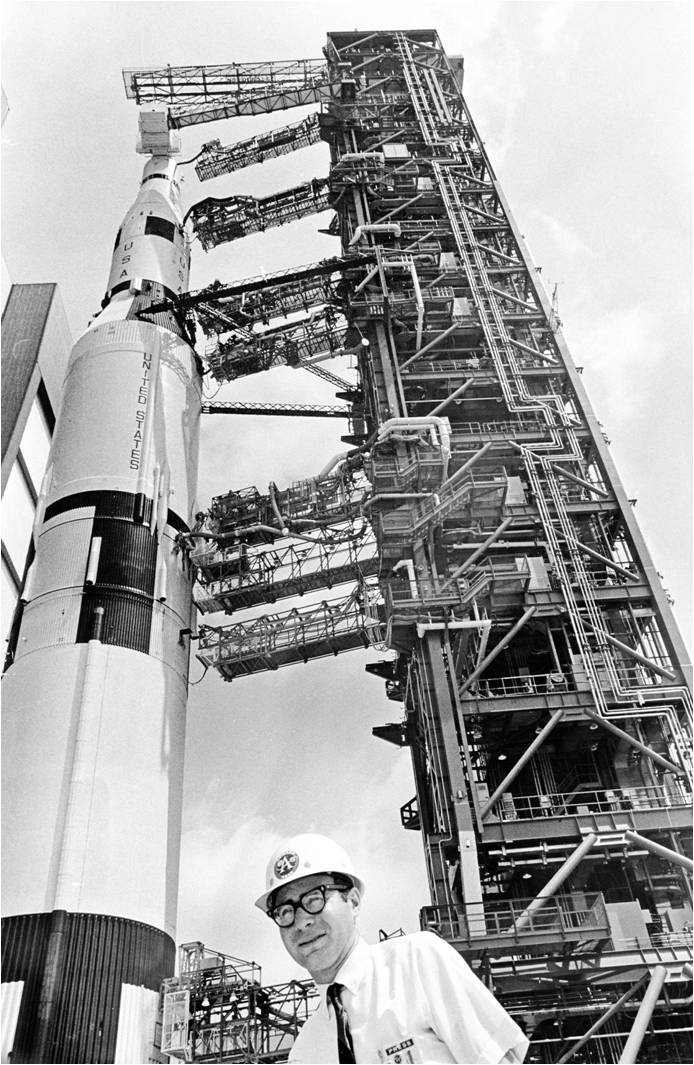
Blog author Steve Milner with a full-scale, non-flyable Apollo/Saturn V space vehicle used to perform fit checks and mobile launcher connections, November 1967.

Sixty-five years ago, on January 31, 1958, the United States entered the space age when it successfully launched and orbited Explorer I, our nation’s first earth satellite. This 30-pound payload was launched by the Army’s Redstone rocket as the first stage of the four-stage vehicle. This payload included scientific instruments that, among other measurements, discovered an inner radiation belt around earth named for its prime researcher, Dr. James Van Allen. And incredibly, less than 11 years later, Neil Armstrong and Buzz Aldrin landed on the moon and returned safely to earth, fulfilling President John Kennedy’s directive issued in May 1961—to achieve this monumental task ahead of the Soviet Union. But we were initially playing catch-up, because the Russians had already dazzled the world by launching Sputnik, the first earth satellite, in October 1957, nearly four months ahead of Explorer I. In doing so the Soviets used a powerful military rocket for the “push” needed to send a satellite into earth orbit.

At that time the U.S. had the rocket hardware and the smarts to beat the Soviets, but President Dwight Eisenhower wanted to show the world we would, instead, pursue space exploration by not using a proven military launch vehicle. Eisenhower’s idea was a noble one but not from a public relations standpoint—and the Soviets capitalized on their beeping Sputnik, orbiting earth every 90 minutes, repeatedly signaling its dominance in space.

Instead, the U.S. tried to launch its Vanguard satellite, using a much less powerful and unproven rocket. I clearly remember watching on live television as Vanguard exploded on its launch pad at Cape Canaveral on December 4, 1957. (The first successful Vanguard was launched from the Cape two months after the Army’s Explorer I launch.)

Three key persons involved in the successful Explorer I launch were, left-to-right: Jet Propulsion Laboratory Director, Dr William Pickering; Dr. James van Allen of the University of Iowa; and Dr. Wernher von Braun of the U.S. Army Ballistic Missile Agency. (U.S. Army)

Finally, the United States switched gears and tasked Dr. Wernher von Braun, the former World War II German rocket engineer, and his Peenemunde team, along with U.S. engineers, to use the Redstone missile as the Jupiter-C’s first stage to launch our first earth satellite.

A modified Jupiter-C used a Restone rocket as its first stage to launch America’s first earth satellite, Explorer I, on January 31, 1958. The UE designation was a once-classified code that designated the specific Redstone used for this mission. (NASA)

Explorer I resembled a rolling pin in shape and was nearly eight feet long and six inches in diameter. It transmitted data to earth and orbited every 115 minutes. At its farthest point from earth, Explorer I’s apogee was more than 1,500 miles. At its closest point, or perigee, it orbited 225 miles above earth.

Explorer I transmitted data for about four months after it was orbited, and remained silently in orbit for another 12 years. It reentered the earth’s atmosphere on March 30, 1970, and burned up.

Artist's concept of Explorer I (U.S. Army)

During the past 65 years, the U.S. has successfully launched a variety of satellites whose contributions we take for granted. These include those used for worldwide communications and weather forecasting, as well as for the global positioning (GPS), a setting we have on our phones. And there have been many spinoff products developed during our U.S. space program, in addition to significant advancements in computer technology.

As a NASA public affairs contractor at Kennedy Space Center and Cape Canaveral (then temporarily renamed Cape Kennedy), I was privileged to have worked with some members of the Explorer I launch team a decade later.


Editor’s Note: In addition to serving as the public affairs officer for 17 years at Norfolk Naval Shipyard, Steve Milner was a NASA public affairs contractor at Kennedy Space Center and Cape Canaveral for nearly a decade, during the manned Gemini, Apollo, and Skylab programs.

Friday, July 24, 2020

Seventy Years Ago: Bumper 8 to Outer Space, Part Two


The Bumper 7 first stage, essentially a captured German V-2 with a new paint job to aid in visual ranging, sits on its Army transporter at Cape Canaveral, a far cry from the custom made crawler that would make its appearance at the Cape only a little over 15 years later for the Saturn Program. Note the insulating blanket around the rocket to keep its cryogenic fuel as cold as possible.  (NASA Alumni League, Florida Chapter)

By Steve Milner
Contributing Writer

Bumper 7 was scheduled to be launched on July 19, 1950, but misfired when some of its components had become corroded by the Atlantic Ocean’s salt air. A local newspaper described this launch abort, according to noted aerospace author L.B. “Bob” Taylor, in his 1968 book, Liftoff. I had the pleasure of working with Taylor at the Cape and Kennedy Space Center, and later for him for nearly a decade in Williamsburg, Virginia, for one of the world’s largest chemical companies. He might be better known for his many Ghosts of Virginia books.

In reporting this first launch attempt at the Cape, the newspaper story noted:


An attempt will be made again next week to launch a reluctant rocket which never got off the ground in nine trying hours today. Just about everything that could go wrong with the first experiment in low-angled firing of a guided missile did. When they finally got around to pulling the firing switch on the giant device, it produced only a popping noise hardly worthy of a champagne cork.

About 100 news personnel attended this first launch attempt, which also featured another aerospace-history first: Most of the few families that lived at the Cape in fishing camps and oceanfront houses, left temporarily when the Army directed them to do so prior to launch day. But one holdout, an elderly woman, refused to leave her house and held authorities at bay with a double-barreled shotgun, according to Taylor in his book. The Cape’s fire chief, Norris Gray, knew the woman and pleaded with her to leave. Despite his efforts, she refused and Gray, who knew the shotgun wasn’t loaded, carried her over his shoulders to a safe area. Gray later worked at the Cape for many years while it was becoming the nation’s foremost launch site.

While Bumper 7 was being repaired, the Army team launched Bumper 8 from the same complex at 9:29 a.m. on July 24. Nine days later, Bumper 7 was successfully launched.

Workers fuel a WAC Bumper second stage as Army officers mill about in the background on July 27, 1950. (NASA Alumni League, Florida Chapter)

Personnel serviced the five-story Bumper 8 rocket by climbing a shaky Rube-Goldberg-like gantry configuration, pieced together from house painters’ scaffolding. Disappointed by Bumper 7’s scrub, only about 25 news personnel showed up to watch the Bumper 8 launch.


Launch personnel move the "missile stand," essentially commercial construction scaffolding appropriated for the purpose, into position around Bumper 7 on July 27, 1950, in preparation for its second flight attempt.  (NASA Alumni League, Florida Chapter)
At the zero mark in the countdown, Bumper 8—fueled by alcohol and liquid oxygen—belched huge billowing clouds of exhaust, as it lifted off skyward. Some 56,000 pounds of thrust pushed it to an altitude of ten miles and 15 miles downrange. The rocket then leveled off horizontally while traveling at a speed of 3,000 miles an hour. And after about a minute of flight, the second stage WAC-Corporal ignited and separated from the spent booster in the first known horizontal two-stage rocket firing. The WAC-Corporal traveled 80 miles downrange from the Cape, before it was deliberately destroyed by on-board explosives. U.S. Navy ships in the Atlantic recorded launch telemetry information, augmented by Cape tracking equipment. Air Force planes also monitored data in the launch area.


Bumper 8 at the moment of ignition on July 24, 1950.  The image was probably taken from the blockhouse (which was also known as the firing room), which allowed an indirect view of Pad 3 through a reflex mirror, which caused the reflection on the left-hand side of the image. (NASA Alumni League, Florida Chapter)
A few daring reporters and photographers stood on a dirt mound in front of the 1950 version of a rocket’s control center and documented the flight. Others, including the public, watched the Bumper 8 launch from several miles away offsite. It was understandable that some of the viewing public mistook the Cape Canaveral lighthouse for the rocket.

With the successful launches of Bumpers 7 and 8, the Army, Navy and Air Force tested numerous missile systems there during the next few years. On May 5, 1961, less than 11 years after these first two missions took place, astronaut Alan Shepard, , was launched on a Mercury-Redstone space vehicle on a 15-minute suborbital flight from the Cape, rocketing America into the manned space age. 


Editor's Note: In addition to serving as public affairs officer for 17 years at Norfolk Naval Shipyard, Steve Milner was also a public affairs contractor with the National Aeronautics and Space Administration at Cape Canaveral during the manned Gemini, Apollo and Skylab programs.

Thursday, July 16, 2020

Seventy Years Ago: Bumper 8 to Outer Space, Part One


A new chapter in space flight began on July 24, 1950, with the launch of the first rocket from Cape Canaveral, Florida: the Bumper 8. Shown above, Bumper 8 was an ambitious two-stage rocket program that topped a V-2 missile base with a WAC Corporal rocket. The upper stage was able to reach then-record altitudes of almost 400 kilometers, roughly the altitude the International Space Station orbits today.  Launched under the direction of the General Electric Company, Bumper 8 was used primarily for testing rocket systems and for research on the upper atmosphere. Bumper rockets carried small payloads that allowed them to measure attributes including air temperature and cosmic ray impacts.  Note how close those recording the event are standing to the launch pad, while the person who photographed this scene wisely decided to stay further back, possibly behind the original blockhouse, which was also known as the Firing Room. (NASA on the Commons/ Image Number: 66P-0631)

By Steve Milner
Contributing Writer

When Bumper 8, the first rocket to roar aloft from Cape Canaveral, Florida, took to the skies on July 24, 1950, its success was due to a combination of American ingenuity and the technology and hardware developed by Germany’s engineers, technicians and scientists during World War II. Only six years before, these same expatriates were working for the Schutzstaffel, producing and launching deadly ballistic missiles to rain down 1,600-pound warheads on London.

I wasn’t able to document how many—if any—of the former German wartime rocketeers attended this first Cape launch. But it’s thought that the top-level team, including its leader, Dr. Wernher von Braun, was busy at that historic moment relocating their operations from the White Sands Missile Proving Grounds in New Mexico to its permanent headquarters at the U.S. Army’s Redstone Arsenal in Huntsville, Alabama.

Six German V-2 missiles, topped by U.S. Army WAC-Corporal rockets in a program managed by General Electric, were launched at White Sands. But a longer firing range was needed, and Cape Canaveral was selected due to its location, year-round mild weather conditions and its relationship to the earth’s rotation. (Launching rockets eastward takes advantage of the earth’s maximum centrifugal rotation at the equator). Jutting into the Atlantic Ocean, it was a favorable place from which to launch rockets more safely for both the Cape communities and downrange areas.

In 1564, Spaniards named Cape Canaveral, which in their language means a field of cane. Today, the Air Force operates Cape Canaveral, while the National Aeronautics and Space Administration is in charge of the nearby Kennedy Space Center, across the Banana River on Merritt Island. The Air Force Eastern Test Range headquarters is located at Patrick Air Force Base at the U.S. Navy’s former Banana River Naval Air Station that operated during World War II.

The first two rockets launched from the Cape were Bumpers 7 and 8, so named because their first stages, modified captured German V-2 missiles, literally “bumped” the second stage WAC-Corporals into their own flight paths. These components were sent by truck from New Mexico to the barren Cape, which was overrun by mosquitoes, poisonous snakes and alligators.

This 1950 image shows a Bumper V-2 on it’s launch stand on Pad 3, with the Firing Room, a frame building in a bunker at lower right. Pad 4 will be built to the lower left and pads 1 and 2 to the upper right. (NASA Alumni League, Florida Chapter)
Despite these obstacles, workers fabricated a primitive launch complex. Over the years there was disagreement in Cape folklore about how extensive this facility was. It was named Launch Complex 3, because its counterparts, 1, 2, and 4 were still being built. One school of thought was that it consisted mainly of a 100-square-foot concrete slab and a converted bathhouse that served as a blockhouse, located only about 300 feet from the launch pad. Experts later determined this control center wouldn’t have withstood an explosive launch mishap. Additionally, under this version, control wires from the blockhouse were run above ground to the slab, and water for fire protection was pumped from a nearby pond.

Conversely, the other school of thought was that Launch Pad 3 was more than a bare concrete slab and a converted bathhouse; instead, it was well-designed and built. It was constructed on an eight-foot-deep hole in the Florida sand and had underground access tunnels and an equipment room. It also had an elaborate water deluge system and a catch basin to trap any spilled liquid rocket fuel. Crews could access these underground areas through hatches built into the launch pad. In 1998, volunteers from the Air Force Space and Missile Museum at the Cape discovered the Launch Pad 3 concrete slab, which had been totally covered by sand over the years. They also found the last surviving hatch, along with the underground equipment chamber, which flooded during the Atlantic Ocean’s high tides.

As for the blockhouse being a converted bathhouse, according to Cape folklore, the Army, instead, had built a small wooden structure that was lined on the outside with a grayish silver material designed to reflect sunlight and help to cool its interior. Blockhouse personnel viewed the two Bumper launches through a mirror-like window. Hundreds of sandbags were stacked in front of the blockhouse for added protection for personnel working inside.

There’s also a discrepancy as to the blockhouse’s distance from the launch pad. As noted earlier, the converted bathhouse was thought to be 300 feet away from it, while a second version had the specially constructed blockhouse at 500 feet.

In the year 2000, some surviving Bumper veterans attended a reunion at Pad 3, reminisced about these two missions and launched a Bumper model rocket. This group also included personnel from the former U.S. Army laboratory at California Institute of Technology that developed the upper-stage WAC-Corporal rocket and other high-altitude vehicles. When the space agency was formed in 1958, JPL became a NASA laboratory that’s still operated by Caltech. 

Editor's Note: In addition to serving as public affairs officer for 17 years at Norfolk Naval Shipyard, Steve Milner was also a public affairs contractor with the National Aeronautics and Space Administration at Cape Canaveral during the manned Gemini, Apollo and Skylab programs.

Friday, November 22, 2019

Philadelphia-born Astronaut Pete Conrad was a ‘Hoot,’ and a Great Pilot


 On August 29, 1965, Astronaut Charles "Pete" Conrad Jr. is hoisted up to a Navy helicopter while astronaut L. Gordon Cooper Jr. waits in a life raft below after the splashdown of the Gemini-5 spacecraft. (NASA Photograph S65-51659)

By Steve Milner
Contributing Writer

I didn’t know astronaut Pete Conrad very well when I worked at Cape Canaveral and Kennedy space Center. I’d see him training for his various space missions, or relaxing somewhere in the Florida Spaceport area. Regardless of the location, he was always approachable and friendly during those times.  

I was contracted to the NASA Public Affairs Office for about eight years. And among my editorial duties was writing most of the Apollo mission photo captions in real-time–from training through splashdown and saw different aspects of Conrad and his Apollo 12 crew, Dick Gordon and Alan Bean. But Conrad and I did have some things in common: We were both from Philadelphia–he was from the up-scale Main Line and I grew up “across the tracks” in less-affluent South Philadelphia; we were both five-foot-six inches tall, bald; and looked a little alike from a distance. But that’s where the similarities ended—he flew jet planes and spacecraft, and I get dizzy on a Ferris wheel.

Astronaut Alan L. Bean, lunar module pilot, is assisted with egressing the Apollo 12 Command Module by a U.S. Navy underwater demolition team swimmer during recovery operations in the Pacific Ocean on November 24, 1969. Already in the life raft are astronauts Charles "Pete" Conrad Jr., commander; and Richard F. Gordon Jr., command module pilot. The three crewmen of the second lunar landing mission were picked up by recovery helicopter and flown to the prime recovery ship, USS Hornet (CVS 12). The Apollo 12 splashdown occurred at 2:58 p.m. (CST), November 24, 1969, near American Samoa. While astronauts Conrad and Bean descended in the Lunar Module (LM) "Intrepid" to explore the Ocean of Storms region of the moon, astronaut Gordon remained with the Command and Service Modules (CSM) "Yankee Clipper" in lunar orbit. (NASA Photograph S69-22265 via Naval History and Heritage Command Photo Curator Flickr)
The recovery ship USS Hornet (CVS 12) hoists the Apollo Twelve Command Module aboard. The spacecraft splashed down less than three miles from the anti-submarine support carrier in the Pacific Ocean, southeast of the island of Samoa, on November 24, 1969. (Naval History and Heritage Command image)
Drawing, Pencil on Paper; by Paul D. Ortlip of the Apollo 12 Command Module being hoisted aboard the anti-submarine support carrier Hornet after its successful return from the moon on November 24, 1969. (Navy Art Collection)
Rear Admiral Donald C. David, Commander, Manned Spacecraft Recovery Force, Pacific, welcomes the crew of  Apollo 12 aboard USS Hornet (CVS 12) on November 24, 1969.  Inside the Mobile Quarantine Facility are (left to right) astronauts Charles "Pete" Conrad, Jr., mission commander; Richard F. Gordon, Jr., command module pilot; and Alan L. Bean, lunar module pilot. Note the "Three More, Like Before" sign where "Hornet +3" was posted after the Apollo 11 mission. After Apollo 14, the requirement for returning astronauts to be quarantined was lifted. (NASA Photo S69-22876 via Naval History and Heritage Command Photo Curator/ Flickr)
Admiral Thomas H. Moorer, Chief of Naval Operations, (left), accepts his personal flag from the three Apollo 12 astronauts who carried it with them during the moon mission.  Admiral Moorer also presented them with the Distinguished Service Medal.  Left to right: Captain Charles "Pete" Conrad, Captain Richard Gordon and Captain Alan Bean.  (U.S. Navy photograph 428-GX-USN 1042856, now in the collections of the National Archives via Naval History and Heritage Command Photo Curator Flickr)
Conrad was a well-known jokester when he wanted to be, but certainly was a highly skilled, cool-headed pilot, whether he was flying a fighter jet on earth or a spacecraft a quarter-of-a-million miles away in space. When I saw a huge lightning bolt strike his Apollo 12 Saturn V rocket while it was lifting off from Kennedy Space Center’s Complex 39A, on November 14, 1969, and heard his calm radio transmissions when he reported on-board situational reports to Mission Control, I knew he was the perfect guy to handle that unforeseen and potentially dangerous situation. Fortunately, Apollo 12 was a successful lunar mission.
Steve Milner and Charles "Pete" Conrad after Conrad spoke at the Virginia Air and Space Center in Hampton, Virginia, about 1994. (Photo by Pete Westerman/ Courtesy of Steve Milner)
Fast forward about 25 years from that dreary launch day. After I had relocated in our local Virginia area, I saw Conrad for the next and last time. He had given a talk at the Hampton Air & Space Center, where his Apollo 12 spacecraft is still exhibited. After this event he and I reminisced briefly about Cape days. At that time, he kindly signed a photo I had brought with me of his Skylab Workshop being transported to the Spaceport’s Complex 39A in 1973. He died at 69, following a motorcycle accident in California in 1999.
Apollo 12 Command Module Pilot Richard Gordon talks with blog post author Steve Milner's wife Enid during a Manned Flight Awareness event on January 30, 1971, the evening before Apollo 14 was launched to the moon with astronauts Alan Shepard, Stuart Roosa, and Edgar Mitchell.  The event was held to honor personnel for their contributions to the space program. (Courtesy of Steve Milner)
Years earlier I, and other honorees, socialized with his Gemini 11 and Apollo 12 crewmate, Dick Gordon, when he greeted us at NASA’s Manned Flight Awareness reception on January 30, 1971. It was held in Cocoa Beach, Florida, the night before the launch of Apollo 14 astronauts Alan Shepard, Stuart Roosa and Edgar Mitchell to the moon. I was pleased to be my company’s Spaceport honoree, based on my work performance. Gordon was friendly to honorees and their families and spent time individually with everyone, thanking us for our contributions to the nation’s space program. Other astronauts and celebrities attended this event. Honorees and their guests watched the launch of Apollo 14 the next day from the Spaceport’s VIP site, along with then President Richard Nixon. While my wife attended the VIP site, I had to work on launch day, documenting and writing related NASA photo captions. This task began with photos of the astronauts’ breakfast activities, their suiting up for their flight, their transfer to the launch pad, their entering their spacecraft and, finally, to their launch on a Saturn V rocket at the start of their mission to the moon.
(Courtesy of Steve Milner)
Even though these events took place 50 years ago, I still recall them vividly. And I’ve always been grateful to have had a front-row seat, and be part of an aspect of America’s important history as it unfolded.

Editor's Note: In addition to serving as public affairs officer for 17 years at Norfolk Naval Shipyard, Steve Milner was also a public affairs contractor with the National Aeronautics and Space Administration at Cape Canaveral during the manned Gemini, Apollo and Skylab programs.

Saturday, November 16, 2019

The Space Sailors of Apollo 12, Before and After

Apollo 12 astronauts (from left) Pete Conrad, Richard Gordon and Alan Bean pause by a T-38 training aircraft at Patrick Air Force base the day before they were launched to the moon.  Each pilot spent nearly an hour aloft that day in individual aircraft, practicing aerobatics in preparation for their space flight. (NASA photo courtesy of Steve Milner)
By Steve Milner
Contributing Writer

Apollo 12 was an all-U.S. Navy crew. The astronauts had been test pilots at Patuxent River Naval Air Station in Maryland.  Pete Conrad then flew in earth orbit aboard Gemini 11 with Richard Gordon, after being launched on September 12, 1966. Conrad and Gordon had roomed earlier aboard USS Ranger (CV 61) from which they flew flight operations. From the outset, the two had established a close personal friendship that continued through Apollo 12 and beyond. Conrad had wanted Gordon to land on the moon with him, but astronaut rules dictated that a command module pilot had to have flown in space previously and Bean was a space rookie.
Lieutenant Commander Richard F. Gordon Jr., prime crew pilot for Gemini-Titan XI (GT-11), and Commander Charles "Pete" Conrad Jr., prime crew command pilot, pose for their official mission photograph on November 4, 1965. (NASA photo S65-58504 via NHHC Photo Curator/Flickr)
Compared to his two crewmates who were considerably more outgoing and known throughout the astronaut corps for speaking their minds, Bean was an introvert. All three astronauts would establish a solid friendship that continued back on earth for many years.
The Apollo 12 lunar Extravehicular Activity (EVA) crew members, Charles "Pete" Conrad and Al Bean conduct a simulation of the lunar surface activity at a training session held in the Flight Crew Training Building at the Kennedy Space Center on October 6, 1969. (NASA photo 69PC-0549 via NASA on the Commons/Flickr)
In my limited dealings with Conrad I found him to be cordial, when I worked at Cape Canaveral and was involved in the photo aspects of Apollo 12 and when I saw him at Hampton’s Air & Space Center (today home to the Apollo 12 command module) about 25 years after his lunar mission.  At that time we reminisced about the “good old days” at Cape Canaveral and Cocoa Beach. During our Hampton conversation he autographed my photo of his unmanned Skylab Workshop being transported to the launch pad (sitting in place of the third stage of the earlier moon-bound Saturn Vs) in 1973.
A modified Saturn V carries the Skylab orbital workshop into orbit in May 1973.  Over the course of its human occupation from May 25, 1973, to February 8, 1974, three crews visited Skylab, carried out 270 scientific and technical investigations and logged a combined 171 days on orbit.
Conrad was launched on the Skylab I mission aboard a Saturn 1B rocket (known as Skylab 2) with another all-Navy crew consisting of Paul Weitz and Joseph Kerwin from KSC’s Launch Complex 39B on May 25, 1973. The trio spent 28 days in the Skylab Workshop, conducting many medical and other experiments. 
Each of the three crewed Skylab missions from May 1973 to 1974 were staffed by three astronauts. Since these were the longest missions ever conducted in low Earth orbit up to that time, one of the top science priorities was to collect medical data on the effects of long spaceflights on humans.  Astronaut Joseph P. Kerwin, science pilot for the first manned Skylab mission and a medical doctor, conducted a physical exam for Astronaut Charles "Pete" Conrad, Jr., the Skylab I mission commander.  Kerwin conducted the exam in the crew quarters wardroom of the orbital workshop developed by the NASA's Marshall Space Flight Center in Huntsville, Ala, which also built equipment used for research. Conrad almost literally stands on his head in the weightlessness of space with only a restraint around his left leg holding in position. (NASA Marshall Space Flight Center/ Flickr)
Conrad was selected in the second group of astronauts and was widely regarded in the aerospace community and the astronaut corps as being quirky, comedic and an unpredictable person. But the overall consensus was that he was a top-flight pilot and aeronautical engineer. He had a confident manner that he sharpened during his test-pilot days, a trait that probably calmed his crewmates during difficult in-flight conditions.
Astronaut Charles "Pete" Conrad, Jr., Skylab I commander, smiles happily for the camera after a hot shower in the crew quarters of the orbital workshop of the Skylab space station on June 1, 1973. (NASA Marshall Space Flight Center/ Flickr)
Despite Conrad’s well-known colorful side and sometimes questionable language, this Princeton graduate knew how “to behave” when the situation called for him to do so. Even though NASA officials weren’t sure what he would tell the world when he first set foot on the lunar surface, they still didn’t prepare momentous words for him to recite.  In fact, noted Italian journalist Oriana Fallaci bet Conrad $500 that NASA would write his comments. Conrad said his would be original ones and he won this bet, but was never paid the $500, he said. Fallaci was visiting the Conrad family when she made the bet. (I remember attending a NASA news conference in Cocoa Beach prior to a different space mission that Fallaci and her good friend, actress Shirley MacLaine, attended).

The mission patch of Skylab I, emphasizing the harshness of space, was spot-on considering that the station was originally too hot to sustain human life. After launching to the station aboard a Saturn IB on May 25, 1973,  Astronauts Charles C. "Pete" Conrad, Paul J. Weitz and Joseph Kerwin made critical repairs to damage sustained when the station was launched, saving the program.  The mission included three spacewalks and lasted 28 days–twice the previous record for an American manned space mission–when it ended on June 22. (NASA on the Commons/ Flickr) 

Following their successful Apollo 12 mission, Conrad moved on to the Skylab Workshop program and commanded the first manned mission to it. When he retired from NASA and the U.S. Navy with the rank of captain, he worked for several aerospace firms and founded one that was trying to develop reusable space hardware. He tragically died at the age of 69, following a motorcycle accident in Ojai, California, on July 8, 1999. While appearing to be okay following this accident, he died a few hours later due to massive internal bleeding. Conrad is buried at Arlington National Cemetery and is remembered for his four successful space missions: two during the Gemini Program, Apollo 12 and Skylab I, logging nearly 1,200 hours in space.

Gordon remained with NASA and was the backup commander for the Apollo 15 mission. At that time Gordon thought he would command a future Apollo mission, possibly Apollo 18, which was later canceled, along with Apollo 19 and 20, due to budgetary constraints. He stayed in the Astronaut Office and helped design crew aspects for the Space Shuttle.
Captain Richard F. Gordon, USN, photographed in his Apollo 12 space suit before his mission in November 1969.  (Johnson Space Flight Center)
Gordon, who was selected in the third group of astronauts, grew up in Seattle and attended the University of Washington, where he received a bachelor’s degree in chemistry. Flying in the Apollo 12 command module alone, he orbited the moon 45 times and kept it flight ready for his crewmates to return from the lunar surface. Gordon logged nearly 316 hours in space, including his time as a Gemini 11 astronaut. He retired from the Navy as a captain and later had a varied business career, including being executive vice president of the New Orleans Saints football team. Gordon was 88 when he died and is buried in Arlington National Cemetery.
The crew of Skylab II (from right to left): astronaut Alan L. Bean, foreground, commander; scientist-astronaut Owen K. Garriott, left, science pilot; and astronaut Jack R. Lousma, pilot. This crew spent 59 days and 11 hours in orbit. (NASA on the Commons photo 72-HC-90/ Flickr)
Like Gordon, Bean thought he would command a future Apollo mission that eventually was canceled. Next, Bean trained for the second crewed flight to the orbiting workshop, Skylab (Skylab 2). He was launched to it on a Saturn 1B rocket with new astronauts Owen Garriott and Jack Lousma from Kennedy Space Center’s Complex 39B on July 28, 1973. Bean was chosen in the third astronaut group and had a bachelor’s degree in aeronautical engineering from the University of Texas at Austin. He logged more than 1,500 of space flight. He retired from the Navy as a captain and became an artist more than a decade after he had landed on the moon with Conrad. Most of Bean’s popular artwork depicted highlights of Apollo missions. He died on May 26. 2018, at the age of 86 and is buried at Arlington National Cemetery.
Astronaut Alan L. Bean, commander of the second Skylab crew, participates in the final extravehicular activity (EVA) of that mission, during which a variety of tasks were performed. Here, Bean is near the Apollo Telescope Mount (ATM) during final film change out for the giant telescope facility. Astronaut Owen K. Garriott, who took the picture, is reflected in Bean's helmet visor. The reflected Earth disk in Bean's visor is so clear that the Red Sea and Nile River area can delineated. (NASA image SL3-122-2612 via NASA on the Commons/ Flickr)
Apollo 11 might be better known as our nation’s first manned lunar-landing mission, but Apollo 12 pioneered a number of its own notable firsts.

Editor's Note: In addition to serving as public affairs officer for 17 years at Norfolk Naval Shipyard, Steve Milner was also a public affairs contractor with the National Aeronautics and Space Administration at Cape Canaveral during the manned Gemini, Apollo and Skylab programs.