Showing posts with label Age of Sail. Show all posts

Thursday, December 16, 2021

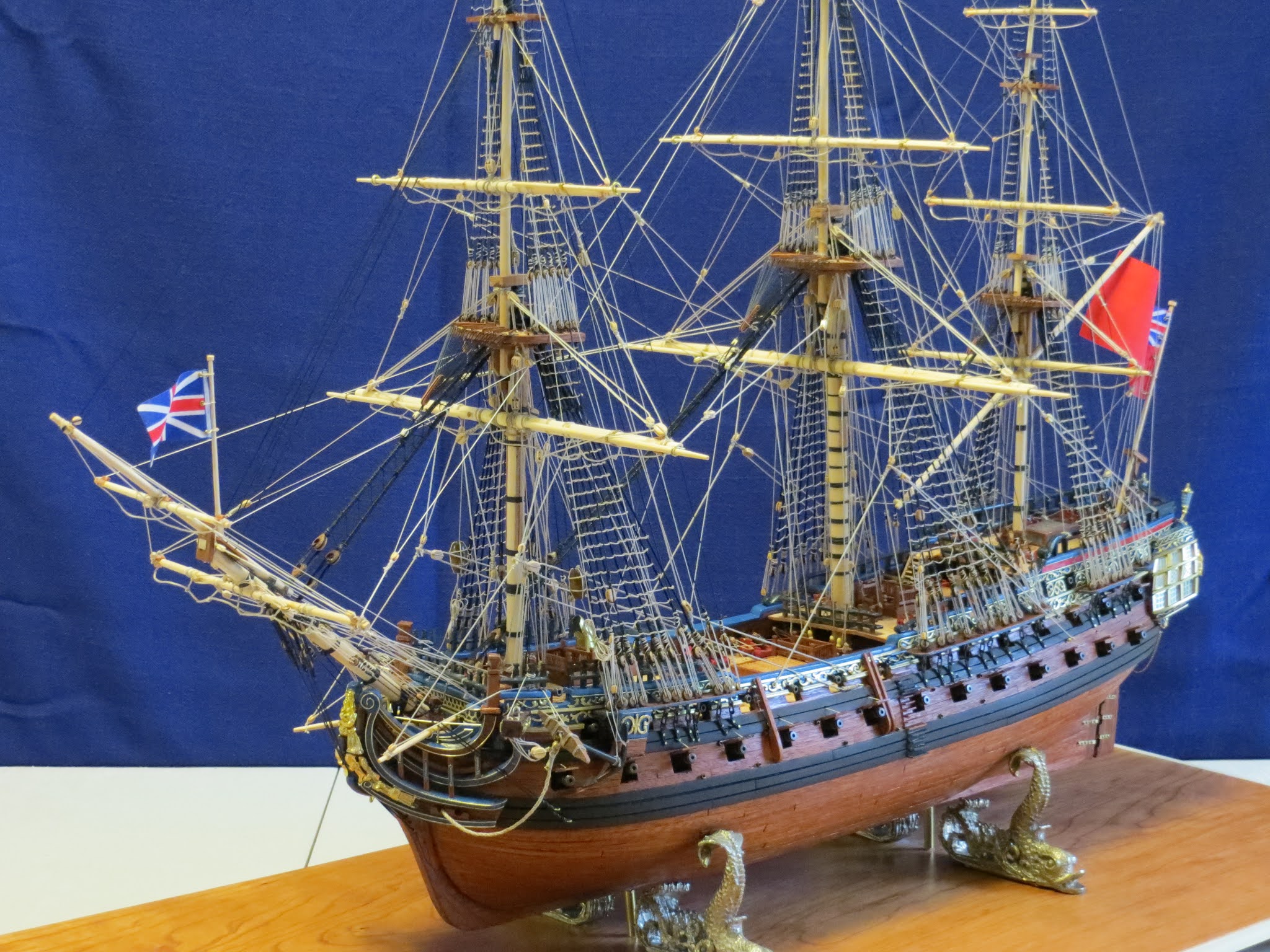
Building the HMS Bellona

By Lee Martin
HRNM Volunteer and Model Builder
Lee Martin with HMS Bellona (Photo by Max Lonzanida)
When I was a youngster growing up in Boston right after World War II, building models from wood was more popular than it is now. I was especially interested in the square rigger ships, in particular liking the complexity of the rigging. Among the models I made were the Golden Hind and the Constitution, all with solid balsa hulls. Then I hit "pause" for 50 years to raise a family and manage my career as a computer programmer. After those responsibilities concluded, I resumed modeling square riggers, this time with the plank-on-frame method (which mimics the construction technique of the actual ships), using hard woods like mahogany that produce more realistic results.

The Golden Age of Sail extended from 1600 to 1800 and that is the historic period that appeals to me the most: when ships were both the "high tech" of the era and were heavily decorated as status symbols. Over the past 14 years, I completed nine models at home and two more as an HRNM docent. I am drawn to the ships of England and France, major players throughout this two-hundred-year Golden Age period.

When selecting a model to build, I look for one that will make an attractive finished product and that has enough detail to keep me interested. HMS Bellona scored well on both of those requirements.
HMS Bellona (Lee Martin)
Historical Background
By the mid-1700s, Europe's two primary antagonists—Britain and France—were locked in a contest for naval supremacy. Their warships kept getting bigger to increase their firepower, but as they did, their cost increased while their maneuverability decreased. The naval establishments of both countries eventually reached the same conclusion: the best compromise between the three competing factors of firepower, cost, and maneuverability was the 74-gun ship. The British built several of various configurations. The one that worked out the best was Bellona, launched in 1760 and named after the Roman goddess of war. With only minor adjustments to the shape of the hull, Bellona became the prototype for 40 more ships. They, in turn, became the backbone of the Royal Navy through the Napoleonic Wars.
In August 1761, HMS Bellona captured the French ship Courageux (Wikipedia)
Bellona's decks were 168 feet long with a crew of 650 officers and men. Its armament, working from the lower decks upward, consisted of twenty-eight 32-pounders on the gun deck, twenty-eight 18-pounders on the top deck, fourteen 9-pounders on the quarterdeck, and four 9-pounders on the forecastle.

In 1780, Bellona was taken into drydock and became one of the first ships to have its bottom coppered. A contemporary model of the coppered Bellona in the British Museum was expressly built to demonstrate to King George what was meant by this new innovation called "coppering." On June 22, 1807, Bellona and HMS Leopard were part of a British squadron anchored in Lynnhaven Bay to buy supplies and search for deserters from the Royal Navy. Later that day, the 52-gun Leopard attacked the 38-gun American ship, USS Chesapeake, over suspicions that it harbored deserters. The incident became one of the rationales for the United States declaring war on Britain in 1812.

HMS Bellona makes a literary appearance in the Patrick O'Brian novels The Commodore and The Yellow Admiral as the lead ship (aka the "pennant ship") of a squadron commanded by the character Jack Aubrey.
Close-up view of HMS Bellona (Lee Martin)
Construction
The model is built on a frame with strips of mahogany forming its hull, a construction technique similar to that of the original ship. The model's hull, following the original specifications, is not coppered. The waling is ebony. The scale is 1:100. The model took about two years to complete. The dolphins supporting its sides are castings of actual model mounts from the 1700s.

Following the custom of the time, the ship is decorated from stem to stern. It was the British practice to employ local craftsmen to design, fabricate, and install most of this decoration themselves using their own creativity. Consequently, except for the figurehead and stern, details of the decorations have not survived. The scroll work along the sides of the model is my attempt to simulate the craftsmen's efforts.
Stern of HMS Bellona (Lee Martin)

Thursday, December 18, 2014

Museum Profile: Lee Martin, Resident Model Shipwright

Model shipwright Lee Martin pauses while constructing the brig Alexander at his work table in the Hampton Roads Naval Museum's main gallery.  
No museum dealing with naval history is complete without its models of those tall sailing ships of old.  Yes, it would be nice to have full-size ships like the battleship Wisconsin, located just outside our museum, to help illustrate each part of the story we tell about the Navy in Hampton Roads.  But we just don’t have room for more than one of those.  This is where people with a passion for model shipbuilding make all the difference; people like Lee Martin.
Lee has been the resident model shipbuilder for the Hampton Roads Naval Museum for about two and a half years now.  He learned about the museum’s need for a model shipwright (a person who builds, repairs and/or designs model ships) while a member of the Hampton Roads Ship Model Society, which meets at the Mariners’ Museum in Newport News.  He now volunteers his time doing live demonstrations of his art at the Hampton Roads Naval Museum.
Lee Martin trims mahogany floorboards for the deck of a brig originally conceived by the model’s makers as the Blue Shadow, but, Martin said, there is no historical authenticity to the name, concluding that “they made it up.”  He has “rechristened” his current project the Alexander, representing a brig built in Baltimore around 1780
Like any other experienced shipwright, Lee possesses knowledge of the arcane terminology and specialized techniques of a bygone era that he enthusiastically shares with visitors, fellow volunteers and staff members.  Talking to Lee, and watching him work, his love of model ship building is obvious.  This could lead one to think he must have spent most of his life working on or around ships.
You would be wrong.
This specialist in centuries-old building techniques actually spent most of his life at the forefront of high technology as a Navy civilian working in computers.  He started out programming IBM mainframe computers in the 1970’s for the F-14 Tomcat fighter program and ended his career helping the military develop aircraft inventory and maintenance programs for desktop computers.  So, with all this time working with computers and military aircraft, why the interest in model shipbuilding?  Like so many who have a love of similar art forms, Lee's answer is simple: “I just always had an interest in model ships."
One of the ships Lee is currently working on is HMS Bellona.  The 74 gun “Ship of the Line” was so successful for the British Navy it became the prototype for a whole class of ships known as the Bellona class.  “Ship of the Line” referred to warships usually having 50 guns or more.  They were the battleships of their time.  Lee expects to spend over 800 hours building the model, which means it will take some time to complete, as he only works on it when he can.  He is also working on another ship, the US Navy Brig Alexander, within the museum gallery.
Lee Martin trims mahogany floorboards on the foredeck of his latest creation, the brig Alexander.
For the museum visitor who wants to see the model ship building process first hand, Lee sets up a work table inside the museum where interested visitors can watch and ask questions.  Lee enjoys answering visitor questions, demonstrating the tools and techniques of the trade and showing photographs of other ships he has worked on. 
The schooner Black Prince. 
Just putting together a ship from a kit isn’t good enough for a passionate model shipwright like Lee.  He does research to find out as much as possible about the ship and orders special woods from different suppliers to get just the right look.  With no photographs of ships in the 1700’s, and changes being made to ships throughout their life, we don’t always know exactly what a ship looked like. According to Lee, “You have to take written descriptions from the time period and compare them to similar ships of the era that we do know what they looked like.”  Only then can you get an accurate model.

If you can’t get by the museum on a day Lee is here, a completed example of his work is on display just inside the entrance.  The schooner Black Prince was a privateer commissioned by the American government during the Revolutionary war.  Privateers were privately owned ships contracted by governments to attack enemy shipping, both military and commercial.  The Black Prince and her sister ship the Black Princess were ships Benjamin Franklin bought from the French and had outfitted as Privateers.  It took Lee over 450 hours, spread over almost two years, to complete this ship.
As a volunteer, Lee doesn’t have a set work schedule, but he usually shows up every other Thursday.  So, if you want to watch him creating one of his works of art and ask him questions, which he enjoys answering, stop by the museum often.  You can also call ahead to find out when he will be here at (757) 322-2987.  And as usual, entrance to the Hampton Roads Naval Museum is always free.
Story by Hampton Roads Naval Museum Educator Jerome Kirkland

Wednesday, July 10, 2013

1853 View of Gosport With the New and Old Navy on Display


(click to enlarge)
This is an 1853 engraving in the museum's collection of the Gosport Shipyard that appeared in the Boston-based Gleason's Pictorial Room Companion. In contrast to the 1820 print shown in the previous blog post, this illustration shows the Yard for what it was: an active industrial site and military base. The ships in the illustration are interesting mix of old and new ships and is good representation of how the U.S. Navy was slowly changing and modernizing its fleet. On the far right is the White Elephant that was the 120-gun ship-of-the-line USS Pennsylvania. To her left is second generation 44-gun frigate USS Columbia. Her sister ship USS Savannah can be seen on the far left. Also on the far left is the remains of the historic first generation 44-gun frigate USS United States. At this point in her career, the old frigate, best known for her War of 1812 operations, was being allowed to have a quiet retirement.

Mixed among these grand sail ships of war are three steam warships, USS Powhatan, Princeton, and Allegheny. While each of these ships had a coal-fired boiler, they were very different ships. Each of them had a different form of propulsion. We often assume that widely used technology must have been obvious choice when the inventor first created his invention. But that is often not the case and was especially true when it came to figuring out what type of propulsion should go on U.S. Naval warships. Powhatan represented the first and oldest concept for steam propulsion: the paddle wheel. When Robert Fulton commissioned the first steam ship, he used this technology and the Navy adopted it for its first steam warships such as USS Mississippi and Missouri. But paddle wheels present a serious problem for warships in that they are large and above the water line, thus making the ship an easy target to immobilize.

So, the Navy went looking for a propulsion system that operated below the water line. It received two other options: Princeton with a "screw propeller" designed by the Swedish inventor John Ericsson, and Allegheny that came equipped with a horizontally mounted paddle wheels that were placed below the water line. This radical idea came from U.S. Navy lieutenant William Hunter. After building a small prototype vessel named Germ, the Navy provided the funding to try the experiment on a larger scale with Allegheny. In the end, the Navy went with Ericsson's idea after discovering it was twice as energy efficient as Hunter's design.

Friday, July 5, 2013

1820 View of Norfolk and the Gosport Navy Yard


This print is entitled Norfolk, As Seen from Gosport, VA.  It is currently in storage, but hope to get it out on public display soon.  Originally painted by English artist Joshua Shaw and engraved by John Hill in 1820, M. Carey & Son of Philadelphia published the print in 1834.  The print presents a view of Norfolk and the Gosport Shipyard from the Elizabeth River, looking north.  On the building ways is a warship that is believed to be the ship-of-the-line Delaware.  Shaw and Hill produced the work as part of a book entitled Pictuesque Views of American Scenery.  This publication contained about twenty different landscape scenes from different places in the United States.  See the entire book here at the New York Public Library's website.

As Shaw's and Hill's goal was to show off the natural beauty of his subjects, Norfolk, As Seen from Gosport, VA produced a much softer view of the Gosport Shipyard, which even in 1820 was a major military instillation, than most illustrations of the yard.  The result is a depiction of Gosport not as a center of industrial activity, but more of a pleasant, peaceful vacation spot.  This interpretation was in line with a school of artistic thinking, that both men subscribed too, that called for detail and emphases on nature.

Joshua Shaw was more or less a self-taught artist.  Born into poverty, he worked as a mail carrier as a teenager to make ends meet.  On the side, he took art commissions such as a painting of the Ten Commandants for the local church.  Another artist took him on as a student.  But Shaw upstaged his master in talent and the teacher kicked him out of his house.   Forced to return to steady work again, this time in construction, he soon landed enough wealthy clients in London to be a full time artist.

Shaw also had talent as an inventor.  After immigrating to America, he invented and patented the world's first fulminated mercury percussion cap for rifled muskets.  The invention made discharging a firearm's blackpowder much easier and efficient.  Most of the world's armies, including the United States, adopted his invention for their rifles.  He also invented new firing locks for cannons, which the British Army adopted. 

His artistic partner, John Hill was a skilled artist in his own right.  Shortly after moving to America from England as a boy, his father taught him the engraving trade. He worked closely with many of the country's best known artists and print shops for over sixty years.  He also produced several original pieces of art work, specializing in landscape scenes. 

Thursday, May 30, 2013

USS Gunboat 135-Ship Model


Editor's Note: HRNM summer intern Brian Sagedy composed this article.

Shown here is the museum model of USS Gunboat 135. It is located in the museum’s War of 1812 gallery.   Built by Tom Hershey, he formerly worked for Department of the Navy as a master ship model builder. Specifically, his job was to build models of proposed new Navy ships and also built models as a hobby.
Gunboats were to be the mainstay of the U.S. Navy from 1803 to 1812.  Rather than spend money on frigates and sloops, President Thomas Jefferson believed that gunboats were more economical to build and maintain.  He also believed that it fit his agrarian outlook of the United States.  This outlook was decidedly against a large, permanent fleet. 
Congress authorized the construction of over 180 gunboats beginning in February 1803.  They were built at various points along the Atlantic Coast and Lakes Ontario and Champlain. Naval officers oversaw construction of the gunboats, and Naval agents dispersed funds and supplies. Most gunboats were form 45’ to 70’ in length, 16’ to 18’ in beam, and sloop- or schooner-rigged and were designed more for fighting not for sailing. They relied on sails or oars for propulsion in the water.
Master ship designer Josiah Fox designed 135 and workers in Philadelphia constructed her.  She was a small galley fitted with a sloop rig and two guns. The type of guns varied, between two 24-pounders and/or 32-pounder smooth bore cannons.  The gunboat's hull dimensions were sixty feet on deck, sixteen feet, six inches at the beam, and six feet, six inches in depth. 
Once finished, the Navy stored 135 at the Philadelphia Navy Yard, since gunboats deteriorated quickly once put into service. Secretary of the Navy Paul Hamilton in 1809 reported to Congress saying, “the sails, and standing and running rigging, at present belonging to those laid up will, probably, at the end of one year, be so much injured as to be unfit for use.” Naval officers and men aboard them disliked gunboats. They were sluggish in their movements and utterly useless except in perfectly calm waters.
The Navy commissioned the vessel for the upcoming war with Britain and assigned her to join the gunboat flotilla already present in Hampton Roads. During the War of 1812's Battle of Craney Island , the Navy’s sixteen gunboats placed themselves across the Elizabeth River, with 135 anchoring the line on the far right side. 

Thursday, May 16, 2013

Ship-of-the-Line USS Pennsylvania, Ship Model

Shown here is the museum’s model of the giant ship-of-the-line Pennsylvania. The museum has had the model for many years and it was one of our earliest acquisitions. The ship model company Arthur G. Henning, Inc. of Mount Vernon, New York built the model in 1970. 
The model impressively shows the ship’s massive battery of guns and her large hull. It size is a show stopper for museum visitors.  One cannot help but notice the battlion of guns, the size of the model, and the detail of the ship’s rigging. As a result, the model is one of the more popular artifacts at the museum.
Unfortunately, the model does not fully present the vision of the ship's deigner Samuel Humphries. Like many builders of large warships before him, Humphries wanted Pennsylvania to have a bold artistic presence to accompany her massive broadsides. The first issue is the ship’s figurehead.  On the model is the bust of woman with a crown and has the appearance of Egyptian Pharaoh Cleopatra. According to Humphries’ original drawings, not only was the figure not a woman but rather a bust of the Greek demi-god/hero Hercules. 
The second issue is the stern art.  On the model, there are a series of human figures, a ship, and what looks like the Acropolis.  These are all correct, but it is incomplete. 


Picture of Cleopatra on th ship model at left and a drawing
of Hercules on the right as Samuel Humphries intended.
According to Humphries' original drawing of Pennsylvania’s stern, in the middle are two representations of war: the brute strength of Hercules with his club in hand and several modern weapons of war surrounding him.  On the starboard side is the goddess Athena, who represented skill and wisdom in war.  Her hand is on the Acropolis, which was her main temple in Athens, Greece.  She is surrounded tools used to plan war. 
On both sides of the ship, Humphries intended for there to be a series of aquatic creatures from Greek myths such as sea nymphs and mermaids.  He also intended for there to be an eagle on an American shield, which is a classic representation of the United States. 

A comparison between the art on the
 model and what Humphries intended.

 The actual ship was impressive. Rated at 120-guns and displacing over 3,000-tons, the ship was the largest sailing warship ever constructed for the U.S. Navy. Her designer, Samuel Humphries, drew inspiration for the design from the Spanish battleship and Battle of Trafalgar-veteran Santisima Trinidad and the British battleship Royal Sovereign.  The Navy intended her to be the ultimate blockade buster, should another European war occur.
The ship's size, however, was the cause of many issues. To build just the hull of a ship of the size cost the taxpayers over $800,000 (1830’s dollars).  The annual budget for the entire Department of the Navy during this time period was about $4,000,000 a year.  The consequences for Pennsylvania and other new ships was lengthy build times.
The ship was not only expensive to build, she was expensive to operate.  If the Navy had sent her into battle, it would have taken 3,000 sailors to man all of her weapons and sails.  The battleship made one voyage: Philadelphia to the Gosport Navy Yard in Portsmouth, Virginia.  Here, workers put her in the new constructed Dry Dock Number 1 and placed copper on her hull.  She never sailed again.  The Navy burned her in 1861 to prevent capture during the evacuation of Gosport. 

Monday, August 6, 2012

HMS Shannon-USS Chesapeake Print

This is a colored print of the epic battle between the Norfolk-built frigate USS Chesapeake and British frigate HMS Shannon that occurred on June 1, 1813 off the coast of Boston.   The engraving can be seen in the museum's gallery.  On the illustration are the words "To Captain Broke, the Officers, Seaman of the Shannon-This view of their boarding & capturing of the American frigate Chesapeake of Boston, the 1st of June, 1813, after a sanguinary conflict of 15 minutes, is with great respect, dedicated to them and admirers of British Valor. (Signed) G. Webster."

"G. Webster" refers to architect, stonemason, and artist George Webster of London (specifically, according to writing on the print, "21 White Lion Street, Pettionville").  He produced the original sketch of this illustration.  Webster nominally made his living working alongside his father and brother rebuilding mansions, churches, and parks in the western part of England.   He also had a talent for drawing, and the Royal Navy was one of his favorite subjects.  For this image of Chesapeake and Shannon, he worked with Sir Captain Charles L. Falkiner to ensure accuracy.   Falkiner was one of Shannon' senior officers and one of the officers who led boarding teams over to Chesapeake.

Webster turned over the original sketch to Joseph Jeakes, also of London, to colorize the illustration and reproduce the print in color. For this print,  Jeakes used the aquatint technique of printmaking.  Widely used in the late 18th and early 19th centuries, the process is used to create vivid color reproductions. The resulting collaboration between Webster and Jeakes produced a graphic depiction of the battle that accurately captures the violence of the battle in a way that other similar prints have not.

Having assembled one of the best-trained ship's companies in the world, Shannon's commanding officer Captain  Philip Bowes Vere Broke led his crew to a deceive victory over Chesapeake and took the American frigate by boarding her.   Despite the American captain uttering the legendary phrase "Don't Give Up the Ship!," the British did capture the ship and scored the greatest victory of the Royal Navy over the U.S. Navy during the War of 1812.  Even though the battle was short, casualities were very high and it was one of the bloodiest single ship actions in the Age of Sail. Read more about the battle here.

Tuesday, July 24, 2012

Print of USS Delaware at Dry Dock Number 1


This is a print of the 74-gun ship-of-the-line USS Delaware at Dry Dock Number 1 at Gosport Navy Yard.  It illustrates the first dry docking in North America.  The print is in the museum's Age of Sail gallery.   Published by the firm Childs and Inman of Philadelphia, the artist sketched the original illustration on stone.   At the bottom of the prints reads a dedication: "To the Officers, Sailors, and Marines, this View of the Delaware 74, Secured in the Dry dock U.S. Navy Yard Gosport, Dedicated with Great Respect (Signed) Joseph Goldsborough Bruff."
The illustration is a popular print that has been reproduced many times and in many different forms.   Some of the prints, like the museum's copy, are in the original black and white, while some were published in full color.  Bruff produced variations on this illustration.  One, for example, shows the ship dramatically entering the dry dock (shown below).  Another shows the ship in the dry dock, but with the crowd of Naval officers removed and Marines standing guard in their place. 
Bruff took great license with the first variation.  In the print, he shows a large crowd of people witnessing the battleship entering the dry dock.  Unfortunately, few people actually witnessed the event due to the local newspapers both reporting that it would take place at 10 a.m., instead of the actual time of 8:45.
The print illustrates one of the great milestones not only for Gosport and the U.S. Navy, but for the United States as a whole.  As part of the post-War of 1812 naval expansion, Congress authorized a dry dock for Gosport and one for the Boston Navy Yard in 1824.  Both dry-docks were finished in 1833.  However, Gosport beat Boston by one week for the title "First dry-docking in North America," much to the embarrassment of the Secretary of the Navy Levi Woodbury.  The SECNAV had informed President Andrew Jackson, Vice-President Martin Van Buren, and Governor of Massachusetts Levi Lincoln, Jr., that Boston was going to be first and that they should attend in person.
The print represents one of Bruff's early works as an artist, though it does not seem he ever had any formal schooling.   At the time of this event, Bruff was working as a draftsman at the Yard.  He soon quit this job to serve on John Fremont's expedition to explore California and the West.  Ever the restless spirit, he later quit that job to open up his own gold mine.  He later published Gold Rush: The Journals, Drawings, and Other Papers of J. Goldsborough Bruff based on his experiences and it is considered to be one of the finest accounts of the California Gold Rush ever written.  He returned to Government service for the remainder of his life to serve as one of the Department of the Treasury’s senior architects.

Monday, June 11, 2012

Age of Sail U.S. Navy Shell Jacket


This is a U.S. Navy enlisted sailor's uniform that is currently on display in the museum's Age of Sail gallery. The coat is called a shell jacket, which was a common military uniform item for land and sea forces. This particular coat dates to 1852. U.S. Navy uniforms like this are quite rare and it is thought that this jacket is one of only about five that have survived. The buttons on the jacket have an eagle holding a fouled anchor, which was the common emblem of American sea service uniforms.

U.S. Navy enlisted uniforms in the early 19th century lacked formal standards, so there were some minor differences from ship to ship. However, sailors generally wore a shell jacket or equivalent type coat, a white shirt, and either blue or white trousers. Rear Admiral George Preble, who did invaluable work in retirement as a historian for the Navy in the 1880s, wrote this about Navy uniforms: "Previous to 1830, and I believe some little time after, the sailors wore red waistcoats when in their mustering suit. A neat pair of stockings and light pumps completed his full-dress costume. The sailor's uniform in 1835-39 was a blue cloth jacket and trousers and a white shirt, with a large blue nankeen collar and front, trimmed with rows of white tape. White trousers were worn in warm weather. His head was protected by a tarpaulin or hat of white sennit."

Shown here is an engraving of George Brown, a boatswain's mate aboard the frigate USS Columbia in the 1840s. It is frequently used by historians to illustrate the enlisted sailor's uniform during this time period.

Monday, October 24, 2011

Three Duels of Honor on One Fall Day in Norfolk

For much of the early 19th century, dueling was considered in some parts of the United States a civilized way to settle disputes. While there were formal rules for duels (see Lorenzo Sabine's 1855 work entitled Notes on Duels and Dueling), the duelers' "seconds" would work out house rules for each particular duel ahead of time.  This led to some unintended outcomes.

Three such duels with unintended outcomes took place in Norfolk.  The background to the duels centered around the 1807 Chesapeake-Leopard Affair.   They occurred between officers of the frigate Chesapeake and friends of Commodore James Barron, the man largely blamed for letting HMS Leopard fire on Chesapeake.  The first occurred between two of Chesapeake's midshipmen who both thought the other acted improperly during the incident.  The second and third involved Master Commandant Charles Gordon, Chesapeake's acting commanding officer during the incident, and two of Barron's friends.  Historian Charles Oscar Pullian picks up the story from here:

"These duels, which took place in the early fall of 1807, grew out of disputes over the fight between the Chesapeake and Leopard. Broome,  Crump, and Gordon were officers of the ill-fated Chesapeake, and Stark and M'Connico were citizens of Norfolk, and relatives or friends of the captain of the Chesapeake, James Barron. In the Broome-Crump duel, Broome received a flesh wound in the thigh. The Gordon-Stark duel arose from certain remarks made by Stark reflecting on Gordon's conduct during the fight.

 In the preliminary arrangements, it was stipulated that should one of the principals fire too soon, the second of the other might shoot him. After six shots had been exchanged, the word for the seventh was given. Stark fired prematurely, so Lieutenant W. H. Crane, the second of Gordon claimed, who, in accordance with the stipulation, shot at the doctor, wounding him in the arm. Stark's second, A. J. M'Connico, denied that his principal had fired improperly. This contention was duly settled by Gordon and M'Connico. Both were wounded, but not dangerously."

Tuesday, October 18, 2011

USS Truxtun Model


This is a half-model of the 12-gun brig USS Truxtun. The model dates to 1841, making it the second oldest artifact in the museum gallery (second only to the museum's half-model of USS Delaware). Before the invention of more advanced means of drawing and designing ships, architects would fabricate a half model from wood to provide guidance to workers on how to build the ship. Workers would take the model, lay it on the ground, and begin drawing out the ship's hull to correct proportions.

Workers at the Gosport Navy Yard (now Norfolk Naval Shipyard) built Truxtun between 1841 and 1843. The ship was one of the last all-sail ships built by Gosport. Operating out of Norfolk, she served one tour with the Mediterranean Squadron and one tour with the Africa Squadron in search of slave traders before being sent to Mexican waters for the Mexican-American War. It was during this conflict that gale force winds pushed her onto a coral reef. The ship's company abandoned the ship after several attempts to free her.

Tuesday, September 28, 2010

The U.S. Navy Outlaws Flogging, 28 September 1850

Punishment on board ship, from the Journal of a Cruise on the USS Cyane, 1842-43, by William H. Myers, Gunner, NH001905

"Seize that man up, Mr. A-! Seize him up! Make a spread eagle of him! I'll teach you all who is master aboard!' - Two Years Before the Mast, Richard Henry Dana, Jr.

Young Richard Henry Dana, Jr. did not intend to write an American classic. Yet the horrible descriptions of life aboard an American Navy vessel during the early nineteenth century did much to pique the interest of the general public about the institution of flogging at sea. As a student entering Harvard University, he contracted measles. Searching for other options, Dana dropped out of school and enlisted as a common sailor in the U.S. Navy. Dana traveled around Cape Horn on the brig Pilgrim, keeping a diary during the entire voyage. When he returned two years later, he penned Two Years Before the Mast with the intention to detail how poorly common sailors were treated. The institution of flogging, or punishing by striking with a cat-o’-nine tails, was highlighted as a particularly cruel form of punishment. The publication quickly became a best seller:
"Swinging the rope over his head, and bending his body so as to give it full force, the captain brought it down upon the poor fellow's back. Once, twice - six times." – Two Years Before the Mast, Richard Henry Dana, Jr.
Flogging was not unique to the U.S. Navy. Historical accounts from other navies around the world detail the horror displayed through corporal punishment during the age of sail. Royal Navy sailor Aaron Thomas remarks of one instance of such corporal punishment in a journal kept between 1798-99 aboard HMS Lapwing:
“At 10 AM Thomsons arms was lashed; the Ships Company formed a Lane all around the Waiste of the Ship, every man being provided with a Nettle, 2 Marines faced him with each a Bayonet pointed at the Theife, a Cord was thrown over the prisoners body, the ends of which were held behind by Two Quartermasters, Things being thus ordered he run the Gauntlet, every man striking him as he passed; the noise of which I thought at the time, resembled Reapers at work, when cuting Corn. After passing once round, he fainted and & droped down. -- The Surgeon threw some Hartshorn in his face, and he was ordered into Irons, to receive more punishment when his back recovers." (reprinted courtesy of University of Miami Libraries)
Sixteen years after the Dana’s publication, Herman Melville, best known for Moby Dick, published White-Jacket, or The World in a Man-of-War.
A Cat-o'-nine tails - The tool of flogging
White-Jacket, much like Dana’s work, detailed shipboard life during the Age of Sail. One of the best chapters of the book concerned descriptions of the “inhuman practice” of flogging:
“And here, though the subject of punishment in the Navy has been canvassed in previous chapters, and though the thing is every way a most unpleasant and grievous one to enlarge upon, and though I painfully nerve myself to it while I write, a feeling of duty compels me to enter upon a branch of the subject till now undiscussed. I would not be like the man, who, seeing an outcast perishing by the roadside, turned about to his friend, saying, "Let us cross the way; my soul so sickens at this sight, that I cannot endure it." – “Flogging Through the Fleet,” in White-Jacket
If Two Years Before the Mast was the start of flogging’s downfall, White-Jacket proved to be the final swing. The general public once again responded in outrage. Many naval officers steeped in tradition took offense to Melville’s writings, publishing remarks in newspapers and pamphlets. One such possible publication, A Plea in Favor of Maintaining Flogging in the Navy, intended to restore the practice of flogging back into the U.S. Navy. The effort proved fruitless. The winds of change were too strong for the “old guard.” On 28 September 1850, Congress abolished the practice with an appropriation bill signed by President Millard Filmore.

In 1855, Congress passed a law establishing better disciplinary measures for the Navy and a system of summary courts martial for minor offenses. Whatever punishment doled out to sailors, it was far more humane than flogging.