Showing posts with label Norfolk Naval Shipyard. Show all posts

Thursday, November 17, 2022

Book Review: The History of Norfolk Naval Shipyard

By James H. Shoemaker
Reviewed by Lee Duckworth
HRNM docent
The History of Norfolk Naval Shipyard (NNSY) is based largely on the unpublished history of a longtime shipyard public affairs officer. There is little documentation of original research, but it appears that much of the history was gleaned from shipboard logs and annual submissions to higher authority. This lack of historiography is evidenced in the first sentence of the acknowledgment section, which states, “This book does not introduce any new history to the long story of Norfolk Naval Shipyard.” The book was started and handed down over the years with seemingly no one able to make the time to complete the history of NNSY. Credit goes to James H. Shoemaker for completing this project, a service to those who will benefit most from reading the book—the workers who have served at the shipyard.
USS Delaware in Dry Dock #1 at Norfolk Naval Shipyard (NHHC)
The author does an outstanding job of relating the NNSY’s 255-year history in the context of what was occurring in America and in the U.S. Navy, and provides a good history review for the reader. Perhaps the most interesting portion of the book details actions within the shipyard during the Civil War. This chapter delves into the strategic importance of NNSY and highlights significant events at the facility as it twice changed hands during that conflict.
CSS Virginia being built during the Civil War (NHHC)
Presented chronologically, it makes for an easy read but too often bounces from topic to topic, frequently with no transition. For example, on pages 180-181, the author goes from describing USS Arthur Radford entering dry dock for repairs to the wage grade system of NNSY employees. There is no apparent connection between the two as it drifts from one paragraph to the next.

The author devotes three pages to enslaved workers, specifically highlighting mechanic George Teamoh and the positions he held and tasks performed. More detail about specific shipyard workers such as Teamoh and their work would have made the book more interesting. Photographs or drawings of many of the shipyard commanders and short accompanying narratives are interspersed throughout the book but unfortunately, there are few photographs of everyday shipyard workers and even less text about the work they conducted.
USS Shangri-La at Norfolk Naval Shipyard, 1944 (NHHC)
The first chapter identifies numerous locations throughout the NNSY area, but there is no accompanying map that allows the reader to determine their precise sites. The only map is one from perhaps the 1700s and is virtually unreadable. A modern-day map with significant annotated landmarks would be a huge help, especially for the reader not familiar with the area. In fact, the author never provides a definition/distinction of “Tidewater” or “Hampton Roads” which will undoubtedly further confuse many readers. The book suffers from too many photos and drawings, several of poor quality/resolution and some absolutely illegible.

The History of Norfolk Naval Shipyard will hold most appeal for its target audience—the personnel who have worked there over the years.

Thursday, September 8, 2022

USS Santee: The Fleet Oiler that Became an Aircraft Carrier

By CAPT Alexander Monroe, USN (Ret.)
HRNM Volunteer

In early May 1960, USS Santee (CVEH 29) ended a trans-Atlantic tow by the German salvage tug Seefalke at a ship breakers in Bremerhaven[i] and was subsequently dismantled for scrap, thus ending a long career. The voyage, which began on April 18, 1960, at the Navy Reserve Fleet in Boston, started inauspiciously when the towline parted and had to be reattached and the crossing begun anew. It was a sad end for the war-weary ship, whose final configuration and utilization was far different from what its builders initially planned.
USS Santee (AO 29) underway in Hampton Roads, Norfolk, Virginia, 99 days prior to entering Norfolk Naval Shipyard (NNSY) to be converted to aircraft carrier (NNSY)
The period between 1934 and 1940 was hectic, characterized by emerging hostilities world-wide. The major goal of U.S. Navy planners during this turbulent era was nothing less than renewal of the United States Navy quantitatively and qualitatively, together with strengthening national defense. The fleet was to be initially increased in size by 20 percent,[ii] thus providing additional combatant ships and fleet auxiliaries. The shore establishment was likewise to be augmented. The first and second Vinson Acts and the Vinson Walsh Two Ocean Navy Act of 1940 funded these mandatory goals. These acts were formulated against the backdrop of the Japanese invasion of mainland China and the Nazi annexation of Austria, known as Anschluss. In fact, the Vinson Walsh Act was signed 18 days after the fall of France.[iii] Among other things, that act provided for construction of two Iowa-class battleships, 18 aircraft carriers and conversion of 100,000 tons of ships for other purposes.[iv]

Concurrently, the Maritime Commission under Chairman Joseph P. Kennedy, who later became Ambassador to the Court of St. James, announced a major program. This called for the Commission to build twelve so-called “National Defense Tankers” in four civilian yards from Massachusetts to Newport News, Virginia. The procurement contract of $37,000,000, funded in part by Standard Oil of New Jersey and the U.S. Maritime Administration, was signed by officials of the Standard Oil Company of New Jersey, known commonly as “Esso,” though it was understood that the ships might be operated by companies other than Esso. The Sun Shipbuilding and Drydock Company of Chester, Pennsylvania, built SS Seakay, later renamed USS Santee (AO 29). The two other ships constructed were USS Chenango (CVE 28) and USS Cimarron (AO 24). Sponsored by Mrs. Charles L. Kurz, wife of the Chairman of Keystone Transportation, Seakay was launched on March 4, 1939, and delivered to Keystone 25 days later.[v]

SS Seakay operated on the West Coast of the United States delivering crude oil to refineries until early October 1940, and on the 18th of that month it was sold to the United States Navy for conversion to a fleet oiler. Seakay’s commanding officer was Commander William Gibb Bartlett Hatch, a 1913 Annapolis graduate who had earlier commanded the destroyers Toucey and Blakely. He had been praised as an “easygoing and a nice man” by his commanding officer, Vice Admiral Elliot B. Strauss.[vi] The ship and its crew carried out the normal duties of a fleet oiler until March 19, 1942, when Seakay entered the Norfolk Naval Shipyard (NNSY) and was decommissioned for conversion to a “Baby Flattop,” as the original CVEs were initially nicknamed.
USS Santee (ACV 29), re-designated CVE 29 on July 15, 1943, anchored in Hampton Roads. (NNSY)
The conversion process involved removal of the forward and after deckhouses, installation of a flight deck with forward and after aircraft elevators, establishment of a hangar deck, and construction of a small bridge and pilothouse on the starboard side of the flight deck about two thirds of the way to the bow. Santee was recommissioned an Auxiliary Aircraft Carrier (ACV) on August 24, 1942, and in the words of its new commanding officer, Captain William Dodge Sample, “shook loose from the Yard” on September 13, 1942. Even so, another month was consumed undergoing shakedown training, with NNSY personnel aboard until the workmen were finally “shaken off” and practice flights might be undertaken.[vii] Flight operations were limited and very few experienced aviators were embarked.
Flight deck of USS Santee showing SBD-3 Dauntlesses and Wildcats with Torch markings near the fuselage stars (NHHC)
Following shakedown, the ship began its journey to war to be a part of Task Group 34.2, involved in the November 1942 invasion of North Africa commonly known as Operation Torch. The initial three days at sea, bound for Bermuda, for rendezvous with other group elements, was marked by a violent storm off Cape Hatteras that brought “howling winds,” and the ship “rolled and pitched, sometimes alternately and sometimes together,” convincing the greenhorn sailors that they would be lost. On the third day, Santee reached calm waters at Bermuda, and during a short respite repaired storm damage such as stove in ship’s boats and attempted to load additional aircraft. During the attempt to load an SBD-3 Dauntless, the hoist cable parted and the aircraft fell to the deck of an alongside lighter, and no other aircraft were loaded.[viii] On October 25, 1942, the ship left Bermuda, bound for Africa. The transit period was used for limited practice flying, and it was marred on October 30th by the accidental dropping of a depth charge from a Dauntless, which detonated close aboard, damaging homing and other navigational equipment—casualties that became significant for the ship’s later employment and mission execution.[ix]
Map of objective area, Safi, Morocco (History of the U.S. Navy in WWII, Samuel Eliot Morison)
Santee, its ship’s company, and its embarked aviation squadrons were called “the greenest of the green” among the carriers involved in Torch by Admiral Samuel Eliot Morison. There were only five experienced aviators aboard and there was only one practice flight of six aircraft undertaken during the transit. Together with the navigational equipment casualty noted above, it led to the ship’s being assigned to provide close air support and combat air patrol to the Southern Attack Group, which was to land troops at Safi. The objective of the landing and others in Morocco was to wrest control of North Africa from the German-sponsored French government established at Vichy in 1940. Aviators from Santee flew fewer sorties that any of the carriers and by November 11, 1942, when offensive operations ended, it had lost 21 of the 31 aircraft embarked.[x]
LCDR John Thomas Blackburn in 1943 as commanding officer of Fighter Squadron Seventeen (NHHC)
On November 8, 1942, seven Wildcat aircraft left the ship at daybreak. Five could not make it back to the ship. Four landed at Magazan airfield and their crews became prisoners. One crashed at sea, and USS Monadnock (CM 9) rescued the pilot, Lieutenant Commander Tom Blackburn, on November 11. One developed an oil line casualty and was lost without a trace, while one was shot down. Its crew burned the ill-fated machine, encountered an American patrol, and an LST returned the crew to the ship.[xi] Another flight left on the same day, ran out of fuel, and landed at the Safi airfield, where all nine planes bogged down in the soft, bumpy landing field.
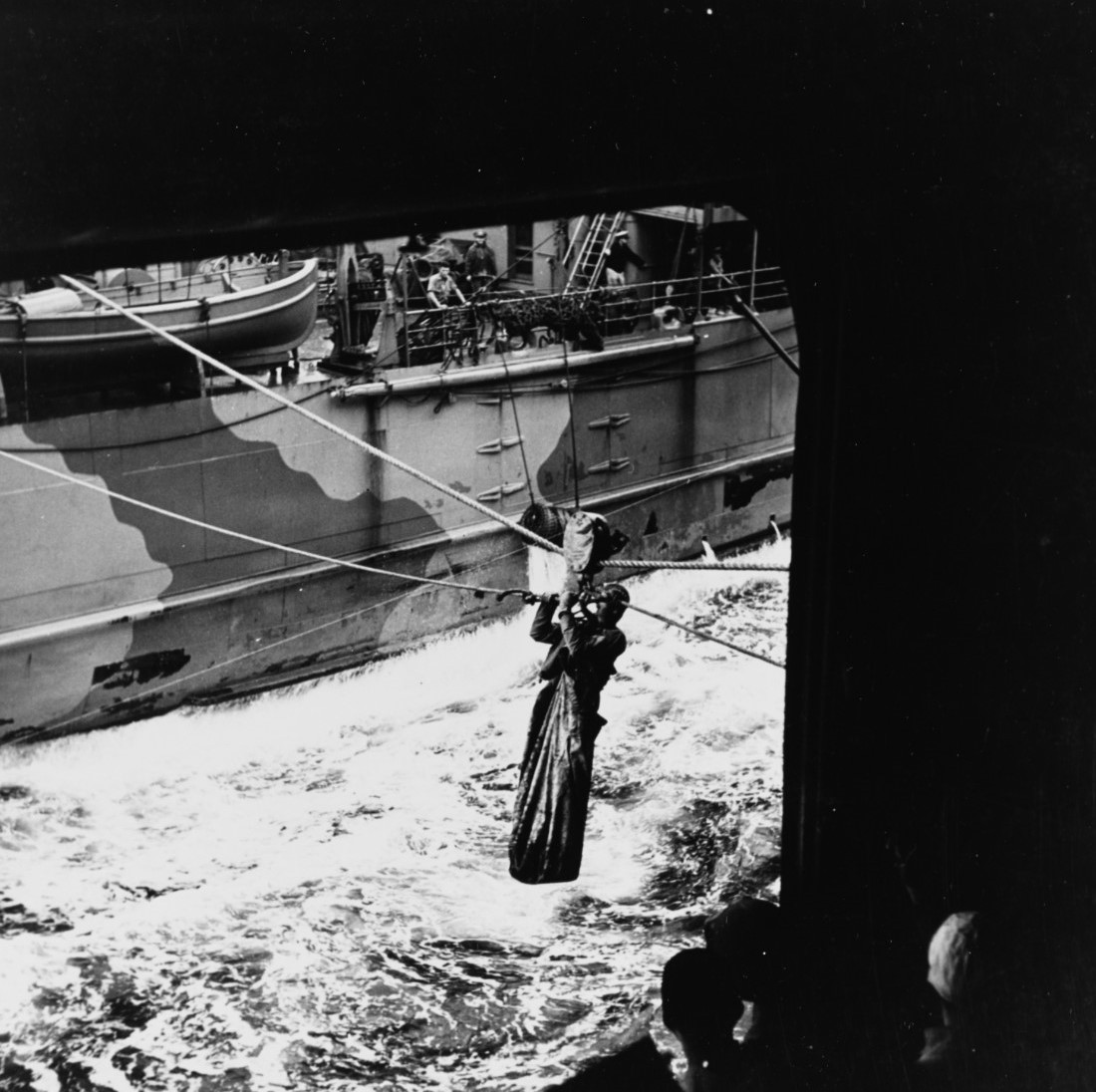
LCDR John Thomas Blackburn being returned to USS Santee in a coaling bag by highline on November 11, 1942, after spending 64 hours in the ocean after a crash (NHHC)
On November 9, 1942, Lieutenant Commander Joseph A. Ruddy carried out a hazardous, low-level reconnaissance flight on the Marrakech airfield. Although his aircraft was struck by ground fire, he made a second approach and made a direct hit on the hangar, inflicting considerable damage, and later attacked a column of enemy trucks he observed, which were bound for Safi. He was awarded the Navy Cross for his achievements. On November 11, 1942, after an armistice had been declared, Santee aviators struck Marrakech a final time and destroyed twelve aircraft on the airfield. The Southern Attack Group assault was one in which, according to Admiral Morison, “everything clicked.” The operational commander Rear Admiral Lyal Davidson observed that:

"The Southern Attack Group was able to land at Safi with but two naval casualties and no material damage other than 8 landing craft…and with comparatively light casualties (8 killed in action and 75 wounded in action) among Army Assault troops is attributable to Divine Providence, good weather, surprise, retention of the initiative and accurate and overpowering gunnery."[xii]
Cover of Record of Dockings, Drydock No. 3, NNSY (NNSY)

There is some indication that Admiral Davidson was not impressed with carrier aviator performance and used aircraft from battleship USS New York (BB 34) and the cruiser USS Philadelphia (CL 41) to execute certain missions, such as sinking the Vichy submarine Medeuse. In any event, on November 13, 1942, with its part in Torch complete, Santee left the theater, bound for its Norfolk homeport. It reached home station on November 24, 1942, two days before Thanksgiving. The NNSY Drydock log shows that Santee was docked on December 8, 1942, for voyage and battle damage repairs and was undocked four days later.[xiii]
Page from log book showing Santee as part of Operation Torch (NNSY)
World War Two was far from over for the versatile ship. Following an extended stand down period, it began operations in the South Atlantic the day after Christmas 1942 to interdict enemy merchant shipping and counter hostile naval activity. Santee was also involved in various convoy operations in the Atlantic over the next year. Particularly noteworthy is a period of a few days following November 17, 1943, when it escorted USS Iowa (BB 61) with President Franklin Roosevelt, who was bound for the Tehran conference. Following delivery of P-38 fighter planes to the United Kingdom at Glasgow on January 9, 1944, it transited the Panama Canal on the 18th and 19th of February and served in the Pacific. It had amassed, in America’s first World War Two offensive operation, a considerable record of operational achievement in the time since its sea change from oiler to carrier completed at Norfolk Naval Shipyard.[xiv]

Note from the author: Special thanks to Marcus Robbins, NNSY, and Dave Kavanagh for their assistance with the research of this blog.

Notes:
[i] Weser Kurier, May 5, 1960.
[ii] Public Law 75-528 of May 17, 1938
[iii] The Vinson-Walsh Act, Public Law 76-757, was the largest naval procurement bill in United States History and increased the size of the fleet by 70%
[iv] “Peacetime Naval Re-Armament 1933-39, Lessons for today,” Naval War College Review, Volume 72, Spring 2019, pp 88-103.
[v] “Standard Oil Contracts to Build Twelve Fast Tankers,” From Bulletin of Sun Shipbuilding and Drydock Historical Society, May 1940.
[vi] Reference to Commander William G.B. Hatch, USN at page 85, Oral History of Vice Admiral Elliott B. Strauss, USN, in Oral Histories of the United States Naval Institute, Annapolis, Maryland
[vii] United States Naval Operations in World War II, Operations in North African Waters, Rear Admiral Samuel Eliot Morison, USN (Ret.) p. 133-155; See Docking Log Norfolk Naval Shipyard for August 20, 1942, slightly before its commissioning. The first flight was made on September 24, 1942.
[viii] “A Torch for Africa,” Archives of the Sun Shipbuilding and Drydock Company, p.34.
[ix] Dictionary of American Naval Fighting Ships, Volume VI, Historical Sketches R-S, p.326
[x] Operations in North African Waters, p. 150
[xi] CVE Piper, Escort Carrier Sailors and Airman’s Association, June 20, 2020
[xii] Ibid. p. 133.
[xiii]Record of Dockings, Drydock 3, Norfolk Naval Shipyard, December 8 and 12, 1942
[xiv] On July 8, 2022, prior to completion of this essay, the Museum was visited by the granddaughter of Petty Officer Jethroe Midgette, a former Gunner’s Mate who served in USS Santee (CVE 29) during Torch. She related that her grandfather served aboard not only during Torch but for the entire war.

Thursday, May 19, 2022

HMS Queen Elizabeth Repairs During World War II

By Thomas Grubbs
HRNM Volunteer

For many years now, Great Britain has been one of the United States’ closest allies. This special relationship dates to the dark days of the Second World War. The history of the Lend Lease Act requires no repetition here nor does the general history of the Second World War. However, large scale material aid to the United Kingdom included more than just providing armaments and raw materials: it also took the form of maintenance services.
HMS Queen Elizabeth during the Second World War (Imperial War Museum)
On the morning of December 19, 1941, a massive explosion ripped through the keel of the battleship HMS Queen Elizabeth, moored in the harbor of Alexandria, Egypt. The limpet mine responsible, planted by Antonio Marceglia and Spartaco Schergat of the Regia Marina (Italian Navy) riding on a human torpedo or maiale, would inflict severe damage on the capital ship, rendering it crippled. Additional maiale launched at the same time sank the battleship Valiant, destroyer Jervis, and the tanker Sagona. This attack, eliminating the only operational capital ships in the Royal Navy’s Mediterranean fleet, would drastically change the balance of power in the region for nearly a year.
Maiale human torpedo of the type used to attack HMS Queen Elizabeth (Wikimedia Commons)
Temporary repairs in Alexandria’s floating drydock took six months, restoring this valuable and desperately needed capital ship to seaworthiness. But battle worthiness would require the attentions of a fully equipped naval dockyard. Unfortunately, no such yard was immediately available: England’s yards were clogged with battle-damaged escorts from the Battle of the Atlantic, while new construction of desperately needed cruisers and destroyers took up any additional capability. Simply put, there was no room to repair this battleship. Fortunately, a powerful new ally had joined the struggle on England’s side: the United States.
HMS Queen Elizabeth repair trails – Norfolk Navy Yard, June 1943 (Image from Historic Norfolk Naval Shipyard Archives, NNSY Historian Marcus Robbins)
The Queen Elizabeth’s epic voyage, taking from June to September 1942, crossed the Indian and Pacific Oceans, passed through the Panama and Suez Canals and ended in Norfolk Navy Yard, now Norfolk Naval Shipyard, in Portsmouth, Virginia. Even though the massive dockyards bulged with new construction, including nine Essex-class aircraft carriers, the Norfolk Navy Yard possessed sufficient industrial might to repair and modernize Queen Elizabeth over the course of the next ten months, completing the task in June 1943. The powerful warship, equipped with the latest in radar and AA protection in addition to its powerful 15-inch guns, would join the British Far Eastern Fleet for the rest of World War Two, protecting Royal Navy aircraft carriers raiding occupied Japanese territory in Indochina and what is now Indonesia before being decommissioned in 1946 and scrapped two years later.
HMS Queen Elizabeth damage, shown in Dry Dock #3 at Norfolk Navy Yard, September 1942 (Image from Historic Norfolk Naval Shipyard Archives, NNSY Historian Marcus Robbins)
The United States became known as the Arsenal of Democracy during the greatest conflict the world has ever seen. What is not as well-known is the support and repair services offered to its allies during the war. A friend helps you move, a good friend brings beer and pizza to the move, and a great friend moves your battleship for you.

Thursday, January 13, 2022

LST 333's Rendezvous with War: Loss of a Norfolk Ship

By CAPT Alexander Monroe, USN (Ret.)
HRNM Docent and Contributing Writer

On October 15, 1942, at 7:30 AM, Mrs. Cornelius Kneeburg, wife of the Master of the Shipfitters and Welders Shop of the Norfolk Naval Shipyard (NNSY), smashed a bottle of champagne across the bow of the newly-constructed Tank Landing Ship LST 333, and the ship slid down the ways of NNSY, into the Elizabeth River in Portsmouth, Virginia. Towed to the St. Helena Annex of the yard for outfitting and receiving its first crew, it was the first of twenty of such “curious appearing ships” built and sent to war by the yard. Barely eight months later, it was the first of the novel ships lost to enemy action.[1] They sailed to landing beaches in the Atlantic, Mediterranean Sea, and Pacific, where their crews performed admirably, contributing significantly to Allied victory.
Mrs. Cornelius Kneeburg, wife of the Master of the Shipfitters and Welders Shops of Norfolk Naval Shipyard, smashes a bottle of champagne of the bow of LST 333 on October 15, 1942, as the Flag Lieutenant of the yard watches. (NNSY photo 3994/42)
The LST was a new class of ship “of which there was no counterpart in the U.S. Navy.” It was developed hurriedly and put into service to meet the exigencies of a new type of operations: Amphibious Warfare.[2] Amphibious warfare required that “landings on enemy beaches have to be made if the war was to be taken to our foes.” These shallow draft vessels would be “capable of running up on a beach, opening bow doors and depositing men and machines directly on the land.” After an early 1942 meeting of various shipyard staffs wherein allocation of construction tasking was formulated, the Secretary of the Navy ordered twenty ships from NNSY on May 19, 1942. Over 1,000 were built, many at sites on inland rivers known as “cornfield shipyards.” Transit to open sea along the Ohio and Mississippi Rivers provided initial training for life at sea.[3]
LST 333 is launched from Builder’s way 1 at the Norfolk Naval Shipyard on October 15, 1942, with a tug standing by in the Southern Branch of the Elizabeth River. (NNSY photo 4003)
LST 333 was towed to the yard annex to be outfitted for sea and receive a crew for intense training. Following various trials, the ship was delivered to the fleet. On November 20, 1942, it was commissioned USS LST 333, under the command of Lieutenant Paul O. Krahenbuhl, a former Chief Boatswain’s Mate. Four days after commencement of the invasion of North Africa known as Operation Torch and shakedown at Camp Bradford (a part of what is now Joint Expeditionary Base Little Creek/Fort Story), the ship left for Africa. Its crew would prepare for Operation Husky, the invasion of Sicily. By May 6, 1943, the ship was berthed at the Advanced Amphibious Training Base Arzew, Algeria. Motor Machinist’s Mate Harvey R. Alexander recalled that, “we met practically no resistance and set up a naval repair and supply base in preparation for the later invasion of Sicily.”[4] Taking the island would provide a foothold for later operations in continental Europe.
LST 333 underway for pre-commissioning trials in the Elizabeth River near Norfolk, Virginia, on November 17, 1942.  (NNSY photo 4173/42)
In mid-June 1943, LST 333 joined Convoy Elastic from Arzew to Bizerte, Tunisia. It had been modified to enable carrying pontoons on either side of the ship, permitting the transfer ashore of equipment when the area inshore of the beaching point was too deep. U-593, built at the Blohm and Voss shipyard in Hamburg, Germany, and commanded by Oberleutnant Gerd Kelbling, concurrently left Italy on June 13, 1943, for its eleventh war patrol. The skipper had destroyed 43,216 tons of allied shipping since March 1942.
Lieutenant Paul O. Krahenbuhl reads orders placing USS LST 333 in commission on November 20, 1942, with Rear Admiral Felix Gygax, Norfolk Naval Shipyard, standing behind him. (NNSY)
The U-593 CO reported in his ship’s war diary that at 9:30 PM on June 22, 1943, near Cape Corbelin, Algeria, he fired three torpedoes at two targets that he assumed were merchant tankers.[5] These torpedoes hit both LST 333 and 387, and LT Krahenbuhl’s subsequent letter reported the time of the attack as 7:19 PM, just after sunset and under clear skies. The ship was steaming on course 080 (T), 6 ½ knots and was hit in the starboard quarter.[6] Blown back to the bridge frame and dazed by the explosion’s force, Krahenbuhl understood the serious injuries to his ship that had rendered it powerless and rudderless. Though holed and taking on water, it was beached. When the dead and wounded had been evacuated, an unsuccessful attempt to salvage it was made, and Krahenbuhl brought his crew ashore.[7] Oberleutnant Kelbling and his boat escaped by evasive maneuvering and ended his 11th patrol in Toulon, France, ten days later. His crew used all torpedoes and 9,408 additional tons of shipping were added to his record. Kelbling was awarded the Knight’s Cross on August 19th, 1943.[8]

Gerd Kelbling’s success as a U-boat commander ended on December 13, 1943, northeast of Bougie, Algeria. His boat had torpedoed HMS Holcombe (L 56) and HMS Tynedale (L 96) on the 12th. It was sighted and attacked by a Wellington aircraft from RAF 36 Squadron B, whose pilot radioed USS Wainwright (DD 419) and HMS Calpe (L 71). They successfully forced Kelbling and his entire crew to surface, abandon, and scuttle the boat. The U-boat’s crew spent the remainder of the war in a Canadian POW camp and returned to Germany in 1947.[9]

Nineteen LSTs followed USS LST 333 from the builder’s ways at NNSY. They served in all areas of hostilities. Four were transferred to the United Kingdom. Two more were lost to enemy action and one to grounding. Two were lost in the Mediterranean and one in the Pacific near New Georgia Island. Ten were involved in Operation Overlord, the invasion of Normandy. The LST, more than any class of U.S. Navy ship, performed well in a variety of operations, from transporting enemy prisoners of war away from the battlefield to transporting medical surgical units to invasion sites.[10] Most were decommissioned and broken up at the war’s end. Only one NNSY-built LST survived, USS LST 344, later named USS Blanco County. It sailed to Vietnam from its Norfolk home port and was sold for scrapping on July 1, 1975. In the Second World War, these ships played a central role in winning the war and brought great credit on those who built them.


*Many thanks to Marcus Robbins, Captain Jerry Mason, and Zach Smyers for their help with the research and writing of this blog.

Notes:
[1] “Four Tank Landing ships will be launched Thursday,” Norfolk Naval Shipyard DEFENDER, October 14, 1942, p.1. ; “4 Landing Craft Launched At Norfolk Navy Yard,” Norfolk LEDGER STAR, October 15, 1942, p.2.
[2] “Six more landing ships are launched, a tribute to the Yard’s Speedy War Production,” Norfolk Naval Shipyard’s DEFENDER, Vol. 1, #19, November 11, 1942, p.2.
[3] “History of the Norfolk Navy Yard in World War Two,” Lieutenant Commander Arthur Sydnor Barksdale, USNR, November 1945, p. 158.
[4] Harv’s site.info, at Interview page 1. This is a series of his recollections of service aboard LST 333
[5] U-593 11th War Patrol War Diary, Admiralty Registry Number 30625/12, Uboatarchive.net, Captain Jerry Mason, USN (Ret.) Translator
[6] Ltr, CO, USS LST 333 to Commander-in-Chief, United States Fleet, “LST 333-Final Report of Torpedoing and Beaching of,” 29 June 1943.
[7] Idem.
[8] Ibid., U-593 War Patrol Diary
[9] U-boat.net, U-593, the pilot of the aircraft was F/O C.F. Parker. Though struck by AA fire from U-593, the plane landed safely at Bone, Algeria.
[10] History, Company B, 48th Armored Medical Battalion, landed at Normandy, June 12, 1944.
Thursday, January 7, 2021

USS Langley (CV 1): The Beginning (Part One)

USS Langley (CV 1) with battleships of the fleet in the 1920s. (Naval History and Heritage Command)

By Thomas Grubbs
Contributing Writer

A collier was perhaps the most unprepossessing vessel afloat. Mostly empty space, it plodded from one port to another laden with coal, metallic ores or other bulky cargoes, fuel for the economy. But one collier, laid down as USS Jupiter (AC 3) on October 18, 1911 at Mare Island Naval Yard in Vallejo, California, would go on to become a nautical trailblazer.

The collier USS Jupiter (AC 3) seen in 1913. (Naval History and Heritage Command)

The second of four sister ships, Jupiter was the first vessel in the fleet to be powered by a turbo electric drive. After being commissioned on April 7, 1913, it spent time with the Pacific Fleet before passing through the Panama Canal on Columbus Day 1914, becoming the first ship to transit the Canal from west to east in the process. It would spend the prewar and the First World War years engaged in the hum drum life of a naval collier, enlivened only by a pair of voyages to France in June 1917 and November 1918 carrying a detachment of 129 naval aviators. After supplying coaling services to ships transporting the American Expeditionary Force home, it returned to Norfolk for decommissioning on August 17, 1918. But its story was not to end there.

After the end of the First World War, the five great naval powers gathered in Washington D.C. in early 1921 to attempt to prevent another ruinous naval arms race like that that had led to the recently ended conflict. Most of the resulting arms treaty, colloquially known as the Washington Treaty, dealt with the battleship: entirely appropriate given that vessel’s then central role in the Fleet. However, recent wartime experience had revealed that ship-based aircraft could prove decisive in any future conflict. Therefore, each of the signatories were allowed to convert for experimental purposes several already existing vessels into aircraft carriers under Article VII of the Treaty.

Langley (ex-Jupiter) being converted at Norfolk Naval Shipyard in 1921 (National Naval Aviation Museum via wikipedia)

Because of its relative newness and ease of conversion, Jupiter was chosen to become America’s first aircraft carrier. Renamed Langley after an aviation pioneer on April 11, 1920, the collier would spend the next two years undergoing an extensive conversion at Norfolk Naval Shipyard. It would eventually be recommissioned as USS Langley (CV 1) on March 20, 1922 as an aviation trials ship. Data on everything from flight deck procedures to arrestor gear collected over its career would be the basis for the great carrier fleet that would lead America to victory a generation later. Under the command of Commander Kenneth Whiting, who had originally proposed the conversion of a collier to a carrier, the little Langley set out to face the future.

USS Langley with aircraft aboard in the 1920s (Wikimedia commons)

Tuesday, November 12, 2019

November 14-15, 1942: Night of the Battleships


The U.S. battleship USS Washington (BB 56) firing upon the Japanese battleship Kirishima, during the Naval Battle of Guadalcanal on the night of November 14-15, 1942. The low elevation of the barrels shows how the close range of the adversaries, only 7,700 m (8,400 yards), point blank range for the 16 inch/45 caliber main armament of Washington. (Wikimedia commons)
By Zachary Smyers
HRNM Educator

Late on the evening of November 14, 1942, two American battleships, USS Washington (BB 56) and USS South Dakota (BB 57), took on elements of the Imperial Japanese Navy (known as “The Tokyo Express”) in what has been referred to as The Second Naval Battle of Guadalcanal. The battle would be the first time U.S. battleships fought against a Japanese battleship. Much like the First Naval Battle of Guadalcanal, the second battle would take place at night in complete darkness. 

William "Bull" Halsey (National Archives)
It was indeed a gamble for Admiral William “Bull” Halsey to detach his only two battleships in the area from providing protection to the carrier USS Enterprise (CV 6), but Halsey had promised the Marines on Guadalcanal that he would give them all he had. So, the six-ship task force under the command of Rear Admiral Willis Lee made its way towards Savo Sound where so many of their fellow Sailors had fought and died during the first battle.
Rear Adm. Willis A. Lee, Jr., USN, Commander Battleship Division Six. Pencil sketch portrait by Commander Dwight Shepler, USNR, December 1942.  (U.S. Navy Art Collection/ National Archives)

What Lee’s task force lacked in number of ships was made up for in firepower. Both Washington and South Dakota had nine 16-inch main guns which were capable of firing a 2,700-pound armor piercing projectile at long range. This, factored in with a precise fire control system and surface search radar, made the two battleships quite formidable.
USS Washington (BB 56) off New York City, August 21, 1942. Note barge alongside amidships and OS2U floatplane afloat off her stern. (Bureau of Ships Collection/ National Archives and Records Administration 19-N-33803)
The American task force was spotted by Japanese destroyers (there were three destroyers and a light cruiser) which were screening for the Japanese advanced force at 2300 on November 14. The advanced force, which was under the command of Vice Admiral Nobutake Kondo, consisted of the battleship Kirishima (sister ship of the ill-fated Hiei), the heavy cruisers Takao and Atago; the light cruiser Nagara, and the destroyers Shirayuki, Hatsuyuki, Teruzuki, Samidare, Inazuma, and Asagumo. The objective of the advanced force was to bombard the Marines on Guadalcanal, while Rear Adm. Lee’s objective was to prevent that from happening.
The Japanese battleship Kirishima. (Kure Maritime Museum)
The evening’s silence was broken when Washington opened fire at 11:16 pm. The 16-inch salvo from the Washington was followed by a salvo from South Dakota. The first shots fired by the two American battleships at the Japanese had passed over their intended targets. Adjustments were quickly made in the gun houses onboard both ships, and 45 seconds later, the second salvo was fired. Officers on watch observing the surface search radar saw the image of the target flicker, which indicated that the 16-inch shells had indeed made an impact.
Chart of the second phase of the Second Naval Battle of Guadalcanal, 23:30-02:00, November 14-15, 1942. Key: A- U.S. warship force: Washington (solid black  line) South Dakota (large dotted line), and four destroyers (small dotted line is route of Gwin and Benham) B- Japanese destroyer Ayanami C- Japanese light cruiser Sendai and destroyers Uranami and Shikinami D- Japanese light cruiser Nagara and destroyers Shirayuki, Hastuyuki, Samidare, and Inazuma E- Japanese bombardment force: battleship Kirishima, heavy cruisers Atago and Takao, and destroyers Asagumo and Teruzuki 1- Location of sinking U.S. destroyers Preston and Walke 2- Location of sinking Japanese destroyer Ayanami 3- Location of sinking, Japanese battleship Kirishima. (Angelus/ Wikimedia Commons)
As the battle continued, Washington’s secondary five-inch batteries began to engage targets as well. The Japanese destroyer Ayanami, which was part of the sweeping unit, opened fire which revealed its position. This made it even easier for Washington to track her, and Ayanami received several hits from Washington which damaged Ayanami’s propulsion system as well as set the ship on fire. Ayanami would eventually sink.
Surrounded by an oily sheen, the beat-up battleship South Dakota after the battle and two destroyers alongside USS Prometheus (AR 3) for repairs, probably at Noumea, New Caledonia, in November 1942. The inboard destroyer, with the distorted bow, is probably USS Mahan (DD 364), which was damaged in a collision with South Dakota at the close of the Battle of the Santa Cruz Islands on October 27, 1942.  South Dakota received damage in both that battle and in the Naval Battle of Guadalcanal on November 15, 1942. The other destroyer may be USS Lamson (DD 367). (Official U.S. Navy Photograph, now in the collections of the National Archives, 80-G-36088)
Lee’s task force continued to track and fire on the Japanese ships when tragedy struck South Dakota. An electrical failure onboard the ship knocked out South Dakota’s radar, gyros, and the ability to fire her main guns. The ship became blind and incapable of being able to put fire on the enemy. The power was eventually restored to the systems, but by this time South Dakota was less than three nautical miles from the approaching Japanese ships. South Dakota was illuminated by search lights from the cruiser Atago, and the other Japanese ships along with Atago opened fire, scoring 27 hits.
Damage photograph of USS South Dakota showing shell hole in ship's side starboard, at frame 29-31. Taken after the naval battle off Guadalcanal, November 15,1942. (National Archives and Records Administration 19-N-42754)
While South Dakota kept the Japanese ships distracted, Washington was able to open fire on the Japanese ships and remain undetected. Firing a combination of five-inch shells, five-inch illumination rounds, and her 16-inch main batteries, Washington scored several hits on Kirishima at a distance of 8,400 yards. Due to the severe damage received from Washington, Kirishima eventually sank.
Rear Adm. Willis A. Lee is presented with the Navy Cross by Admiral William F. Halsey, during ceremonies on board a U.S. Navy warship in the South Pacific, circa January 1943. Rear Adm. Lee received the decoration in recognition of his achievements during the Naval Battle of Guadalcanal, November 14-15, 1942. (Official U.S. Navy Photograph, now in the collections of the National Archives)
Rear Adm. Lee and his small task force had prevented the Japanese from resupplying their troops as well as bombarding the Marines. For his leadership during the battle, Lee received the Navy Cross. Halsey’s gamble of dividing what little forces he had left had paid off and the Marines were eventually able to secure Guadalcanal. For the people of the United States, defeating the Japanese in a major land battle was a much-needed boost for the morale on the homefront. For the United States Navy, the battles that took place during the campaign for Guadalcanal were a series of very bloody lessons in how to conduct naval warfare at night against a seasoned enemy.
Back in fighting shape, USS South Dakota off the Norfolk Navy Yard, Virginia, August 20, 1943. (Official U.S. Navy Photograph, from the collections of the Naval History and Heritage Command)
This huge Japanese torpedo, Type 93 (long lance), fired from a submarine, failed to hit its mark during the Guadalcanal Campaign. It plunged harmlessly ashore on the beach of Guadalcanal. U.S. Navy photograph. (National Archives and Records Administration Lot-801-27 via Naval History and Heritage Command/ Flickr)
USS Washington (BB 56) and USS Enterprise (CV 6) Transiting the Panama Canal from the Pacific to the Atlantic, early in October 1945. They were then en route to the U.S. East Coast to participate in Navy Day celebrations. (National Archives and Records Administration 80-G-K-6568)

Friday, November 8, 2019

Seventy-Five Years Ago: Gone in a Flash

By M.C. Farrington
HRNM Historian

An old naval aphorism goes, "Why die? Go supply!"

But warfighting is a dangerous business from stem to stern; whether at the tip of the spear or in the rear with the gear.

On the morning of November 10, 1944, Lieutenant Lester A. Wallace, a Naval Reserve communications officer originally from Atlanta, Georgia, learned this in a very visceral way after leading 13 of his men ashore from the ammunition ship Mount Hood (AE-11). Wallace was to pick up new communications manuals and his charges were assigned to pick up mail or receive dental treatment.
Smoke cloud expanding, just after USS Mount Hood (AE 11) exploded in Seeadler Harbor, Manus, Admiralty Islands, 10 November 1944. Photographed by a photographer of the 57th Construction Battalion, who had set up his camera to take pictures of the Battalion's camp. (Commander Lester B. Marx Collection, U.S. Naval History and Heritage Command Photograph)
"We went ashore about 0830 (8:30 A.M.) and were walking up the beach," he reported later, "when a sailor, with a startled look in his eye, screamed: 'LOOK!', and pointed to seaward. There was a flash, followed by two quick explosions. We were knocked down, but scrambled to our feet and got back in the boat.”
The mushroom cloud marking the death of USS Mount Hood expands over Seeadler Harbor, Manus, Admiralty Islands, on the morning of November 10, 1944. (Collection of Commander Lester B. Marx, Commanding Officer of the 57th C.B. Naval History and Heritage Command Photograph)
One moment, Mount Hood was a 13,910-ton ship with a crew of over 300 men, loaded with over 3,800 tons of ammunition. The next, it was a smoking column of smoke and fire that ultimately stretched 7,000 feet into the sky and measured a half-mile wide at its base. The explosion carved a trench in the harbor floor 35 feet below the surface measuring over 300 feet long, 50 feet wide, and 30 to 40 feet deep.
Explosion of USS Mount Hood (AE 11) at Seeadler Harbor, Manus Island, Admiralty Islands, seen from USS Omanney Bay (CVE 79), located between four and-a-half and 5 miles from scene, one and-a-half minutes after explosion.  Released November 10, 1944. (National Archives and Records Administration image 80-G-289933)
In an instant, Lt. Wallace was rendered the only surviving officer of the 22 detailed to the ship. The 13 Sailors with him, along with four others sent ashore separately that morning, two of whom for pre-trial confinement, were left the only other survivors from Mount Hood's enlisted compliment of 296.
Small craft gathered around USS Mindanao (ARG 3) during salvage and rescue efforts shortly after Mount Hood blew up about 350 yards away from Mindanao's port side. Mindanao, and seven motor minesweepers (YMS) moored to her starboard side, were damaged by the blast, as were USS Alhena (AKA 9), in the photo's top left center, and USS Oberrender (DE-344), in top right. Note the extensive oil slick, with tracks through it made by small craft. (Copied from the War Diary, Manus Naval Base, for November 1944. Naval History and Heritage Command Photograph)
Not only was the entire ship destroyed, but nothing within 500 feet of the explosion survived intact, including eight landing craft mechanized (LCMs), and pontoon lighters being used to transfer ordnance, as well as 13 other whaleboats and other small craft, including auxiliary motor minesweepers. It was estimated that over 350 Sailors died in the instant holocaust, with 82 killed aboard the repair ship USS Mindanao (ARG 3), a former Liberty ship, which was floating only about 350 yards away from Mount Hood.  Around an equal number were injured in the blast.

Salvage and rescue work underway on USS Mindanao (ARG 3) shortly after Mount Hood blew up about 350 yards away from where the ammunition ship had been moored. Note heavy damage to Mindanao's hull and superstructure, including large holes from fragment impacts. View looks forward from alongside her port quarter. USS Mindanao had 180 crewmen killed and injured by this explosion. She was under repair until December 21, 1944. Small craft alongside or nearby include (from left) YPB-6 (probable identification), two LCVPs and YPB-7. (Copied from the War Diary, Manus Naval Base, for November 1944 U.S. Naval History and Heritage Command Photograph)
Pharmacist's Mate Hunter Gammon, originally from Kerrville, Texas, was dispatched to Mindanao from where he had been working at a naval hospital on Manus Island, encountered "an unbelievable scene of human carnage with men still living with arms gone, legs gone, terrible wounds in chests and stomachs."

"Jagged metal shards were sticking out of the living as well as the dead," Gammon continued. "My medical team stayed on board this slaughterhouse until early evening doing our best to ease the pain and suffering of the victims."

The repair ship Argonne (AG 31) was caught 1,100 yards away from the explosion and was pelted with at least 220 pieces of Mount Hood. Over 1,300 pounds of debris was recovered from that ship and the waters immediately surrounding it alone.

Damage to Quonset huts atop the barge YF-681 from concussion from the explosion that destroyed USS Mount Hood. The barge is alongside USS Argonne (AG 31), which was also damaged by the blast. (Copied from the War Diary, Manus Naval Base, for November 1944. Naval History and Heritage Command Photograph)
Seabees stationed on Manus were also dispatched to Mindanao and other damaged ships still afloat in order to assist in repairs. One of them, welder William Meinders, told Sea Classics magazine in 2006:

It was difficult to accept the way our shipmates had died; that your mortality was so easily swept away–your life gone without a trace as if it had never existed. Words must have been stopped in mid-sentence, or caught in the middle of a thought the moment she blew. I guess they never knew what hit them.

The board of investigation convened to look into the disaster didn’t know what hit them either, nor could they reach an ironclad conclusion. Although they decisively dispelled theories about Japanese midget submarines or an air attack, another notorious culprit came to the fore.

Their final report released in December noted, “Evidence indicates the possibility of the detonation of TPX loaded depth bombs while it was being loaded into the number three or number four hold.”

Torpex. This was exactly the same type of munition that had caused Naval Air Station Norfolk’s worst-ever disaster in September 1943, and a similarly catastrophic accident at Naval Weapons Station Yorktown just shy of two months later. The casualty count from those accidents, particularly the one at Yorktown, were limited in scope due to the limited amount of munitions involved. This time, however, the unstable depth bombs were being handled within a huge ammunition ship packed with ordnance. Mount Hood was acting as a mobile ammunition depot in its own right, containing all the munitions being used by the Third Fleet at the time.

USS Mount Hood appears in Measure 32 camouflage pattern in a print by David Hendrickson. (HRNM Study Collection S2015.4)
USS Mount Hood (AE 11) off Norfolk Navy Yard, Virginia, July 16, 1944. She is painted in camouflage Measure 32, Design 18F. (Photograph 19-N-70330 from the Bureau of Ships Collection, National Archives and Records Administration)
Just a year before the disaster, Mount Hood had been the U.S. Maritime Commission C2 all-purpose cargo ship SS Marco Polo, but it had been converted at Norfolk Navy Yard into an ammunition ship.

Recommissioned on July 1, 1944, Mount Hood left Hampton Roads for the Pacific in August, arriving at Seeadler Harbor, Manus, on September 22, which was a major staging area northeast of Papua New Guinea for the invasion of the Philippines over 3,000 miles away.

USS Mount Hood (AE 11) underway in Hampton Roads, Virginia, August 6, 1944. (Naval History and Heritage Command Photograph)
Mount Hood was struck from the naval register on December 11, 1944, but her name lived on in USS Mount Hood (AE-29) for nearly three decades until she was scrapped in 2013.  Today, original prints of both Mount Hood and Argonne reside in the Hampton Roads Naval Museum's study collection, reminders of two overlooked support vessels that Sailors took directly into harm's way, giving the ultimate sacrifice three-quarters of a century ago.

USS Argonne, a Pearl Harbor attack survivor which also survived the Mount Hood disaster, was scrapped after the war. (HRNM Study Collection S2015.3)