Showing posts with label CSS Florida. Show all posts

Thursday, May 5, 2022

In the Collection: Rear Admiral Napoleon Collins' Sword

By Nick Wieman
HRNM Intern
Commander Napoleon Collins, circa 1864 (Wikipedia)
Napoleon Collins was born in Pennsylvania on March 4, 1814, and commissioned as a midshipman in the United States Navy in January 1834. After an “arduous but undistinguished” career in the Navy, then-Commander Napoleon Collins lucked into a chance to make his mark in September of 1864 while in command of USS Wachusett. While re-coaling in the Canary Islands, he was informed that the Confederate commerce raider CSS Florida had recently refueled there as well and was bound for the Port of Salvador in Bahia, Brazil. Intent on destroying the dreaded Confederate commerce raider, Collins set sail for Bahia.

Wachusett beat Florida to Bahia by about two days, anchoring outside the Brazilian harbor on October 2, 1864. In the dead of night on October 4, sentries aboard Wachusett spotted a ship pulling into port, later confirmed to be Florida. Collins messaged Florida’s commander, Lieutenant Charles M. Morris, formally requesting a naval duel outside Brazilian territorial waters. There was established precedent of respecting neutral nations’ territorial sovereignty; Captain John Winslow, of USS Kearsarge, had waited to engage CSS Alabama until after the latter ship had left French waters. Morris rebuffed the invitation, citing Collins’ disrespect of the ship and its crew in addressing the ship as “the sloop Florida” rather than the proper CSS Florida. He announced his intention to stay in Bahia for as long as necessary, and that he would neither “seek nor avoid a contest with the Wachusett” but that at a later date he would “use his utmost endeavors to destroy her.” Morris’ arrogance would prove to be his undoing, as it only served to reinforce Collins’ desire to see Florida sunk, maritime law be damned.

On the evening of October 6, Morris and several officers went ashore to spend the night in Bahia, alongside roughly half the crew who had been granted liberty, leaving Florida under the command of his First Lieutenant. Not anticipating any action from Wachusett and obliging maritime law to disarm in a neutral port, he removed the shot from Florida’s guns and allowed the ship to lose its steam.

At precisely 3:00 am on October 7, Collins made his move. Having pulled out of the harbor to give Wachusett sufficient clearance and time to build up a good head of steam, Collins ordered Wachusett to charge at the anchored Florida at full speed, intending to ram the ship with enough force to sink it. Wachusett struck Florida on the starboard quarter, tearing down the mizzenmast and main yard and crushing the ramparts, but the ship had not received a fatal blow, disabled but otherwise afloat. Rather than finish it off with cannon, Collins instead took the opportunity to seize Florida as prisoner. After securing the surrender of Florida’s remaining crew, he secured a towing hawser to the ship and towed Florida out to sea, briefly pursued by a Brazilian corvette. Captain Morris, running from the hotel where he had been staying, reached the dock just in time to see his ship being towed away over the horizon.
Cutting out the Florida from Bahia, Brazil by USS Wachusett (Frederick Gutekunst)
Collins arrived in Hampton Roads on November 12, 1864, Florida in tow, to a jubilant reception from the public and an awkward reception from Secretary of State William Seward. Collins had broken international law by seizing the ship in neutral waters, and it was feared that to make peace with the Brazilian government, Florida would have to be returned to Bahia, and by proxy the Confederate Navy. When the formal diplomatic protest arrived, Seward assured the Brazilian government that Collins had acted without authorization, and that he would be suspended and court-martialed. However, Florida could not be returned to Bahia as requested, as the ship had been accidentally struck by a transport ship early on November 28, while anchored off Newport News, and sunk. Whether it was an accident or Florida had been intentionally sunk is unknown.

Collins would indeed be court martialed within six months of the incident and sentenced for dismissal. However, the verdict was set aside by Navy Secretary Gideon Welles, and Napoleon Collins was restored to duty. He continued serving in the Navy until his death in 1874, having been promoted to Rear Admiral in command of the South Pacific Squadron in Peru.
Obverse view of Napoleon Collins’ sword, with included scabbard (HRNM)
Rear Admiral Napoleon Collins' personal effects had remained with his family until recently, when they were donated to the Hampton Roads Naval Museum by his great-grandson Grant Collins. Along with his uniform jacket, naval officer’s fore-and-aft, belt, and epaulets, one of the most striking artifacts is his officer’s sword. Once as essential to a nobleman’s or gentleman soldier’s attire as his uniform, the sword has served as a symbol of military authority for thousands of years worldwide, and the United States is no exception. While the increasing proliferation of firearms in the 18th and 19th centuries restricted the sword’s practical usage on land to the cavalry, it retained its value aboard ships as one of the weapons of choice for boarding parties until the late 19th century, where the close quarters of the ship made it much more practical than a rifle in combat. Even if the sword has been replaced in the hands of the infantry, it remains an essential part of the officer’s uniform for ceremony.
"N.P Ames/Cutler/Cabotville” (HRNM)
Rear Admiral Napoleon Collins’ sword is an N.P. Ames Cutler Model 1841 Naval Cutlass, produced by the Ames Manufacturing Company in Cabotville, Massachusetts. The sword is in very good condition overall, albeit with some discoloration from age.
Liberty pole and eagle with shield (HRNM)
Both sides of the blade feature ornate foliate (leaf patterns) running down its length. Beginning from the tip of the blade going down, we find a bald eagle charged with an escutcheon (heraldic shield) emblazoned with stripes under the chief (upper half of the shield), like the Great Seal of the United States. Below it is a continuation of the foliate, here featuring a trellis crossed with two naval cannons. The center of the blade features a prominent etching of a boy atop a pole, capped with a banner or pennant. This most likely depicts a “liberty pole,” a classic symbol of republicanism dating back to the late Roman Empire, and which was a common sight in the lead-up to the American Revolution as a symbol of protest against British rule. Just above the grip is the manufacturer's inscription, “NP Ames/Cutler/Cabotville,” placing its date of manufacture between 1841 and 1848. Below this inscription, closest to the hilt, is a sunburst-like ray pattern.
“United States Navy” (HRNM)
Beginning just past the tip of the blade, we find more foliate. Then, there’s stylized etching of a ship at sea, with the aft of the ship facing outwards judging by the windows of the cabin, with a prominent wake. After this is a prominent “United States Navy” inscription, flanked on either side by a pair of sunburst-esque ray patterns. After these sunbursts, there is a prominent ship’s anchor nestled in foliate, which continues down the length of the blade to the hilt.
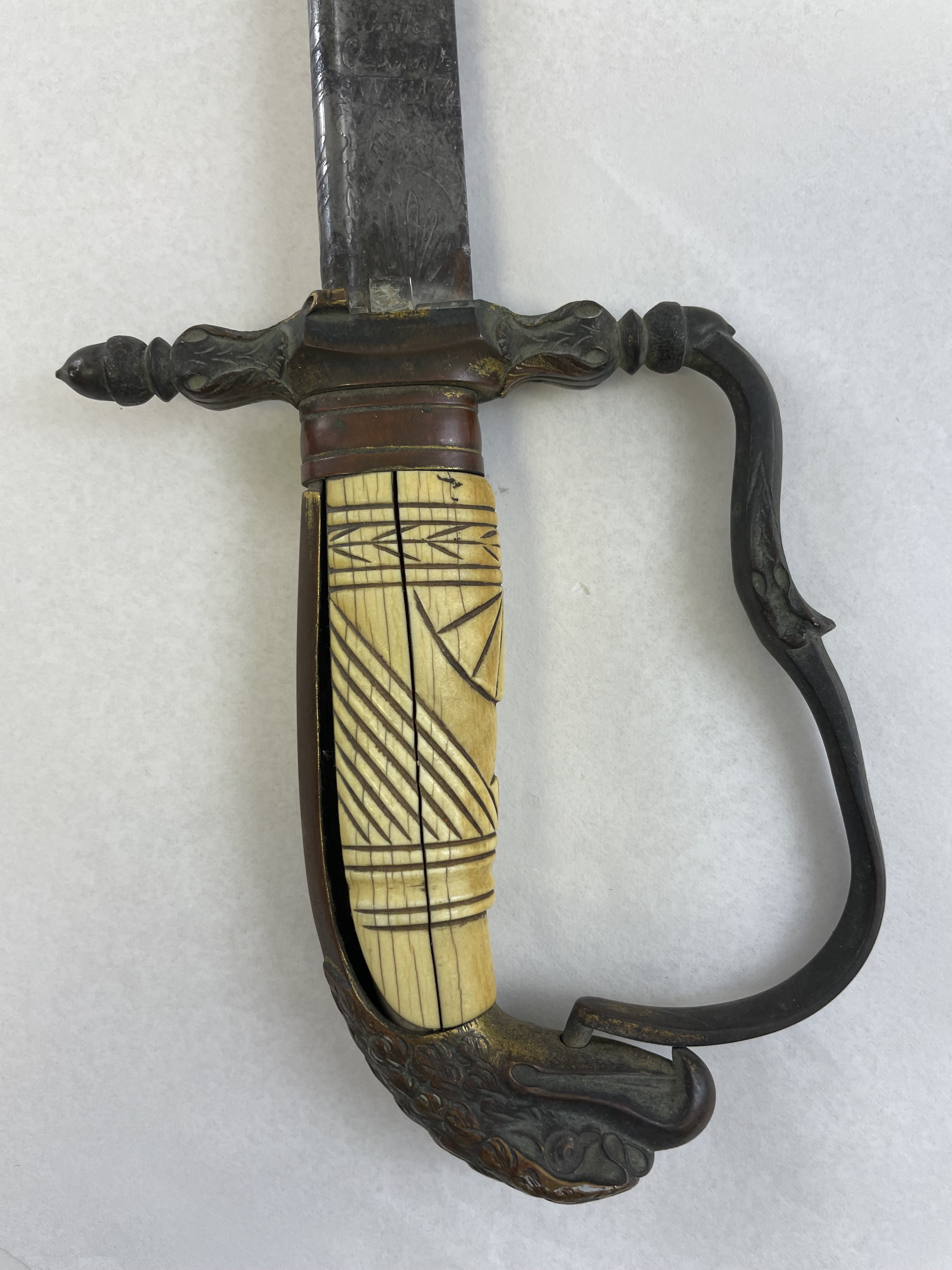
Grip and eagle-head pommel (HRNM)
The grip is made of an off-white material, possibly ivory or whalebone, that has probably yellowed with age. The grip is carved with symmetrical lines on either side, a semi-circle with lines radiating from a central point, and an arrow-like pattern closest to the crossguard. The pommel is carved prominently in the shape of a stylized eagle’s head. Included with the sword is a black leather scabbard with two large brass mounts on the throat of the scabbard and its midsection. Both brass mounts are etched with an anchor design.

Both sword and scabbard are in good condition, albeit affected by the elements and the passage of time. The brass and steel have become discolored with a dark patina, particularly on the edges of the blade and the manufacturer’s inscription. The ivory grip has discolored into a sort of creamy yellow and may be coming unglued from the rest of the hilt; the brass at the base of the blade is also faintly discolored with yellow patches. It should be noted that this sword model was produced with a large folding guard, embossed with a foliate pattern. While it is unknown whether this particular sword was manufactured with a folding guard, the geometric indentations on the base of the hilt seem to indicate that something could have slotted in.

While the sword itself was not used by Collins during the incident, that he retained possession of the sword altogether is a testament to the nation’s support for his actions outweighing legalities. Under other circumstances, the seizure of another nation's vessel in international waters would have spelled the end of his career, perhaps even imprisonment. However, dispatching one of the feared Confederate commerce raiders that had claimed so many Union merchant ships in the Atlantic proved that the government and the public were willing to overlook such transgressions in the pursuit of victory over the secessionists.


Primary Sources
-Report of Lieutenant Morris, C.S. Navy, late command C.S.S Florida, of the seizure of that vessel by U.S.S Wachusett. October 13, 1864, Bahia. Naval History Heritage Command https://www.history.navy.mil/research/library/online-reading-room/title-list-alphabetically/c/capture-of-css-florida-by-uss-wachusett-report-of-lieutenant-morris.html
-Report of Commander Napoleon Collins. U.S. Navy, commanding U.S.S Wachusett, of the seizure by that vessel of C.S.S Florida. October 31, 1864. U.S.S Wachusett. St. Thomas, West Indies. Official Records of the Union and Confederate Navies in the War of the Rebellion. Series 1, vol. 3. Washington. Government Printing Office. 1896.
-"The Capture of the Florida." New York Times (1857-1922), Nov 9, 1864. https://www.proquest.com/historical-newspapers/capture-florida/docview/91834546/se-2?accountid=12967
-"THE FLORIDA CASE.: CORRESPONDENCE BETWEEN MR. SEWARD AND THE BRAZILIAN AUTHORITIES." New York Times (1857-1922), 1865. https://www.proquest.com/historical-newspapers/florida-case/docview/91934907/se-2?accountid=1296

Friday, February 28, 2020

Forty Years Ago: Clive Cussler's Contentious Contribution

The image of the ill-fated sloop-of-war USS Cumberland looms large in the logo and front window of the Hampton Roads Naval Museum in downtown Norfolk, Virginia.  Without (M.C. Farrington)
By M.C. Farrington
HRNM Historian
 
Those familiar with the Hampton Roads Naval Museum (HRNM) know of the special status conferred upon the museum with regards to two famous local shipwrecks, USS Cumberland and CSS Florida–the former being the first vessel sunk by an ironclad warship, CSS Virginia, during the Battle of Hampton Roads in March 1862, and the latter being a captured Confederate commerce raider brought to Hampton Roads in November 1864 after her capture in Brazil by USS Wachusett the month before. 

A permanent exhibit devoted to the Confederate raider Florida has been a part of the museum's Civil War gallery since 2011. (M.C. Farrington)
HRNM is the only museum in the world authorized by the United States Government to hold artifacts recovered from both vessels.  Both wrecks rested close to one another on the bottom of the James River not far from Newport News Shipbuilding, which began operations over two decades after the Civil War.  There the two wrecks rested in obscurity for over a century.

That is, until one of the most famous authors in the world, Clive Cussler, set out to find them. 

Novelist and ocean adventurer Clive Cussler (9News Australia)
Cussler, the best-selling adventure novel writer who died last Monday in Arizona at the age of 88, used the proceeds from his first commercially successful book Raise the Titanic (1976) to found an organization dedicated to undertaking the types of undersea adventures he wrote about in his novels. Fittingly, the name for that organization, the National Underwater and Marine Agency (NUMA), began a fictional government organization in his novels.

Cussler and NUMA set out boldly across the Atlantic in 1977 in a quest to find the wreck of John Paul Jones' flagship Bonhomme Richard, the first in a long list of history's lost shipwrecks that they hoped to discover.  According to Cussler's obituary in The New York Times, NUMA ultimately discovered some 60 wrecks over the following decades and that "[v]aluable artifacts raised by his expeditions were given to museums or governments." Considering that the Bonhomme Richard expedition ended in failure (the ship wasn't found until 2018), perhaps Cussler's first experience with artifact giving occurred in Hampton Roads.  But what happened in 1980 when the swashbuckling exploits of Cussler's official-sounding yet private organization brought it to Hampton Roads and attracted the attention of the real by-the-book feds?  Namely, those at the Hampton Roads Naval Museum, which had opened less than a year before? 

Accounts differ.

Patricia Gleeson, the Hampton Roads Naval Museum's first registrar, and Mike Curtin, the museum's first director, stand in front of the historic Pennsylvania House, which was built for the 1907 Jamestown Exposition, after the museum's opening there in 1979.  It moved to join Nauticus, the National Maritime Center, in 1994. (Hampton Roads Naval Museum file)
Retired Vice Admiral Bernard "Beetle" Forbes, who was tasked by the Navy to bring the museum into operation, and founding civilian Director Mike Curtin had practically just begun amassing artifacts from what was then the Naval Historical Center for the museum's collection when they caught wind of what was in the offing. 

NUMA divers had been working on what was left of the remains of CSS Virginia in the shallow waters off Craney Island at the mouth of the Elizabeth River when they decided to cross the roadstead and look for the wrecks of Cumberland and Florida.

"The Rebel Steamer 'Merrimac" running down the frigate 'Cumberland' off Newport News," an illustration of the sloop-of-war's demise after the emergence of the Confederate ironclad in Hampton Roads on March 8, 1862. (Harper's Weekly/ Hampton Roads Naval Museum file)
Long-time HRNM curator Joe Judge wrote an account of the affair in the fortieth anniversary edition of our journal, The Daybook, which was published last year:
The museum’s early years coincided with important developments in the region’s underwater historic sites. In 1980, Clive Cussler, popular novelist best known for his book, Raise the Titanic, pursued a long-standing interest in the two Civil War ships whose remains lie in the James River: USS Cumberland and CSS Florida. Cussler contracted with a local archaeological firm, who in turn called on the knowledge of local watermen to help locate the ships. This knowledge, combined with a remote sensing survey, led archaeologists to the two wrecks. The recovery of numerous artifacts confirmed that these shipwrecks were most likely Cumberland and Florida.

The archaeology team transferred the artifacts to the Virginia Historic Landmarks Commission, where they quickly became a source of contention. The Navy asserted its rights to them with a frosty note from the JAG corps that stated “these vessels and related artifacts are considered the property of the United States … it is therefore requested that these artifacts be transferred to the Hampton Roads Naval Museum.” In November 1983, HRNM received the artifacts, which became a cornerstone of the collection. Director Mike Curtin summed up the swirling debate about who owned the artifacts to a newspaper reporter: “There’s a lot of ego involved.”      

"The sinking of the rebel war steamer Florida, near Fortress Monroe, Nov. 28...,"  an 1864 illustration from Frank Leslie's Illustrated Newspaper. (Hampton Roads Naval Museum file)
For his part, Mr. Cussler was a bit blunter and less magnanimous in his recollection of the affair during their second expedition to Hampton Roads in July 1982, recorded for posterity on the NUMA website.
A display case in the Battle of Hampton Roads section of the museum's Civil War gallery displays artifacts recovered from the sloop-of-war Cumberland, including a caliper (HR83-066-011), a gun site cover (HR83-066-004), and a sabot for one of Cumberland's rifled gun rounds (HR83-066-016). (M.C. Farrington)
In any event its can be said that, despite differing opinions and some hurt feelings, the late, legendary author helped get the HRNM collection off the ground, whether he wanted to or not.

Artifacts from the Confederate screw steamer Florida, from shoes to medicine bottles to Blakely rifle shells, line the exhibit devoted to the ship within the Hampton Roads Naval Museum's Civil War gallery. (M.C. Farrington)
When it comes to the wrecks of the Cumberland and Florida, the Hampton Roads Naval Museum's acquisition of their artifacts was obviously not the kind of ending Clive Cussler would have penned for one of his adventure stories.  Yet in reality, for nearly four decades the public has been able to see the choicest artifacts from both vessels in HRNM's Civil War Gallery in downtown Norfolk, with some of the larger pieces of the wrecks available for view by appointment at the museum's annex near its original home on Naval Station Norfolk.  
The bell of the sloop-of-war Cumberland in the Hampton Roads Naval Museum's Civil War gallery. It was found in 1981 by Underwater Archaeological Joint Ventures of Yorktown, Virginia, working under contract for NUMA. (HR83-066-22/ M.C. Farrington)
Not all of the artifacts from the Cumberland and Florida were accessioned into the HRNM collection from Clive Cussler and affiliated colleagues such as Dr. John Broadwater, then of the Virginia Historic Landmark Commission's Research Center for Archaeology. Many were confiscated later by the U.S. Department of Justice and Naval Investigative Service from looters who dredged the shipwreck sites during the late-1980s, possibly after learning of their existence and location from news stories about their discovery. That story will have to wait until another time.

Until then, suffice to say that all's well that ends well.
 

Monday, October 26, 2015

Unexpected Enemies in the Civil War: The Japanese (Part One)

By Elijah Palmer
Hampton Roads Naval Museum Educator

While the majority of the US Navy in the Civil War was involved in blockade operations along the Southern seaboard, a few ships were needed to patrol the high seas because of the success of Confederate commerce raiders. In July 1863, USS Wyoming was finishing its cruise spent searching for CSS Alabama in the Pacific. Commander David McDougal, captain of Wyoming, received orders to head  back to the United States. However, just before the crew was to leave from Yokohama, they heard of a nearby attack on the American merchant steamer, Pembroke. Perhaps contrary to expectations, the aggressor was not Raphael Semmes and the Alabama, but Japanese forces flying their national flag. This was alarming, as the United States and Japan were not at war, having signed a treaty only a few years before. 
USS Wyoming (from Official Records)
Commander McDougal
Deciding that such an affront could not go unpunished, Commander McDougal postponed his return to the United States, instead taking his ship to what he termed "the scene of the outrage."* Pembroke had been attacked near the heavily transited Shimonoseki Straits (known now as the Kanmon Straits), a key waterway between two of the main Japanese islands, Kyushu and Honshu. 
(image from http://www.shimonoseki-fc.jp/)
 USS Wyoming arrived at the straits on the morning of July 16, 1863. Near the town of Shimonoseki on the north side of the channel, the crew spotted three Japanese vessels which were identified as those that had attacked the Pembroke. Remarkably, these ships were originally American and British-built merchant vessels which had been outfitted for combat. McDougal noticed that while these ships flew the Japanese flag, they were also flying the colors of the powerful Prince of Nagato (a feudal domain also known as Choshu), who was "bitterly opposed to foreigners." This fact explained the antagonism previously displayed by these forces, who were acting independently from the Japanese government. When USS Wyoming approached these ships, previously unknown shore batteries opened fire upon it. A Japanese eyewitness onboard the American frigate reported that the fire intensified when the American flag was hoisted. The American ship was faced with fire from three ships as well as six shore batteries, yet McDougal did not back down even as most of his inexperienced crew had become "quite pale." Even though afraid, these green sailors would prove themselves this day. 
McDougal's map of the battle (From Official Records)
While the shore artillery included modern Dahlgren guns (given to the Japanese by the US), most of their shells were aimed at the center of the channel, which Wyoming dodged by hugging close to shore. For sheer number of cannon involved, the American ship was outnumbered, but was able to take advantage of better gunnery skill as the Japanese shore gunners' "aim was wild" and "their shot mostly went ten to fifteen feet overhead." Wyoming's crew returned fire with "XI-inch shell from pivot guns and solid shot from broadside guns" as it headed towards the Chosu vessels. The American ship first passed between two of the ships, a brig and a bark, exchanging broadsides at pistol range,** receiving damage and casualties, but crippling the Japanese vessels. Commander McDougal then targeted the Japanese steamer Koshin (formerly known as Lancefield), which the Wyoming's 11-inch Dahlgren cannon crews put out of action when "two well-directed shells exploded [Koshin's] boilers...proved by the vessel being immediately enveloped in steam and smoke." 
USS Wyoming (center) attacks between the Japanese ships
Koshin's (Lancefield) boiler exploding, causing an estimated 40 casualties. Wyoming to the right.
The battle was over in about an hour, with the Pembroke's attackers crippled or destroyed, and with punishment meted out to the artillery on shore as well. Wyoming suffered heavy damage, being "hulled 11 times, and with considerable damage to smokestack and rigging aloft." In addition, around a dozen sailors and marines were killed or wounded. McDougal praised his men, stating that "the conduct of the officers and crew was all I could desire." 


Due to the continued threat of CSS Alabama, USS Wyoming put off returning to the United States for another year, only arriving in Philadelphia in July 1864, in dire need of repair. However, the threat of another Confederate raider, CSS Florida, forced McDougal and his crew to return to sea. For all their likely grumbling, this endeavor proved to be short-lived as a faulty boiler prompted its return to the navy yard for repairs, likely to the crew's great appreciation. 

Commander McDougal believed that his actions against the Choshu had taught them "a lesson that will not soon be forgotten," but he was being too optimistic. European ships would continue to be harassed at the Shimonseki Straits, causing international ire and resulting in action the following year. (to be continued)

*All quotations taken from The Official Records of the Union and Confederate Navies, Series 1, Vol. 2 and The Narrative of a Japanese, Vol. 1 by James Heco.
** Sailors and marines shot "100 rounds of musket-ball cartridges, 50 of Sharps rifle ball cartridges, 50 pistol-ball cartridges, 50 revolver cartridges."

Wednesday, December 31, 2014

CSS Florida: Symbol and Substance

The front page of Frank Leslie’s Illustrated Newspaper of December 24, 1864, currently displayed in the gallery of the Hampton Roads Naval Museum, shows the defeat of an antiquated, moribund Confederacy symbolized by the submerged Florida, under the guns of the modern Union Navy in the form of a Passaic-class ironclad, possibly USS Sangamon.  In reality, the Confederate commerce raider and the Union ironclad were both launched in 1862.  
At the close of 1864, two different messages were being broadcast to two different audiences concerning the sinking of the captured Confederate commerce raider Florida.  The image shown by the Northern press to its domestic readership was one of triumph. 

The accompanying story above the illustration did not refer directly to the Florida, its capture from Brazil in October or its sinking near Newport News Point the following month.  It was an editorial on Abraham Lincoln's state of the union address, made on December 6.  It read in part, "There is something almost marvelous in the positive proofs thus furnished that the great loyal section of the Union, in the fourth year of this stupendous civil war, is vastly more powerful in men, materials, resources, all the elements of strength, wealth and prosperity, than at the beginning of the struggle."  The vanquished rebel steamer and victorious Union ironclad merely served as a useful illustration of the state of affairs between the Union and the Confederacy during what would prove to be the latter's final winter.

Within his state of the union address to Congress, Lincoln himself made mention of the international backdrop to the Florida affair; the contentious relations between the US government and those nations granting the status of belligerents to Confederate vessels, diplomats and agents: 

It is possible that if it were new and open question the maritime powers, with the lights they now enjoy, would not concede the privileges of a naval belligerent to the insurgents of the United States, destitute, as they are, and always have been, equally of ships of war and of ports and harbors. Disloyal emissaries have been neither less assiduous nor more successful during the last year than they were before that time in their efforts under favor of that privilege, to embroil our country in foreign wars. The desire and determination of the governments of the maritime states to defeat that design are believed to be as sincere as and can not be more earnest than our own. Nevertheless, unforeseen political difficulties have arisen, especially in Brazilian and British ports and on the northern boundary of the United States, which have required, and are likely to continue to require, the practice of constant vigilance and a just and conciliatory spirit on the part of the United States, as well as of the nations concerned and their governments.
William H. Seward (Wikimedia Commons) 

As with such speeches made today, the state of the union address is an important way for the chief executive to communicate policies and intentions to foreign powers.  A way to send a more direct message, of course, is through the Secretary of State.  A message sent on December 26 from William H. Seward to the Brazilian charge d' affaires in Washington reflected the uncompromising stance Lincoln's cabinet took towards the Confederacy.  In response to an official protest made on December 12 against the US government over Florida's seizure by USS Wachusett from the port of Bahia, Seward replied:

This Government disallows your assumption that the insurgents of this country are a lawful naval belligerent, and...it maintains that the imputation of that character by the Government of Brazil to insurgent citizens of the United States who have been hitherto been, and who still are, destitute of naval forces, ports, and courts is an act of intervention in derogation of the law of nations.... 

So also the Government disallows your assumptions that the Florida belonged to the aforementioned insurgents, and maintains... that the vessel, like the Alabama, was a pirate belonging to no nation or lawful belligerent, and therefore the harboring and supplying of these piratical ships and their crews in Brazilian ports were wrongs and injuries for which Brazil justly owes reparation to the United States as ample as the reparation which she now receives from them.

Seward then declared that, although the Florida's crew were "enemies of the United States, and as they contend, enemies of the human race," they had been unlawfully brought into custody and therefore "could not lawfully be subjected to the punishment which they had deserved."  They would then "be set at liberty to seek a refuge wherever they may find it...."  

"The Florida was brought into American waters and was anchored under naval surveillance and protection at Hampton Roads," Seward continued.  "While awaiting the representation of the Brazilian government, on the 28th of November she sunk, owing to a leak which could not be seasonably stopped."  Seward announced that a naval court of inquiry had submitted its report, concluding that "...it is assumed that the loss of the Florida was a consequence of some unforeseen accident which casts no responsibility upon the United States."   

Because CSS Florida and the men who sailed upon her were considered the unlawful combatants of their day by the United States Government, the laws of warfare, such as there were, did not apply to them.   The demands of the Brazilian government that the United States government abide by international laws and treaties by returning the steamer were met by the insistence that Brazil was abrogating those same laws and treaties by recognizing Florida as a lawful combatant in the first place.

Seen in this light, Seward's alleged suggestion to Rear Admiral David Dixon Porter that Florida be surreptitiously sunk is perfectly plausible.  And if this was the real reason for her demise, it would be far from the first or last time international laws and conventions were skirted, bent or broken in the interest of defeating an enemy perceived as illegitimate.  

Saturday, November 29, 2014

Sesquicentennial of a Sinking

A contemporary illustration shows a whaleboat from USS Atlanta (foreground) returning to the ironclad at about daybreak, November 28, 1864, following the unsuccessful effort to save the prize steamer Florida.  Although the broken mizzen mast is shown correctly, the former Confederate commerce raider actually had two funnels, and her jib boom had been lost during a collision on November 19.   
One-hundred-and-fifty years ago, anyone gazing over the James River from Newport News Point looking for the recently captured prize cruiser Florida would have seen only its fore and main masts jutting out of the water.  To the men who had spent years scouring the seas looking for the elusive Confederate commerce raiders, there must have been something satisfying about seeing her consigned to the river bottom.  To her former crew who by this time had either arrived back in England from Brazil or were prisoners near Boston, the image of the wreck in the northern press might have appeared tragic.  The northern press, however, treated the sight as both emblematic of the Confederacy’s folly and the Union’s supremacy.  

Symbolism aside, Florida had been a captured enemy warship, and even if international opinion at the time favored her return to the Brazilian port from whence she was taken, she should have remained in place, well-guarded and maintained, as negotiations continued.


By order of Rear Admiral David D. Porter, commander of the North Atlantic Blockading Squadron, Florida had been well-guarded, placed 1,200 yards away from the former Confederate ironclad USS Atlanta on November 24, 1864, with the instruction to "always have steam up, make sure deck pumps are working in case of failure of steam."  There was also a signaling plan in place in case things went awry.  But after things did go awry, starting with a sudden increase of water within Florida's engine compartment late on the evening of November 27, she was settling on the bottom of the James by 7:30 the following morning.   

Had the sinking actually been the accidental outcome of a well-intentioned yet insufficient effort?  Or, rather, had things gone exactly according to plan?

Surviving documents from the period show both the former and the latter.  

Let’s look at the first one.  Within the Official Records of the Union and Confederate Navies in the War of the Rebellion, Acting Master Jonathan Baker, who had been put in charge of Florida on November 18, described the circumstances of the sinking in an initial report to Rear Adm. Porter: 


This morning at 1:30 the engineer in charge reported that he could not keep her clear; that the water was gaining constantly.  I called all hands and rigged the deck pumps and commenced bailing, and signalized to the U.S.S. Atlanta for assistance.  Her commander with two boats came to me, and did all in his power to keep her afloat, but in spite of all our efforts the water kept gaining on us, till, finding that our utmost endeavors were unraveling, I gave orders that all the property belonging to the crew should be put into the boats and sent to the Atlanta.
At 7:15 I got a tugboat alongside for the purpose of towing her into shoal water, but she was settling so rapidly that I considered it dangerous to make fast, and at 7:30 she went down in 9 fathoms water.


The papers of John N. Maffitt, who had captained CSS Florida through her first and most successful cruise, offer an alternative explanation for the sinking; one that does not appear on any official government record, investigative document or piece of diplomatic correspondence.  But if true, the account of what really happened, supposedly given to Maffitt after the Civil War by none other than Porter himself, stands as a fascinating example of the deficiencies official records pose to those seeking the truth.

Maffitt wrote:


Admiral Porter placed an engineer in charge of the stolen steamer, his imperative instructions being, “Before midnight open the sea cock, and do not leave that engine-room until the water is up to your chin.  At sunrise that rebel craft must be a thing of the past, resting on the bottom of the sea.”

Saturday, November 22, 2014

Florida's Unplanned, Uncertain Sojourn

One-hundred-fifty years ago this week, Confederate States Navy Lieutenant Thomas K. Porter, the man who had surrendered CSS Florida after a pre-dawn raid a month and a half earlier, beheld her sorry state on the James River while he was being transferred to Boston as a prisoner of war.  “She had lost her jibboom[sic] by a steam tug running into her,” Lt. Porter reported after his release to his erstwhile commanding officer, Charles M. Morris.   
On November 19, 1864, the Army troop transport Alliance, according to one witness, “thumped the Florida pretty hard, two or three times.  She swung around for and aft and did the Florida considerable damage,” while getting underway.   
Five days after the collision, Rear Admiral David D. Porter, commander of the US Navy’s North Atlantic Blockading Squadron, ordered Florida be taken about 1,500 yards further up the James and put beside another former Confederate warship, the ironclad USS Atlanta.  Until then, the prize steamer had been anchored above the remains of USS Cumberland, famously sunk by CSS Virginia during the Battle of Hampton Roads more than two-and-a-half years earlier.  


Union officers made it clear to the Confederate lieutenant that he would in all likelihood never see Florida again.
Lt. Porter wrote, “A Lieutenant-Commander told me that if the United States Government determined to give her up, the officers of the navy would destroy her.” 
Back in Brazil, United States Minister J. Watson Webb had known of the plan to attack CSS Florida.  After all, he had told USS Wachusett’s commander Napoleon Collins, among other Union captains on the hunt for “rebel cruisers,” that they were to attack or “run down” any they found in Brazilian ports.  Webb claimed that he “would make it all right with Brazil,” believing he had reached an understanding with their minister of foreign affairs.  Webb had also written to Secretary of State William H. Seward in May 1863 that, “…if we should sink these Pirates in Brazilian waters, the government of Brazil would secretly rejoice over the act, and be content with a handsome apology.”  
But taking the raider back to America as a prize?  That had not been part of the plan and the operation exposed senior US officials to charges of hypocrisy that were hard to refute.  In the end, the American Secretary of State merely claimed the operation had not been authorized to begin with, and that the blame for the Florida imbroglio rested with those responsible for carrying out the operation.
In his protest against the Florida seizure, the Brazilian charge d’affaires to the United States in Washington cited as a precedent the American government’s demands that the French release HMS Grange after the frigate L’Embuscade seized her in Delaware Bay in 1793.  The CSS Florida case was more egregious however because of assurances made by the United States Consul in Bahia, Thomas F. Wilson, that Brazilian neutrality would be respected, only to have the diplomat board the offending warship just before the attack and sail away with the prize. 
Seward, while claiming the Florida was, “…like the Alabama, a pirate belonging to no nation or lawful belligerent,” yielded to the Brazilians that “…the capture of the Florida was [an] unauthorized, unlawful, and indefensible exercise of the naval force of the United States within a foreign country in defiance of its established and duly recognized government.”  As a consequence, Seward announced that Consul Wilson, the man most responsible for persuading Napoleon Collins that he should make the attack, would be dismissed, and that “[President Lincoln] will suspend Captain Collins, and will direct him to appear before a court-martial.” 
After Florida's bow sustained substantial damage in a collision with US Army transport Alliance as it was getting underway on the morning of November 19, she was moved from her original position (in red) to a new position (in blue) about 1,500 yards upriver near what was then Camp Butler (in purple) on the 24th.    
As for acceding to demands to return the Confederate vessel to Brazil, her first commander John N. Maffitt wrote the following account of the conundrum after conducting a personal fact-finding mission years after the war:
Mr. Lincoln appeared exceedingly mortified and confused on receiving protests from the different representatives of the Courts of Europe denunciatory of this extraordinary breach of national neutrality.  Mr. Seward, with his usual diplomatic insincerity and Machiavellian characteristics, prevaricated, while he plotted with a distinguished Admiral as to the most adroit method of disposing of this elephant.  During an interview between Mr. Seward and Admiral Porter, the former exclaimed, “I wish she was at the bottom of the sea” 
“Do you mean it?” exclaimed Porter.
“I do, from my soul!” was the answer. 
“It shall be done” replied Porter.  
 

Friday, November 14, 2014

Florida’s Fractious Final Voyage

Despite the peaceful depiction of Florida (left) and Wachusett in this contemporary illustration from Harper's Weekly, on its voyage to Hampton Roads from Brazil, Florida was missing its mizzenmast (the mast closest to the stern) after an initial attempt to sink the vessel.     
One-hundred-and-fifty years ago this week, the former CSS Florida, a cruiser less than three years old yet a shell of the dreaded rebel commerce raider it had been, arrived in Hampton Roads shadowed by its captor, the sloop of war USS Wachusett.
After leading the successful capture of Florida in the “neutral” port of Bahia, Brazil and successfully delivering her as a prize back to the United States, one would think Wachusett’s commanding officer Napoleon Collins might have been in a celebratory mood over his achievement.  The U.S. Navy’s official records show, however, that he was a man with an axe to grind.  Mistakes made during the sneak attack on the commerce raider followed by accusations and recriminations made along the 1,400 mile journey to Hampton Roads brought Commander Collins and a principal officer under his command to the point that each threatened to fire upon the other before reaching home waters.  
According to Collins’ account, the trouble started before the journey even began.  
In a report to Washington dated October 31, 1864, detailing the seizure, Collins mentioned two problems he encountered during the pre-dawn attack on October 7.  The first was an “unforeseen circumstance that prevented us from striking [Florida] as intended.”  The Union sloop of war dragged its anchor across the harbor as it made for the slumbering rebel raider.  Collins had intended to stealthily cast away the anchor chain, slip her moorings and strike a decisive blow.  He wrote later, “…it was my intention to strike her full speed amidships, without firing a shot of any kind or a loud work being spoken, and if we succeeded in sinking her to back off and go quietly to sea.”
Dragging her anchor along, however, Wachusett could only manage a glancing blow at less-than-optimal speed, taking down Florida’s mizzenmast and main yard, leaving the ship crippled, yet still very much afloat.  
With a Brazilian navy corvette nearby preparing to intervene, the entire plan had to be changed.  
After the half of Florida’s crew on duty during the attack either surrendered, escaped or were shot in the attempt, Collins ordered a prize crew dispatched to take over the raider.  They would have to deal with managing a ship deprived of its aft sails at the very moment they would have to escape the now non-neutral harbor under fire from Brazilian warships and shore batteries and then sail their prize all the way back to America.  Collins chose Lieutenant Commander Lester A. Beardslee to lead the prize crew.
There seemed to be no alternative.  If Collins broke off the engagement and withdrew at this point, Florida, although damaged, would be retaken by her captain and the members of her crew who had been on liberty and who were no doubt converging on the port in the early dawn, drawn by the sounds of snapping timbers and cannon fire.  
This leads us to the second problem mentioned in Collins’ report, which concerned the use of two of Wachusett’s 32-pounder guns to answer the Confederates’ small arms fire.  Collins claimed they were fired “contrary to my orders.”  

During their first stop en route, Wachusett put into the tiny island of St. Bartholomew for provisions and to transfer 19 of their 70 prisoners over to the Union sloop Kearsarge while Florida remained offshore.  Collins later claimed that, despite having given the lieutenant commander strict orders not to let Wachusett out of his sight, Beardslee had by that evening somehow managed to drift over 20 miles from the five-mile-long island.  Furious at what he regarded as Beardslee’s disregard of his orders, Collins was overheard by one of the prize crew officers threatening to shell Florida with one of his 100-pounder rifled guns.  
The following day, the acting ensign returned and told Beardslee about the claim that he had disobeyed orders and that Collins had contemplated shelling him.  In response, Beardslee fired off a letter to the commander denying he had gone further than nine miles and requesting a court of inquiry be convened upon their return to investigate not only the validity of that charge but the conduct of the entire operation.  “I feel very confident that a court bringing out all the facts connected with the Florida since the day she arrived in Bahia will find little to censure in my conduct,” he wrote, “unless the capture itself be declared wrong [emphasis added].” 
“Should the Wachusett at any time begin firing at this United States steamer,” continued Beardslee, “I should most certainly be led to the belief that the Confederates aboard of[sic] the Wachusett had captured the vessel and that my duty to my country called upon me to destroy her.”  He added, ominously, “I shall most certainly return a shell from the Wachusett with both broadsides of this ship, which are in readiness, and if I shall have made a mistake none of us will live to rectify it, as I shall sink this ship, if I can not the Wachusett.”
Perhaps under the assumption that an investigation would indeed be forthcoming, Collins then wrote directly to Navy Secretary Gideon Welles from Hampton Roads two days after their arrival on November 12 requesting Beardslee be court-martialed on eight different counts, including failing to detach the anchor chain from his ship despite assurances it had been done, firing the broadside without permission,  sending the “improper letter” to him (which he enclosed), repeating his intention to call for a court of inquiry upon their return, and even “charging me by implication with cowardice.”
Of course a court of inquiry would be convened and a court martial conducted in the months to come, but not because of the nearly fratricidal feud between the two officers. 

Wednesday, October 8, 2014

The Capture of CSS Florida, October 7, 1864

USS Wachusett rams CSS Florida at daybreak, October 7, 1864 (Century Magazine)
US Navy ships based in Hampton Roads today routinely make port calls around the world, but their journeys in times of war or peace usually begin and end in their home port.  During the Civil War, however, those working aboard Confederate commerce raiders could claim no such luxury; every port in their homeland was sealed off by Union warships.      
The Confederate strategy to attack Union commercial shipping with privateers and commerce raiders, called guerre de course, was often employed by weaker naval powers (including the United States).  But the strategy came with more than its share of vulnerabilities.
The commerce raiders’ dependence upon using the ports of neutral powers for operations not only hobbled their ability to take on essential provisions and make needed repairs, but an adversaries’ disregard of neutrality also made possible the capture of one of the Confederacy’s most important raiders: the cruiser CSS Florida.  Like the famous CSS Alabama, Florida wreaked havoc on Union shipping over two extended cruises, accounting for 60 of more than the 200 merchant ships lost to raiders during the Civil War.  More than just a naval victory, the ship’s capture 150 years ago is also a controversial example of the American diplomatic corps’ role in armed conflict. 
Built as Oreto in a Liverpool shipyard, Florida would have never seen action if American consular authorities had achieved their aims early on.  After its arrival at Nassau in April of 1862, Samuel Whiting, the United States Consul, immediately recognized Oreto as a possible blockade runner and demanded the ship’s seizure, claiming that it was being armed in a neutral British port, and thus was in violation of the Foreign Enlistment Act.  After the Royal Navy briefly complied with the request, the British governor C.J. Bayley intervened and ordered her release, pointing out that Oreto was registered as a British vessel, flew the British flag, and carried no armament.  Nevertheless, the vessel was seized two more times in Nassau as the British civil and military authorities of the colony struggled amongst themselves as to whether the American diplomats were right about the ship.  Bayley finally decided that a trial by an admiralty court was in order. 
Despite a litany of sworn statements from American officials attesting to the nefarious nature of the ship, the British attorney general in Nassau, G.L. Anderson, stuck to the defense throughout the trial that although Oreto was designed like a warship, it was simply not a warship due to the fact that no weapons were aboard.  It was also a fact that Anderson had been quoted in public that his sentiments were with the Confederacy, but no matter.  His nakedly legalistic defense won the day and Oreto was released on August 7, meeting a British schooner loaded with arms and ammunition two days later near deserted Green Cay north of Nassau.  Ten days after that, with guns loaded and ready for action, Oreto was officially christened Florida and commissioned into the Confederate Navy. 
        
During two eventful cruises capturing 38 enemy vessels, CSS Florida paid call on the ports of officially neutral but friendly ports in Cuba, the Bahamas, Barbados, Bermuda, the Portuguese island of Madeira, the French island of Martinique, Spain, and Brazil, and even a lengthy yard period in France, all the while under the vociferous objections of American diplomats, who would simultaneously demand the ship be detained while frantically trying to summon the nearest Union warship.   In almost every case, the US Navy arrived too late.  But after 61 days at sea over the summer of 1864, Florida’s luck ran out in the port of Bahia, Brazil, where it had arrived on October 4 to take on coal and provisions, as well as make some needed repairs to its boilers.  Waiting in the harbor was USS Wachusett, commanded by Napoleon Collins, who dispatched a boat pretending to be from HMS Curlew in order to ascertain the ship’s identity.  He readied the ship for a fight, yet took no immediate action as Florida settled in.
Florida's commanding officer, Confederate Navy Lieutenant Charles Manigault Morris, assured the president of the province that he would respect Brazilian neutrality and take no action against the larger Federal ship across the harbor.  In response, the president told Morris that Thomas F. Wilson, the United States Consul at Bahia, had pledged that Wachusett would also respect the port’s neutrality.  This was a pledge Wilson would later deny making.
The plan to attack Florida while in a neutral port did not originate with the US Navy.  It was actually hatched by US Minister to Brazil J. Watson Webb and Consul Wilson, after securing the advance approval of Secretary of State William H. Seward.  Seward had encouraged Ambassador Webb: “If nations shall in violation of our right suffer their ports to become bases for the operations of pirates against us we shall adopt such remedies as the laws of self defense allow.”  For his part, Collins was just as reluctant at first to violate neutrality as his Confederate adversary and said as much during his first meeting with Wilson.
On October 5, the day after Florida’s arrival, Consul Wilson attempted to deliver two letters challenging Florida to fight Wachusett, but the Confederate lieutenant refused to even read them.  With several tubes being removed from the boilers of his cruiser and half his crew on leave, Morris would have none of this Federal pugnaciousness. 
After a second contentious meeting with Collins on the afternoon of the 6th, the Consul finally persuaded him to summon his officers for a vote, and with the exception of one, all decided that attacking the ship outweighed all other considerations.  After having committed his diplomatic office to the destruction or capture of Florida, Consul Wilson elected to stay aboard for the duration of hostilities.
As it happened, the Confederate commander was not aboard Florida when Wachusett approached at full steam on the morning of October 7, ramming the smaller commerce raider on the starboard quarter, cutting down her bulwarks and carrying away her mizzenmast and main yard.  The most the stunned crew of Florida, only half of whom were aboard, could answer with were a few pistols.  None of her larger Parrott Rifles were even loaded.  Collins thought he might have put Florida in a sinking condition and he backed his ship off.  The crews began to exchange small arms fire and Wachusett delivered two broadsides.
At this point Collins demanded Florida’s surrender.  This left the difficult decision to submit or fight in the hands of Confederate Lieutenant T.K. Porter, commanding the ship in Morris’ absence.  After conferring with the other officers present, Porter boarded Wachusett to present his sword and ship’s ensign to Collins.   
     
Collins took his prize in tow and made his way quickly out of the port.  He was hurried along by the Brazilian gunfire from the harbor forts.  The Brazilians missed their mark and Collins escaped.  Brazilian and international outrage was swift and severe.  Consul Wilson wisely escaped with Wachusett, as the citizens of Bahia sacked the American consulate the next day.  No matter, the captured Florida was on her way to Hampton Roads.
Despite the fact that the American diplomats goaded him into capturing Florida, Napoleon Collins was nevertheless court-martialed under pressure from Brazil and sentenced to be dismissed from the service.  In reality, he rejoined the active Navy and ultimately rose to the rank of rear admiral in 1874.