Showing posts with label USS Santee. Show all posts

Thursday, September 8, 2022

USS Santee: The Fleet Oiler that Became an Aircraft Carrier

By CAPT Alexander Monroe, USN (Ret.)
HRNM Volunteer

In early May 1960, USS Santee (CVEH 29) ended a trans-Atlantic tow by the German salvage tug Seefalke at a ship breakers in Bremerhaven[i] and was subsequently dismantled for scrap, thus ending a long career. The voyage, which began on April 18, 1960, at the Navy Reserve Fleet in Boston, started inauspiciously when the towline parted and had to be reattached and the crossing begun anew. It was a sad end for the war-weary ship, whose final configuration and utilization was far different from what its builders initially planned.
USS Santee (AO 29) underway in Hampton Roads, Norfolk, Virginia, 99 days prior to entering Norfolk Naval Shipyard (NNSY) to be converted to aircraft carrier (NNSY)
The period between 1934 and 1940 was hectic, characterized by emerging hostilities world-wide. The major goal of U.S. Navy planners during this turbulent era was nothing less than renewal of the United States Navy quantitatively and qualitatively, together with strengthening national defense. The fleet was to be initially increased in size by 20 percent,[ii] thus providing additional combatant ships and fleet auxiliaries. The shore establishment was likewise to be augmented. The first and second Vinson Acts and the Vinson Walsh Two Ocean Navy Act of 1940 funded these mandatory goals. These acts were formulated against the backdrop of the Japanese invasion of mainland China and the Nazi annexation of Austria, known as Anschluss. In fact, the Vinson Walsh Act was signed 18 days after the fall of France.[iii] Among other things, that act provided for construction of two Iowa-class battleships, 18 aircraft carriers and conversion of 100,000 tons of ships for other purposes.[iv]

Concurrently, the Maritime Commission under Chairman Joseph P. Kennedy, who later became Ambassador to the Court of St. James, announced a major program. This called for the Commission to build twelve so-called “National Defense Tankers” in four civilian yards from Massachusetts to Newport News, Virginia. The procurement contract of $37,000,000, funded in part by Standard Oil of New Jersey and the U.S. Maritime Administration, was signed by officials of the Standard Oil Company of New Jersey, known commonly as “Esso,” though it was understood that the ships might be operated by companies other than Esso. The Sun Shipbuilding and Drydock Company of Chester, Pennsylvania, built SS Seakay, later renamed USS Santee (AO 29). The two other ships constructed were USS Chenango (CVE 28) and USS Cimarron (AO 24). Sponsored by Mrs. Charles L. Kurz, wife of the Chairman of Keystone Transportation, Seakay was launched on March 4, 1939, and delivered to Keystone 25 days later.[v]

SS Seakay operated on the West Coast of the United States delivering crude oil to refineries until early October 1940, and on the 18th of that month it was sold to the United States Navy for conversion to a fleet oiler. Seakay’s commanding officer was Commander William Gibb Bartlett Hatch, a 1913 Annapolis graduate who had earlier commanded the destroyers Toucey and Blakely. He had been praised as an “easygoing and a nice man” by his commanding officer, Vice Admiral Elliot B. Strauss.[vi] The ship and its crew carried out the normal duties of a fleet oiler until March 19, 1942, when Seakay entered the Norfolk Naval Shipyard (NNSY) and was decommissioned for conversion to a “Baby Flattop,” as the original CVEs were initially nicknamed.
USS Santee (ACV 29), re-designated CVE 29 on July 15, 1943, anchored in Hampton Roads. (NNSY)
The conversion process involved removal of the forward and after deckhouses, installation of a flight deck with forward and after aircraft elevators, establishment of a hangar deck, and construction of a small bridge and pilothouse on the starboard side of the flight deck about two thirds of the way to the bow. Santee was recommissioned an Auxiliary Aircraft Carrier (ACV) on August 24, 1942, and in the words of its new commanding officer, Captain William Dodge Sample, “shook loose from the Yard” on September 13, 1942. Even so, another month was consumed undergoing shakedown training, with NNSY personnel aboard until the workmen were finally “shaken off” and practice flights might be undertaken.[vii] Flight operations were limited and very few experienced aviators were embarked.
Flight deck of USS Santee showing SBD-3 Dauntlesses and Wildcats with Torch markings near the fuselage stars (NHHC)
Following shakedown, the ship began its journey to war to be a part of Task Group 34.2, involved in the November 1942 invasion of North Africa commonly known as Operation Torch. The initial three days at sea, bound for Bermuda, for rendezvous with other group elements, was marked by a violent storm off Cape Hatteras that brought “howling winds,” and the ship “rolled and pitched, sometimes alternately and sometimes together,” convincing the greenhorn sailors that they would be lost. On the third day, Santee reached calm waters at Bermuda, and during a short respite repaired storm damage such as stove in ship’s boats and attempted to load additional aircraft. During the attempt to load an SBD-3 Dauntless, the hoist cable parted and the aircraft fell to the deck of an alongside lighter, and no other aircraft were loaded.[viii] On October 25, 1942, the ship left Bermuda, bound for Africa. The transit period was used for limited practice flying, and it was marred on October 30th by the accidental dropping of a depth charge from a Dauntless, which detonated close aboard, damaging homing and other navigational equipment—casualties that became significant for the ship’s later employment and mission execution.[ix]
Map of objective area, Safi, Morocco (History of the U.S. Navy in WWII, Samuel Eliot Morison)
Santee, its ship’s company, and its embarked aviation squadrons were called “the greenest of the green” among the carriers involved in Torch by Admiral Samuel Eliot Morison. There were only five experienced aviators aboard and there was only one practice flight of six aircraft undertaken during the transit. Together with the navigational equipment casualty noted above, it led to the ship’s being assigned to provide close air support and combat air patrol to the Southern Attack Group, which was to land troops at Safi. The objective of the landing and others in Morocco was to wrest control of North Africa from the German-sponsored French government established at Vichy in 1940. Aviators from Santee flew fewer sorties that any of the carriers and by November 11, 1942, when offensive operations ended, it had lost 21 of the 31 aircraft embarked.[x]
LCDR John Thomas Blackburn in 1943 as commanding officer of Fighter Squadron Seventeen (NHHC)
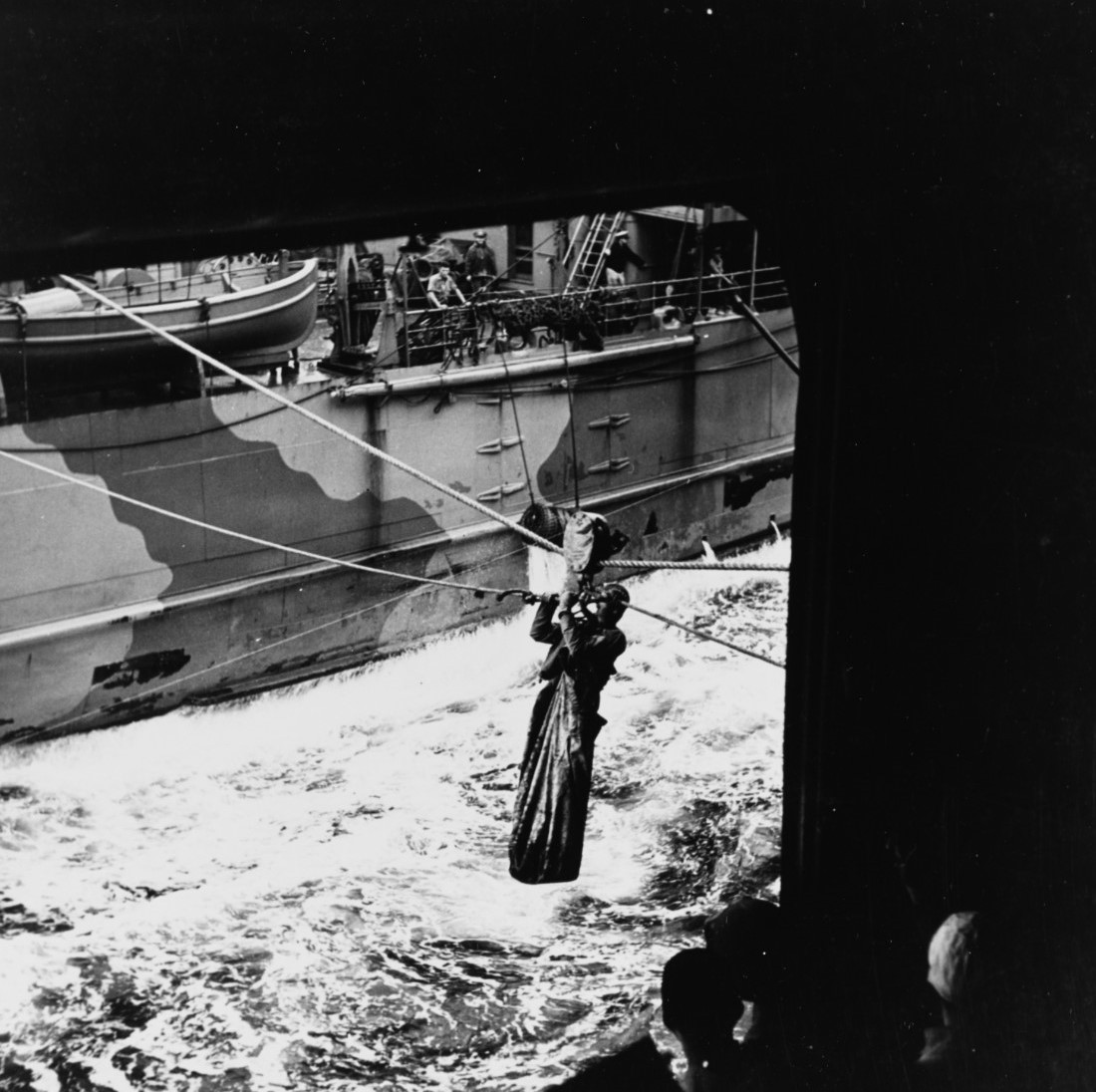
On November 8, 1942, seven Wildcat aircraft left the ship at daybreak. Five could not make it back to the ship. Four landed at Magazan airfield and their crews became prisoners. One crashed at sea, and USS Monadnock (CM 9) rescued the pilot, Lieutenant Commander Tom Blackburn, on November 11. One developed an oil line casualty and was lost without a trace, while one was shot down. Its crew burned the ill-fated machine, encountered an American patrol, and an LST returned the crew to the ship.[xi] Another flight left on the same day, ran out of fuel, and landed at the Safi airfield, where all nine planes bogged down in the soft, bumpy landing field.
LCDR John Thomas Blackburn being returned to USS Santee in a coaling bag by highline on November 11, 1942, after spending 64 hours in the ocean after a crash (NHHC)
On November 9, 1942, Lieutenant Commander Joseph A. Ruddy carried out a hazardous, low-level reconnaissance flight on the Marrakech airfield. Although his aircraft was struck by ground fire, he made a second approach and made a direct hit on the hangar, inflicting considerable damage, and later attacked a column of enemy trucks he observed, which were bound for Safi. He was awarded the Navy Cross for his achievements. On November 11, 1942, after an armistice had been declared, Santee aviators struck Marrakech a final time and destroyed twelve aircraft on the airfield. The Southern Attack Group assault was one in which, according to Admiral Morison, “everything clicked.” The operational commander Rear Admiral Lyal Davidson observed that:

"The Southern Attack Group was able to land at Safi with but two naval casualties and no material damage other than 8 landing craft…and with comparatively light casualties (8 killed in action and 75 wounded in action) among Army Assault troops is attributable to Divine Providence, good weather, surprise, retention of the initiative and accurate and overpowering gunnery."[xii]
Cover of Record of Dockings, Drydock No. 3, NNSY (NNSY)

There is some indication that Admiral Davidson was not impressed with carrier aviator performance and used aircraft from battleship USS New York (BB 34) and the cruiser USS Philadelphia (CL 41) to execute certain missions, such as sinking the Vichy submarine Medeuse. In any event, on November 13, 1942, with its part in Torch complete, Santee left the theater, bound for its Norfolk homeport. It reached home station on November 24, 1942, two days before Thanksgiving. The NNSY Drydock log shows that Santee was docked on December 8, 1942, for voyage and battle damage repairs and was undocked four days later.[xiii]
Page from log book showing Santee as part of Operation Torch (NNSY)
World War Two was far from over for the versatile ship. Following an extended stand down period, it began operations in the South Atlantic the day after Christmas 1942 to interdict enemy merchant shipping and counter hostile naval activity. Santee was also involved in various convoy operations in the Atlantic over the next year. Particularly noteworthy is a period of a few days following November 17, 1943, when it escorted USS Iowa (BB 61) with President Franklin Roosevelt, who was bound for the Tehran conference. Following delivery of P-38 fighter planes to the United Kingdom at Glasgow on January 9, 1944, it transited the Panama Canal on the 18th and 19th of February and served in the Pacific. It had amassed, in America’s first World War Two offensive operation, a considerable record of operational achievement in the time since its sea change from oiler to carrier completed at Norfolk Naval Shipyard.[xiv]

Note from the author: Special thanks to Marcus Robbins, NNSY, and Dave Kavanagh for their assistance with the research of this blog.

Notes:
[i] Weser Kurier, May 5, 1960.
[ii] Public Law 75-528 of May 17, 1938
[iii] The Vinson-Walsh Act, Public Law 76-757, was the largest naval procurement bill in United States History and increased the size of the fleet by 70%
[iv] “Peacetime Naval Re-Armament 1933-39, Lessons for today,” Naval War College Review, Volume 72, Spring 2019, pp 88-103.
[v] “Standard Oil Contracts to Build Twelve Fast Tankers,” From Bulletin of Sun Shipbuilding and Drydock Historical Society, May 1940.
[vi] Reference to Commander William G.B. Hatch, USN at page 85, Oral History of Vice Admiral Elliott B. Strauss, USN, in Oral Histories of the United States Naval Institute, Annapolis, Maryland
[vii] United States Naval Operations in World War II, Operations in North African Waters, Rear Admiral Samuel Eliot Morison, USN (Ret.) p. 133-155; See Docking Log Norfolk Naval Shipyard for August 20, 1942, slightly before its commissioning. The first flight was made on September 24, 1942.
[viii] “A Torch for Africa,” Archives of the Sun Shipbuilding and Drydock Company, p.34.
[ix] Dictionary of American Naval Fighting Ships, Volume VI, Historical Sketches R-S, p.326
[x] Operations in North African Waters, p. 150
[xi] CVE Piper, Escort Carrier Sailors and Airman’s Association, June 20, 2020
[xii] Ibid. p. 133.
[xiii]Record of Dockings, Drydock 3, Norfolk Naval Shipyard, December 8 and 12, 1942
[xiv] On July 8, 2022, prior to completion of this essay, the Museum was visited by the granddaughter of Petty Officer Jethroe Midgette, a former Gunner’s Mate who served in USS Santee (CVE 29) during Torch. She related that her grandfather served aboard not only during Torch but for the entire war.

Thursday, January 9, 2014

USS Savannah Hit By Radio-Controlled Bomb, 1943

By Elijah Palmer
Hampton Roads Naval Museum Educator


The picture above shows the aftermath of an aerial attack on the Norfolk-based USS Savannah (CL-42) off of Salerno, Italy, and an unknown PT-Boat attempting to lay smoke as cover in 1943. On the morning of September 11, 1943, anti-aircraft fire and fighter planes targeted a slow-moving German plane above the US fleet off of Salerno, Italy, but could not stop an object that the plane had fired. Soon, an explosion ripped through the light cruiser USS Savannah, causing serious damage and loss of life. The ship had been hit by an advanced German weapon that the fleet was ill-prepared to meet.
The Norfolk-based Savannah was a series of pre-World War II light cruisers that were used during the war as shore bombardment vessels. 
Commissioned in 1938, Savannah stopped in Norfolk a handful of times before World War II. In late 1942, she was included in the Northern Attack Group (part of Western Naval Task Force), when it sailed from Norfolk in October 1942. As part of Operation Torch, Savannah saw combat action off Morocco in support of the amphibious landings there. By January she had been assigned to help patrol the South Atlantic. Once there, the ship was teamed with the USS Santee (CVE-29) and several destroyers. Returning to the United States after a few months, Savannah sailed out from Norfolk in May 1943, heading for the Mediterranean Sea. Throughout the summer, she supported operations in Sicily and southern Italy, proving very effective in naval gunfire support against German shore targets. On occasion, the ship’s crew also provided medical care for wounded soldiers.

On September 11, disaster struck. The Germans launched a high-tech weapon against the ships offshore. This weapon was the “Fritz X” radio-guided bomb. The Germans used this anti-ship bomb largely in the Mediterranean. The attack on Savannah came shortly after a bomb narrowly missed her sister ship, USS Philadelphia (CL-43). It also came three days after several Fritz X bombs sank the Italian battleship Roma, killing over 1,250 men. The Allies quickly began work on countermeasures for these bombs beginning in August 1943, but effective means were not completed until early 1944, so the fleet at Salerno was vulnerable. 

The Fritz X was an air-dropped, radio-guided missile used by the German air force as an anti-ship weapon. With a 705-lb armor-piercing warhead, it was a weapon to be feared. 
The bomb that hit Savannah went through the top of the No. 3 turret and continued down three decks before exploding in the lower ammunition handling room. The explosion ripped a hole in the keel and part of the port side. The crew fought fires and sealed up the damage, getting the ship underway by the afternoon. After temporary repairs in Malta, the ship sailed for the Philadelphia Naval Yard for eight months of serious repair work. The bravery of these men saved the ship, but the cost of the attack was high. 197 men died, and over a dozen were seriously wounded.

After being repaired, USS Savannah returned to Norfolk and in early 1945 had the honor of sailing as part of the escort for USS Quincy (CA-71), which was carrying President Franklin Roosevelt to the Mediterranean on his way to the famous Yalta conference with Josef Stalin and Winston Churchill. Savannah served as part of the President’s convoy on his return to the United States.

Thursday, August 13, 2009

Model of USS Santee (CVE-29)


The Escort Carrier Sailors and Airmen Association has donated a model of the escort carrier USS Santee (CVE-29) to the museum. The association has placed several models of escort carriers at several other museum around the United States in an effort educate the public about these important warships. The model of the ship is currently on display in the museum.


The vessel herself was formerly the Standard Oil of New Jersey tanker Esso Seakay before being converted into an escort carrier by the workers at Norfolk Naval Shipyard-Portsmouth. During World War II, Santee served out of Naval Station Norfolk for all of 1942 and much of 1943 hunting U-boats (her air wing is credited with sinking three boats, U-43, U-160, U-509), escorting President Franklin Roosevelt across the Atlantic, and transporting Army Air Corps fighters to Europe.

She then served in the Pacific for the remainder of the war. Here her air wing is credited with several dozen air-to-air kills and providing ground support in many of the island campaigns. She was hit by a kamikaze and torpedoed by a Japanese submarine. Both attacks heavily damaged the ship, but did not sink her. She survived the war.