Showing posts with label SEAL. Show all posts

Thursday, November 4, 2021

Book Review: Sea Stories, My Life in Special Operations

By Admiral William McRaven
Reviewed By Captain Alexander Monroe, USN (Ret.)
HRNM Docent and Contributing Writer

In Sea Stories, Admiral William McRaven has written a well-organized, powerful book in which he performs a number of valuable functions. The title Sea Stories is misleading because it has a connotation in the patois unique to the Navy, which means the story is embellished to meet the intent of the teller. The admiral’s stories are, by contrast, real. He shows his personal sacrifice and involvement in his arduous initial training as a SEAL (Sea, Air and Land) special operations officer, an experience shared by all SEAL personnel, officer and enlisted. He describes the wide variety of situations in which Special Operations forces apply their training. Most important, he provides an inspiring catalog of events worldwide which, taken together, show the Navy’s institutional response to the novel challenges of unconventional warfare where one fights against often un-uniformed yet dangerous adversaries. The book gains meaning because of his personal involvement in many of the evolutions of which he writes.

McRaven immediately engages the reader’s attention by linking his personal growth and testing as a nascent high school track star to his indoctrination as a special operations officer. The common thread in the experiences is the necessity for overcoming the difficult aspects of a situation under pressure. He notes doing this through the intercession and encouragement of a devoted coach, Jerry Turnbow, who inspired him to greater effort to break a school record in the one-mile run. He was later inspired by the often profanity-laced exhortations of instructors in BUD/S (Basic Underwater Demolition/Seal) training, reputed to be the most strenuous indoctrination syllabus in the armed forces. He describes what he considers the most important objective of BUD/S indoctrination: to push trainees to their limit and beyond, “to eliminate those unsuited for the world of the special forces operator.” It entails giving encouragement to others as team players in the final stage of a seemingly insurmountable task: surviving Hell Week, the capstone of initial SEAL training.

The book is a rendition of operations in which the United States Navy, often in cooperation with other nations, has applied military power to attain goals to include ensuring national safety, if not survival. McRaven uses various situations requiring rapid response to emerging threats as well as those requiring complex, highly sensitive preparation. An example of the first operation is the seizure and inspection of SS Amuriyah, a hostile merchant vessel thought to be carrying contraband to Saddam Hussein in Iraq. Supported by USS Ogden (LPD 5) and USS Brewton (FF 1086), a team fast roped onto the ship, stopped it, and subdued a bellicose master and hostile crew. The operation, fashioned in about 72 hours, was a success because of total dedication of the SEAL team to mission completion, though it could not be ascertained beyond all doubt that no contraband had been found. McRaven notes in justifying abandoning detailed R2P2 (Rapid Response Planning Process) planning that, “all the staff work on the world doesn’t get you better results than what the experienced officer knows intuitively.” The operation was executed “without any major injuries to either Americans or Iraqis. He later emphasizes another key ingredient in carrying on unconventional operations exemplified in dealing with pirates who seized the SS Maersk Alabama. That is: “factors unfold quickly—you give authority to the ground commander and hope that will win the day.” A second type of operation, shown in the effort to remove Osama Bin Laden, known as Operation Neptune’s Spear, requires planning of a detailed sensitive nature involving the same considerations. Operators must take risks to accomplish the mission.

Admiral William McRaven (Official U.S. Navy photo)

The most moving chapter of the book, “The Next Greatest Generation,” describes his visit to the U.S. Army Hospital, where he visited special operations personnel wounded in the line of duty. Some of these gallant soldiers required intensive hospital care to survive the long journey to CONUS medical facilities. His description of the injuries sustained by one young soldier, who is connected to a multitude of life support appliances, is devastating to the reader and clearly affected the admiral. It renews his admiration for their “tremendous sense of determination, ebullience and lack of self- pity” in facing catastrophic injuries. The abiding lesson for the nation, made at various points in Sea Stories, is that its citizens, like special warfare operators, must be “imbued with an indomitable spirit, a true belief that tomorrow will be a better day—if only they fight and never give up.”

Certain aspects of the book may be distracting to the reader unfamiliar with military patois. The use of coarse language throughout, though sometimes good natured, may be offensive and tiresome; however, it gives it authenticity that is required. The author generally strives to define unique military/Navy terms and acronyms. It might, however, be useful to have a separate glossary of terms and expressions not known to the non-military reader.

In summary then, Admiral McRaven has fashioned an engaging volume well worth the reading. It clearly shows what he quotes from Helen Keller in the page immediately preceding the table of contents that, “Life is either a daring adventure or nothing.”

Friday, January 3, 2020

The Right Tools for the Job: SEAL Firearms of the Vietnam War

Seen from the boat he just jumped from, a Navy SEAL (Sea Air Land Team Member) hoists his  Mk 23 (Stoner 63) high as he makes his way ashore through deep mud during a combat operation in South Vietnam in May 1970.  Although it only fired 5.56 mm rounds, at about 13 pounds, the Stoner in its light machine gun (LMG) configuration weighed roughly half of what a comparable M60 machine gun (firing 7.62 mm rounds) weighed, making it much more portable. (Chief Photographer's Mate A. Hill/ US Navy photo K-84315/ National Archives and Records Administration via Naval History and Heritage Command
By A.J. Orlikoff
Hampton Roads Naval Museum Educator

On October 31, 1972, Engineman 2nd Class Mike Thornton, a member of SEAL Team One, was thrown to the ground by the explosion of an enemy grenade. With shrapnel in his back, Thornton scrambled to his feet to join his fellow SEAL, Lieutenant Thomas R. Norris, and three South Vietnamese Lien Doi Nguoi Nhai (LDNN, Vietnam Navy Special Forces) members. Behind enemy lines, the five men engaged a force of 150 North Vietnamese soldiers for nearly four hours. With fire support from nearby Navy destroyers unable to reach them, Thornton and his comrades contacted the heavy cruiser USS Newport News (CA 148) to provide covering fire and they prepared to retreat into the surf of the Gulf of Tonkin. Norris, while covering their retreat, was severely wounded in the head by an enemy round. Thornton fought his way back to Norris’ position, put the wounded man across his shoulders, and retreated in the face of heavy enemy fire. With covering fire from Newport News so close that one shell burst lifted the two 20 feet into the air, the five men swam to Newport News with Thornton carrying the wounded Norris while helping a wounded LDNN member. Thanks to the courage and valor of Thornton, Norris miraculously survived and the two were awarded the Medal of Honor. It stands as the only instance of two Medal of Honor recipients involved in the same combat operation.


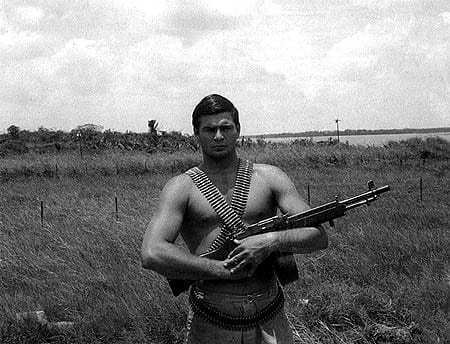
Engineman 2nd Class Mike Thornton poses for a photograph with a Stoner 63 in the LMG configuration while deployed in Vietnam. Thornton enlisted in the Navy in 1967 and served as a gunner’s mate apprentice until he attended SEAL training in Coronado, CaliforniaAfter graduating Basic Underwater Demolition/SEAL (BUD/S) school, Thornton joined SEAL Team 1 where he served in Vietnam from 1969-1972. After his service in Vietnam, Thornton continued to serve in the Navy as a BUD/S instructor and as a founding member of SEAL Team 6, the first SEAL unit dedicated to counter-terrorism efforts. Thornton retired as a lieutenant in 1992. (Defense Media Network)
The story of Thornton and Norris stands as an example of the dedication, bravery, and combat prowess that Navy SEAL members displayed in the Vietnam War. Fulfilling the vital missions of intelligence gathering, counter-intelligence efforts, and long-range patrols, Navy SEALs were a devastatingly effective fighting force that consistently stymied enemy efforts throughout South Vietnam and undoubtedly saved the lives of hundreds if not thousands of Americans and South Vietnamese. Though small in number, they were feared by their enemies, admired by their allies, and were an integral component of the Navy’s largely successful combat operations in Vietnam.
Uniforms and weapons used by SEALs in Vietnam are seen here among uniforms and weapons used by their Viet Cong adversaries in the Intelligence section of the new HRNM exhibit The Ten Thousand-Day War at Sea. (M.C. Farrington)
Several SEAL artifacts are currently on display in the gallery of Hampton Roads Naval Museum as a part of the new exhibit The 10,000 Day War at Sea: The U.S. Navy in the Vietnam War.  Foremost among these are the specialized firearms Navy SEALs used in Vietnam. These firearms allowed Navy SEALs to operate as an elite cadre of extraordinary warriors.
The Stoner 63 (Mk 23 Mod 0) in its commando (15.7-inch barrel) LMG configuration on display in the Intelligence section of the new HRNM exhibit The Ten Thousand-Day War at Sea. (NHHC 1991-58K/ NHHC 1991-58-AZ/ M.C. Farrington)
The Stoner 63, officially known as the Mk 23 Mod 0 Machine Gun, was a powerful and versatile weapon used by Navy SEALs in Vietnam. Designed by Eugene Stoner and manufactured by Cadillac Gage in the early 1960s, the Stoner 63 used the 5.56 x 45 NATO round (though initially designed with the 7.62 round in mind) and was capable of firing 700 to 1000 rounds per minute. Despite some initial problems in manufacturing and weapon trials, the Stoner 63 was hurried into service as one of the primary firearms of Navy SEAL Teams in 1966. Deemed too unreliable for general issue, Navy SEALs nonetheless quickly proved the Stoner 63 to be an effective and efficient weapon.
Armed with a Stoner 63 in the light machine gun configuration in October 1968, this well-camouflaged SEAL could easily lay down a wall of fire against enemy positions. (US Navy photo K-74900/ National Archives and Records Administration via Naval History and Heritage Command)
The Stoner 63 was particularly suited to the needs of Navy SEAL teams due to its unparalleled versatility.  The modular design of the weapon featuring interchangeable parts around a common receiver allowed several configurations of the firearm such as assault rifle, carbine, and light machine gun (LMG). This outstanding versatility allowed SEAL Teams to tailor their weapon to their often-clandestine missions.  SEALs were particularly enamored with the LMG variant as their 75 to 150-round magazines gave them a mobile high rate of fire weapon capable of suppressing enemy forces.  SEALs continued to successfully use variants of the Stoner 63 through 1980, although it was never widely produced for American forces. 

Petty Officer 1st Class Sam Fournier, a member of SEAL Team One, still wears his grease paint as he keeps a sharp lookout from a Navy landing craft which picked up other SEAL team members following an operation along the Bassac River in November 1967.  In addition to their standard modified firearms, SEALs often made further customizations to their gear in the field such as the straps on this M16. Indeed, many SEALs would use non-standard firearms on missions such as the Chinese Type 56 or commercially available shotguns such as the Remington Model 870. Essentially, SEALs made all the modifications to firearms, gear, and uniforms they deemed necessary to accomplish their often difficult and dangerous missions. (US Navy Photo K-42770/ National Archives and Records Administration)
Navy SEALs used their own specialized variant of the M16A1 Assault Rifle, the Mk4 Mod 0.  Like the Stoner 63, the M16 was designed by Eugene Stoner and, unlike the Stoner 63, became one of the most widely produced firearms in world history. After extensive testing and debate in the 1950s and early 1960s, the Air Force and Army officially adopted the M16 as a jungle warfare weapon. Using the 5.56 NATO round, the M16 was an impressive and innovative lightweight weapon capable of accurately delivering high velocity rounds at a relatively high rate of fire. Unfortunately, the M16A1 was a notoriously unreliable weapon in the jungles of Vietnam early on in the war due to it’s propensity to jam when dirt, water, or grim fouled the complicated and intricate internal components of the firearm. Later and improved models of the weapon proved far more reliable and the M16 stands as one of the most effective rifles in modern history.
An M16A1 assault rifle equipped with a Mk 2 suppressor on display in the Intelligence section of the new HRNM exhibit The Ten Thousand-Day War at Sea. (NHHC 1991 58-N/ NHHC 1995-96-I/ NHHC 1996 156-L/ M.C. Farrington)
The Mk 4 Mod 0 was optimized for the amphibious and maritime operations of the SEALs. Most of the operating components of the weapon were coated in Kal-Gard and a small quarter inch hole was drilled in the buffer assembly to allow water drainage out of the weapon’s stock. This allowed the Mk 4 Mod 0 to survive depths of approximately 200 feet of water. The weapon also mounted a Mk 2 Mod blast suppressor as a standard component of the firearm. Based on the HEL (Human Engineering Lab) Mk4 suppressor, the Mk 2 Mod 0 suppressor, in addition to dampening the weapon’s noise, drained water faster than other suppressors while still allowing automatic and semi-automatic fire. These modifications armed SEALs with a powerful and specialized standard firearm in which to conduct their covert missions.
The Smith and Wesson Model 39 equipped with a Mk 3 suppressor on display in the Intelligence section of the new HRNM exhibit The Ten Thousand-Day War at Sea. (NHHC 1996 18-R/ NHHC 1996 18-AA/ M.C. Farrington)
The side arm of choice for Navy SEALs in Vietnam was another modified firearm, the Mk 22 Mod 0 “Hushpuppy” pistol. The Hushpuppy was a variant of the Smith and Wesson Model 39 semi-automatic 9mm pistol, entering the market in 1955. Designed as a replacement for the legendary M1911 and utilizing design features of the German Walther P38, the Model 39 was a conventional double-action pistol with an 8-round magazine. The Model 39 would not see use in the U.S. military until a modified variant equipped with a Mk 3 suppressor and raised iron sights was used by Navy SEALs in Vietnam. The Hushpuppy’s lightweight, relatively small size, and effective suppressor allowed SEALs to quietly engage sentries or guard dogs during covert intelligence gathering raids.


Landing from a River Division 91 Assault Support Patrol Boat (ASPB) on the Rach Thom Rach Mo Cay canal system in Kien Hoa Province 50 miles southwest of Saigon on January 25, 1968. They raided a Viet Cong base, destroying an estimated 40 to 50 bunkers and numerous camp structures, including a propaganda center and two tax collection stations, and detained 51 Vietcong suspects.  The SEAL leaping from the bow carries a shotgun; the next two SEALs have M-16 rifles; the SEAL by tire fender has a Stoner 63A1 light machine gun with drum magazine; and the SEAL at right has an M-16 rifle with a 30-round magazine and an XM148 grenade launcher mounted under the barrel. The ASPB has a pair of Honeywell Mark 18 40mm grenade launchers mounted on deck in front of the superstructure and two 20mm cannon in turrets. (Journalist 1st Class Tom Walton/ Naval History and Heritage Command Image)
The three firearms mentioned, as well as a bevy of other firearms, weapons, and gear, gave SEALs the tools they needed to execute their missions with their trademark deadly efficiency. However, it is important to mention that tools like these firearms were only as good as the men who wielded them. The SEALs did not succeed in their missions due to their specialized firearms; They succeeded because of their qualities, valor, and skill. That proud tradition established by SEALs in Vietnam like Mike Thornton, Thomas Norris, and hundreds of others continues to this day in the Navy’s efforts to safeguard American interests around the world.