Showing posts with label book review. Show all posts

Tuesday, October 15, 2024

Book Review, Codename Nemo: The Hunt for a Nazi U-Boat and the Elusive Enigma Machine

by Charles Lachman
Reviewed by Lee Duckworth, HRNM docent


Author Charles Lachman’s book, Codename Nemo: The Hunt for a Nazi U-Boat and the Elusive Enigma Machine, provides a unique perspective of life on board WWII German U-Boats, US Navy ships, and merchantmen. The book reads like a historical novel and relies heavily on personal US and German sailor diaries as the author weaves the story from both Allied and Axis viewpoints.

Lachman gives a thorough history of Germany’s U-505 from pre-commissioning through its current resting place (Museum of Science and Industry, Chicago, IL). He discusses the operational history of the submarine and spends a significant amount of time on each of her three German commanding officers.

The author also details the lives of US Navy sailors who were involved in the search for and ultimate capture of U-505. He devotes several pages to each member of the nine-person boarding party and his action-packed chapters highlight the drama from both sides: the hunter and the hunted.

His characterization of US Navy Captain Dan Gallery (Commanding Officer of USS Guadalcanal (CVE 60), and officer in tactical command of a five-ship task group (TG 22.3), depicts him as a “maverick” and makes one wonder how higher authority allowed him to formulate plans for capture of a U-Boat. This daring and dangerous scheme includes actions that would never be tolerated in today’s Navy: ordering pilots to self-qualify for night carrier landings; allowing his ships’ fuel to get so low that he nearly needs to be towed to port; and seemingly carrying out his own personal quest for capture of a U-Boat. All of this was accomplished without making higher authority completely aware of his actions until they were either already under way or completed.

U-505 sinking (NHHC)

The most riveting chapters of Codename Nemo contain detailed descriptions of the unmatched bravery of the nine-man US Navy boarding party. They unhesitatingly boarded the sinking U-505, not knowing if there were still armed German sailors or booby traps on board, whether they could stop the flooding in the scuttled submarine, or if they could even right her for towing. The extraordinary, risky, and time-critical actions (sometimes just having to guess which valves to turn) in their attempt to stop the progressive flooding make you feel like you are right there alongside them.

Crewmembers of USS Pillsbury, some of the first Sailors to board U-505 (NHHC)

Lachman uses scant official US Navy or German documents in his research and relies almost entirely on diaries or books written by the main participants. Deeper dives into ship’s logs and other official US Navy records might have enhanced his book. He writes little about the actual significance of the capture of the Enigma machine at this stage of the war (mid-1944). Although he alludes to its importance throughout the book, he fails to present any detail about the importance of the capture other than one paragraph where he states it may have shortened the war. This lack of the specific importance of capture of the U-505 enigma machine and code books seemingly lessens the heroics of the US Navy boarding party who risked their lives to recover these items.

Perhaps one of the most remarkable achievements of the US Navy task group is that there wasn’t a single leak from any Sailor about the capture of U-505. The fact that virtually nothing was divulged and Germany and most of the US Navy knew nothing about the U-505 capture is a real testimony to those Sailors.

I recommend Codename Nemo to readers who want a fast-paced account of the audacious plan to hunt, capture, and keep secret one of the most daring actions of WWII.

Thursday, July 25, 2024

Book Review: From Yeomanettes to Fighter Jets: A Century of Women in the U.S. Navy

by Randy Carol Goguen
Reviewed by Lee Duckworth, HRNM docent

From Yeomanettes to Fighter Jets covers a century of the role of women in the U.S. Navy as author Randy Carol Goguen paints a vivid canvas of their storied advancement. Her book is divided into four phases: 1917-1947 militarization; 1948-1966 marginalization; 1967-1993 transition; and 1994 to present. Goguen’s book goes into great detail surrounding the economic and political conditions, and cultural and technological changes that both plagued and advanced their cause.


The path to progress for Navy women is highlighted by examples of some unlikely leaders with unique personalities and views that bolstered women’s rights over the course of the century. She opens the book in 1917 with Josephus Daniels, the secretary of the navy who acted independently of the secretary of war and others, including senior navy officers. Daniels took advantage of a gap in law (others later do the same) with the Naval Reserve Act of 1916 which didn’t specify sex as defining eligibility to bring women into the navy. Eventually, 11,880 women served as yeoman (F) during WWI and the author details how the exigency of war prevented others from overriding this new policy.

Four Yeoman (F) in the late 1910s (NHHC)

Though openings were advertised for numerous positions, WWI Navy women were assigned mostly administrative duties. The author’s premise is that new technology, such as the typewriter and telephone, opened opportunities for women and, as there were many unknowns as to how this technology would be used, little prejudice against women had developed. Despite the overall satisfaction of the performance of the yeomen (F), they were rapidly discharged at the end of the war.

Goguen’s research reveals that during the inter-war period, only two offices (Bureau of Aeronautics and Office of the Chief of Naval Operations) were “positive” about allowing women in the Navy. As aviation was a “new” industry, there were no preexisting barriers or traditions in that field to break down. A wide variety of billets were opened to women but they (other than nurses) were not allowed to serve outside the continental United States or aboard vessels or combat aircraft. Additional detail and discussion of the WWII era would have provided a more even balance to the book.

Members of the first class of WAVES to graduate from the Aviation Metalsmith School, at the Naval Air Technical Training Center, Norman, Oklahoma, 1943. (NHHC)

The concept of separate spheres for men and women enjoyed a resurgence in the post-WWII era, marginalizing military women for the ensuing three decades. In June 1948 the first peacetime draft was initiated, with a two percent ceiling established for women in the total force. Several factions wanted to retain women in a “reserve status” while others felt a need for regular commissions. Most of the service leaders supported a regular commission for women, though Congress did not. President Harry Truman signed the 1948 Women’s Armed Service Integration Act, which set permanent status for women in regular components in the armed forces, though they were prohibited from going to sea in ships other than transports and hospital ships. Yet, two years later when the Korean War broke out, an active-duty recall was established which included women.

By the mid-1960s, despite much controversy over the Equal Rights Amendment (ERA), cultural attitudes toward women in the Navy had changed little since 1917. The author goes into great depth as to how Chief of Naval Operations Adm. Elmo Zumwalt Jr. charted a new course for Navy women by expanding opportunities. As the advent of the telephone in the WWI era provided a viable career path for Navy women, development of the Integrated Undersea Surveillance System (IUSS) specialty did the same in the 1970s.

The final section of her book goes into significant detail of the turmoil of the late 1980s and the initiatives and changes to allow women on combat ships and aircraft. During those strained times, Congress, SecNav, CNO, and presidential influence wavered greatly, depending on who was in office. The Tailhook scandal of 1991 demonstrated a catastrophic failure of leadership, yet finally opened the door for Navy women to go to combat.

Airman Ora Howard, Plane Captain, (left), and Airman Grisselle Martinez, perform a routine maintenance on an A-7 Corsair II aircraft, November 1988. (US Navy)

The author delineates the rapid progress in the 1990s and recognition that successful integration could be achieved in units that possessed an excellent command climate and strong leadership. By the early 2000s, successful integration in aircraft and ships was commonplace and warfare specialties became available to women in nearly every area of the U.S. Navy. The integration of women into the Navy succeeded despite the cultural challenges. Set in motion by the exigency of war, progress in the first half of the twentieth century and scandals in the second half led to eventual qualification for sea-going and combat assignments.

CNO Admiral Lisa Francetti (US Navy)

This well researched and written book is a must-read and belongs in the library of every Navy person—man and woman.

Thursday, May 30, 2024

Book Review: America’s First Aircraft Carrier: USS Langley and the Dawn of U.S. Naval Aviation

By David F. Winkler
Reviewed by David J. Scherer, HRNM Volunteer


America's First Aircraft Carrier is an account of the Navy's leap into air combat. It is an incisive report that pinpoints the obstructions faced entering into a new faction of sea warfare, chronicling its costs, both financial and personal. This book was written by David F. Winkler, a retired surface warfare officer, naval historian, and adjunct professor at the Naval War College.

Major changes in military aviation took place in the early 1920s, after the First World War. It was then that costs became a giant concern, and seemingly everyone in a uniform and in an office chair had suggestions but without offering sensible answers. Opposition to sending colliers to sea was loud and long until someone stunned the naysayers with this idea: convert the old collier Jupiter into a prototype aircraft carrier and make aviation an adjunct to the fleet. Two colliers, Jupiter and Jason, were given the honor.

Jupiter at Mare Island in 1913 (Wikipedia)

The hearings about the Navy’s foray into aviation were legendary. Even Army Air Service Maj. Gen. William (Billy) Mitchell asserted sternly that the Navy needed to stay on the water and allow the newly-formed U.S. Army Air Service handle airborne threats. On the arguments went, with Mitchell finally going overboard. He talked himself into a court martial as he hammered home the point that surface vessels were highly susceptible to air attacks (as if airborne vessels were not). His claim was that the Army Air Corps was designed and manned specially to meet that particular threat. An illustrious military aviation career ended for Mitchell all because the Navy promoted an independent naval air arm, and he could not accept that proposal.

The first aircraft carrier certainly was a sight to see, but not in terms of beauty. It began life as a collier, destined to become the first United States aircraft carrier USS Langley (CV 1), named for a Naval Academy assistant professor. This former coal collier underwent a major restoration to become the first aircraft carrier. Workmen peeled back several levels of the collier's superstructure and laid down a wooden deck in its place, bow to stern. A few steel cables were stretched crosswise and anchored in place with heavy bags near the stern—arresting gear, they called it.

USS Langley underway in 1927 (NHHC)

One can imagine what went through the mind of the first “visiting” aviator, flying an Aeromarine 39B bi-wing aircraft, and looking down on what he thought was an American aircraft carrier. He was right. It was USS Langley (CV 1), collier-turned-carrier with a bit of genius woven throughout. What that aviator would have seen from a few thousand feet above was a long, flat deck and trailing wake. The ship had no superstructure. Most of what made the wake was under the deck, where the business of flying over water begins. Lined atop the deck and near the rear were several thick adjustable cables lined perpendicular to the flying deck edges. Their job was to snag a hook dangling from the aircraft's tail section, thus bringing the plane and pilot to a jolting stop. Ultimately, Langley was in service into the Second World War.

America’s First Aircraft Carrier is a detailed and deeply researched demonstration of the myriad snags and drags at the beginning of naval aviation. The cost was more about the loss of life of those early carrier pilots than about monetary concerns. USS Langley faces up to and fends off an enemy striving to sap its fuel and blood.

Winkler interprets the evolution of naval aviation as only an acclaimed writer and historian can. He is studied and thorough. His descriptions are extensive, as Langley confronts numerous Japanese vessels in the sea battle for Java. It does not end well for an old coal hauler turned fighting ship. Langley met its end in 1942 off the coast of Java when it was attacked by Japanese aircraft. The crew was rescued, and Langley was scuttled.

As a World War Two history junkie and one who lived two years aboard an aircraft carrier in the late 1950s, I found America's First Aircraft Carrier to be incisive and replete with people and places that recounted America's war in the Pacific Ocean.

Thursday, October 5, 2023

Book Review of Shipwrecked: A True Civil War Story of Mutinies, Jailbreaks, Blockade-running, and the Slave Trade

By Jonathan W. White
Reviewed by Lee Duckworth, HRNM Docent


Shipwrecked: A True Civil War Story of Mutinies, Jailbreaks, Blockade Running, and the Slave Trade highlights the saga of a family through three decades of the nineteenth century. Jonathan W. White’s Shipwrecked is a biography of Appleton Oaksmith and, to a lesser extent, his mother Elizabeth. The author chronicles Appleton’s entire life, including a two-year sea voyage in the early 1850s to the West Coast of North and South America, Brazil, and Africa. During this period, Oaksmith worked his way from seaman to ship master. Throughout their lives, Appleton and his mother had access to high-level government officials and easily mingled with the well-to-do. Both of them had a knack for being in the right spot at just the right time and they benefited from their connections with the country’s elite. Despite a couple of bankruptcies, Oaksmith managed to maintain a life of danger and intrigue. His mother—an equally complicated figure—followed the same pattern, becoming a literary luminary and an advocate for women’s rights.

The centerpiece of Shipwrecked involves the story of Oaksmith’s possible involvement in the transatlantic slave trade. In December 1861, Union authorities arrested him, first for disloyalty, and then for fitting out a whaler as a slave-trading ship. In September 1862, in daring fashion, he escaped Boston’s Charles Street Jail and set sail for Havana, where he became a blockade runner for the Confederacy. After that, he fled to England, while his mother—who steadfastly maintained her son’s innocence—sought out political avenues to exonerate him. Twenty years later, President Ulysses S. Grant issued him a pardon.

Appleton Oaksmith (Bonnie and Stanley Oaksmith III)

White provides insight into the U.S. government of the 1860s, exploring the means that President Abraham Lincoln employed to bring slave traders to justice, often bypassing international and federal law. Additionally, the author’s research of the Oaksmith family is thorough, though it could be argued that the author’s excessive details concerning minor family members add little to the overall narrative. If it was White’s goal to use the story of Lincoln and the Oaksmith family to paint the political and cultural landscape of America in the era from 1850-1880, then Shipwrecked succeeds in those areas.

Shipwrecked is not without its problems. Oaksmith may have been involved in the slave trade during the 1850s, but the book says little about the horrors of the practice. The book is filled with photographs and some drawings of minor characters, but it contains no drawings of a slave ship or the horrific living conditions. Additionally, the majority of the book focuses on Oaksmith’s efforts to clear his name and prove his innocence. The author paints a picture of Oaksmith as a clever and shrewd renegade, but never answers the question as to his guilt or innocence as a slave trader.

Was he trader (or perhaps a traitor) or a victim of Lincoln’s injustice? You’ll have to read the book to make that judgment.

Thursday, February 23, 2023

Book Review, Reflections on Captivity: A Tapestry of Stories by a Vietnam War POW

By Porter Halyburton

Reviewed by Lee Duckworth
HRNM Docent

Reflections in Captivity is decidedly different from any of the myriad books I’ve read on the subject of Vietnam prisoners of war. Release of this book (actually 50 short stories) is timed perfectly to coincide with the 50th anniversary of the return of American POWs.

Author Porter Halyburton spent over seven years in captivity but somehow came away with a positive outlook on his time in imprisonment. His focus isn’t on the torture, mistreatment, and solitary confinement, though those topics are covered. Uniquely, the book centers on Halyburton’s ability to adapt and react physically, mentally, and spiritually to various situations, changes, and time periods.

The first third of the book (“Rolling with the Punches”) is devoted to how he concentrates on the past in order to escape the reality of the present. The second part (“Surviving”) is where he lives in the future—to get away from the present. And the final portion (“Living in the Present”) is where he discovers he can still lead a meaningful life that did not depend on his freedom.

Much of the early part of the book is focused on Halyburton’s time caring for fellow POW Major Fred Cherry. If you haven’t read about the amazing story of friendship and devotion, I’d recommend James S. Hirsch’s Two Souls Indivisible: The Friendship that Saved Two POWs in Vietnam. Halyburton provides just enough of the story of their eight months as a black and white cellmate living together that you come away with tremendous respect for what they endured and how they persevered.

Sketch showing torture of Vietnam POWs (Naval Institute Press)

During his time in North Vietnam, the author composed poetry and even put some of it to music, doing this in his mind and retaining it for years before he could put pen to paper. Various poems are interspersed throughout the book, and most are uplifting, speaking of hope rather than the woes of being a POW. Halyburton used humor, faith, prayer, and mind exercises to persevere. Placing emphasis on the positive aspects, he and his comrades mentally developed detailed meal plans as ways to fill their time. He even taught other prisoners how to play bridge—a difficult enough game, especially when much of the time they had no cards to play with and had to totally rely on their memory. Halyburton learned to play the guitar using a broom that had six strings (straws) that the POWs colored black and pretends to play musical chords. Finally, he kept a jukebox in his mind, cataloging scores of songs he could call up on demand.

Vietnam POW release, 1973 (UPI)

The author credits the superior leadership of the senior POW officers as a factor in keeping his positive outlook. In addition, there were excellent lines of communication among American prisoners despite the fact that guards were always on the lookout for covert networks. The bottom line on his seven-plus years as a POW was that it shaped and guided his life in a very positive way—he seemingly had few “down days” and weathered the storm that brought down and humbled so many others. Poignantly, his final words as he left prison will echo in your mind—Halyburton turned around to the POW camp and said out loud: “I forgive you…I forgive you.” He walked away with a clear conscience and a knowledge that his entire life was still ahead of him. Fifty years later, in this highly recommended book, he openly shares how his years as a POW positively affected his life.

Thursday, November 17, 2022

Book Review: The History of Norfolk Naval Shipyard

By James H. Shoemaker
Reviewed by Lee Duckworth
HRNM docent
The History of Norfolk Naval Shipyard (NNSY) is based largely on the unpublished history of a longtime shipyard public affairs officer. There is little documentation of original research, but it appears that much of the history was gleaned from shipboard logs and annual submissions to higher authority. This lack of historiography is evidenced in the first sentence of the acknowledgment section, which states, “This book does not introduce any new history to the long story of Norfolk Naval Shipyard.” The book was started and handed down over the years with seemingly no one able to make the time to complete the history of NNSY. Credit goes to James H. Shoemaker for completing this project, a service to those who will benefit most from reading the book—the workers who have served at the shipyard.
USS Delaware in Dry Dock #1 at Norfolk Naval Shipyard (NHHC)
The author does an outstanding job of relating the NNSY’s 255-year history in the context of what was occurring in America and in the U.S. Navy, and provides a good history review for the reader. Perhaps the most interesting portion of the book details actions within the shipyard during the Civil War. This chapter delves into the strategic importance of NNSY and highlights significant events at the facility as it twice changed hands during that conflict.
CSS Virginia being built during the Civil War (NHHC)
Presented chronologically, it makes for an easy read but too often bounces from topic to topic, frequently with no transition. For example, on pages 180-181, the author goes from describing USS Arthur Radford entering dry dock for repairs to the wage grade system of NNSY employees. There is no apparent connection between the two as it drifts from one paragraph to the next.

The author devotes three pages to enslaved workers, specifically highlighting mechanic George Teamoh and the positions he held and tasks performed. More detail about specific shipyard workers such as Teamoh and their work would have made the book more interesting. Photographs or drawings of many of the shipyard commanders and short accompanying narratives are interspersed throughout the book but unfortunately, there are few photographs of everyday shipyard workers and even less text about the work they conducted.
USS Shangri-La at Norfolk Naval Shipyard, 1944 (NHHC)
The first chapter identifies numerous locations throughout the NNSY area, but there is no accompanying map that allows the reader to determine their precise sites. The only map is one from perhaps the 1700s and is virtually unreadable. A modern-day map with significant annotated landmarks would be a huge help, especially for the reader not familiar with the area. In fact, the author never provides a definition/distinction of “Tidewater” or “Hampton Roads” which will undoubtedly further confuse many readers. The book suffers from too many photos and drawings, several of poor quality/resolution and some absolutely illegible.

The History of Norfolk Naval Shipyard will hold most appeal for its target audience—the personnel who have worked there over the years.

Thursday, August 11, 2022

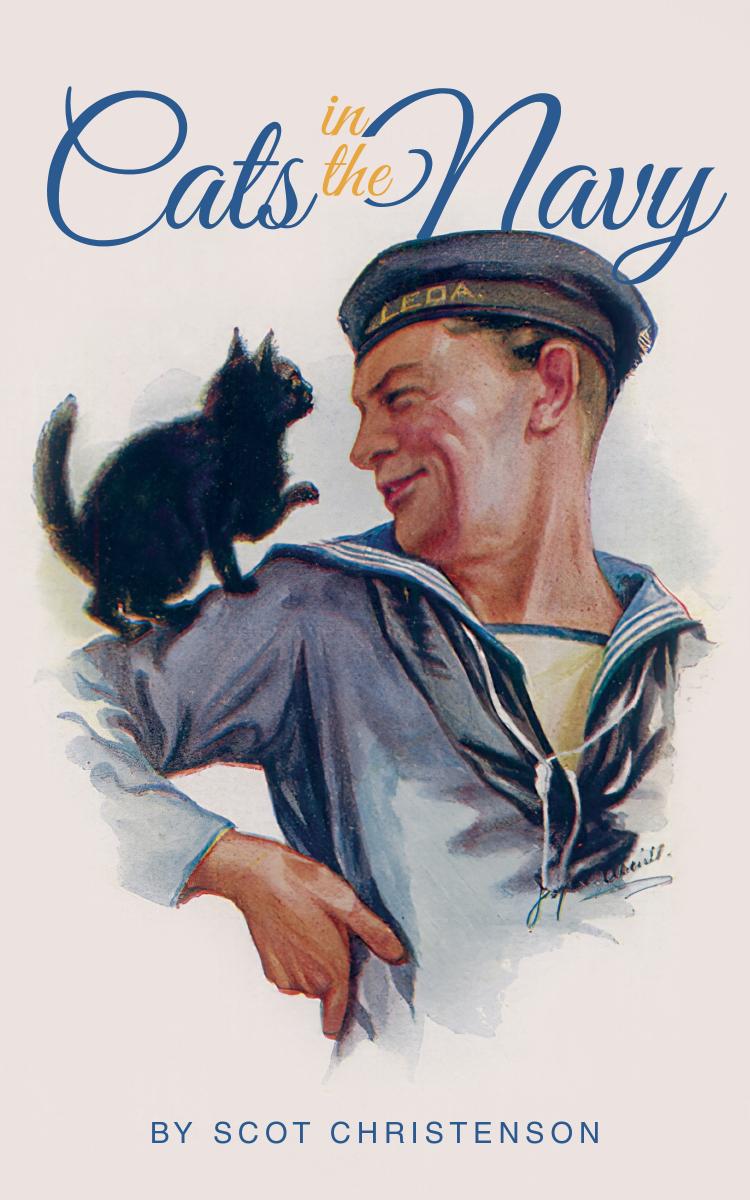
Book Review: Cats in the Navy

By Scot Christenson
Reviewed by Lee Duckworth
HRNM Docent
Cats in the Navy is published by Naval Institute Press. Find out more at: https://www.usni.org/press/books/cats-navy 
Cats in the Navy is a short, whimsical book filled with photographs that cat lovers will enjoy. Each photo is accompanied with a short write-up about that specific cat and a more detailed paragraph on the facing page that describes that cat’s role in the Navy. The author is obviously a cat-lover as several photos are from his own personal collection.

The first chapter of the book provides an overview of the history of cats at sea, going back over 3,000 years to ancient Egyptian seafarers. The author focuses most of his book on United States and British Navy ships with cats embarked during WWI and WWII and the inter-war period. 

The next portion of the book explains the various tasks assigned to the ship’s cat (e.g., elimination of rodents that spread disease, storm warning, crew morale, and companionship). Just the right amount of information is given to each of the highlighted cats. A short paragraph highlights a unique characteristic of that feline and is accompanied with a photograph of the cat and its often humorous interaction with the crew.
One page from Cats in the Navy, showing the types of images and writing included in this book (Naval Institute Press)
The final section of the book is devoted to some “heroic” cats and is fetchingly titled “Claws of Fame.” Their heroic actions (at least in the eyes of their shipmates) deal mainly with cats being viewed as “good luck charms,” especially after surviving a ship’s collision, engagement with the enemy, battle damage, or sinking.

The author includes a few ‘catchy’ phrases but doesn’t go overboard with naval terms such as aircraft carrier bow and waist cats, catenary in refueling lines, or cat’s paws on the water. All-in-all, this is a fun book for pet lovers of all ages and there is sufficient research to suggest that those interested in naval history will also enjoy the read.

Thursday, April 21, 2022

Battleship Commander: The Life of Vice Admiral Willis A. Lee, Jr.

By Paul Stillwell

Reviewed by Lee Duckworth
HRNM Docent
Paul Stillwell’s biography of Vice Admiral Willis A. Lee Jr. is a book 40 years in the making and finally published in 2021. It details the life of Lee and focuses on his leadership experiences in the Second World War. Lee’s early life is unremarkable, other than the fact that he was an expert marksman. This shooting ability figures prominently during his time at the US Naval Academy (1904-1908) and participation in the 1920 Olympics. After graduation, Lee had assignments to various ships, including a battleship, cruiser/receiving ship, gunboat on the Yangtze River Patrol, and submarine tender. Stateside, his earliest shore duty was with the Bureau of Ordnance and later with the Fleet Training Division of the staff of the Chief of Naval Operations, where he made his reputation as a gunnery and fire control systems expert.
Lee as a US Naval Academy midshipman in 1908 (NHHC)
The author cites numerous examples of Lee’s ship-handling and tactics abilities that further his career as a surface warfare officer. Interestingly, Lee never had command of a battleship but was commanding officer of two destroyers. Two additional tours in Washington, D.C., with the Fleet Training Division (OPNAV 22) solidified his position as a gunnery expert, and his pioneering efforts in development of a Combat Information Center (CIC) set the stage for the major portion of the book and his career: World War Two.

The author details Lee’s preparations and conduct in battle in the Pacific during his three years as “Battleship Commander” and highlights three decisive battle opportunities. At Guadalcanal, Rear Admiral Lee was commander of a task force consisting of two battleships and four destroyers. The November 14-15, 1942, night battle was the first time his units had operated together, and Lee had no opportunity to publish a formal Operations Order, nor was there any common doctrine. U.S. Navy forces opened the battle and had the advantage of radar, but in short order the destroyers at the head of Lee’s column were out of action. The battleship USS South Dakota sustained significant damage and was also out of the fight. Through Lee’s perseverance, the Japanese battleship Kirishima was sunk and a few hours later the Japanese forces withdrew. Lee’s utilization of radar in this battle proved to be the deciding factor and the turning point in the six-month fight for Guadalcanal. He later received his third star and was assigned as Commander, Battleships Pacific Fleet, where he was responsible for fleet battleship doctrine and procedures.
ADM Raymond Spruance, VADM Marc Mitscher, Fleet Admiral Chester Nimitz, and VADM Willis Lee in Feb 1945 (NHHC)
The second opportunity for Lee came on June 19, 1944, at the Battle of the Philippine Sea. The officer in tactical command urged Lee to pursue the Japanese fleet at night and force a surface action. Lee declined, reasoning that there was a lack of training in fleet tactics at night. Although senior US Navy admirals were disappointed, they took no action against Lee. It is ironic that the man who—two years earlier—led a night engagement successfully with a unit that had never operated together would not enter this fight. Lee neglected to take action that could have destroyed a major portion of the Japanese fleet.
VADM Lee in 1944 or 1945 (NHHC)
The final opportunity for Lee to see major combat was on October 24-25, 1944, at Leyte Gulf. The failures at this battle are well-known, especially regarding Admiral William Halsey. Lee was designated commander of Task Force 34 with four fast battleships, seven cruisers, and nineteen destroyers. The battleships had all operated together under Lee a month earlier, practicing tactical exercises. But most of Halsey’s task force, including Lee’s ships, went north in search of Japanese aircraft carriers. Lee sent two messages to Halsey, stating Task Force 34 should remain to cover the San Bernardino Strait, but received no reply. Lee’s battleships went far north of the strait and, when finally detached from the rest of Halsey’s ships, returned too late to face the retreating Japanese navy. Lee could have applied more pressure to make sure Halsey was aware that there was no U.S. Navy coverage at the strait. As a three-star admiral and the officer designated to take over if something happened to Halsey, Lee bears some responsibility for the failure.
RADM Lee receiving the Navy Cross from Admiral Halsey after the Battle of Savo Island in 1942 (NHHC)
Research for Battleship Commander began more than 40 years ago, but little recent research is evident. It is a fair, balanced view of Lee’s life and highlights his superb reputation as a marksman, ship handler, and loyal shipmate. In summary, the author concentrates on Lee’s lasting accomplishments in improving the Navy’s readiness in the areas of shipboard radar, fire control systems, anti-air gunnery, proximity fuses for 5-inch projectiles, and perhaps most important, the development of the CIC concept. VADM Lee is indeed worthy of the title “Battleship Commander,” given his recognized leadership during three years of intense fighting at sea in WWII. I recommend this book, filled with vignettes from family, friends, and shipmates, to learn more about the battleship admiral who spent three years in the Pacific during WWII, and whose total focus was on the readiness of the US Navy.

Thursday, February 24, 2022

Book Review, The Sailor's Bookshelf: Fifty Books to Know About the Sea

By Admiral James Stavridis
Reviewed by Steven Ludwig, HRNM Volunteer
The Sailor’s Bookshelf: Fifty Books to Know the Sea, by Admiral James Stavridis, has something for anyone drawn to the sea. The book provides a comprehensive reading guide for old salts, historians, adventurers, scientists, and dreamers alike, and its structure allows each to “navigate“ the sections depending on their individual preference. This is a challenging book to review, as it is a collection of reviews itself. Admiral Stavridis has distilled thousands of books about the sea, sailors, explorers, fictional characters, and naval history to his top 50 recommendations. Anyone reading this guide might have other choices, but few are as qualified to make these selections as the author.

Admiral Stavridis’ love of the sea and literature is evident in his reviews. Here we get the benefit of him doing our intellectual heavy lifting. The admiral is a sailor/scholar uniquely qualified to author this well thought out guide. He is a retired four-star U.S. naval officer, and currently Vice Chair, Global Affairs and Managing Director of The Carlyle Group, a global investment firm. He is also chair of the Rockefeller Foundation board. Previously he served for five years as the dean of The Fletcher School of Law and Diplomacy at Tufts University. He was the first Navy admiral to lead the NATO Alliance in global operations from 2009 to 2013 as Supreme Allied Commander.
Admiral James Stavridis (Official Navy photo)
After the preface, the book is divided into four categories: The Oceans, Explorers, Sailors in Fiction, and Sailors in Non-fiction, followed by an afterword. The preface gives us insight into the Admiral himself. His love of family, the sea, and literature are examined from his early childhood to the present. Each of the following four sections contain reviews of multiple books of varied topics. The reviews start with a glimpse into why this selection is important to the author, from childhood memories to personal and professional references over his vast naval career. Each review ends with a bonus feature. Some bonuses reference other books or movie adaptions. My favorite bonus is in the review for The Bedford Incident. The admiral explains the psychological and literary parallels with Herman Melville’s classic Moby Dick. His ability to make these parallels of two books separated by 100 years is an example of how insightful these reviews are.

The Oceans: From navigation, naval history, and the importance of cod on a global economy, to free diving, ecology, and a book devoted to the most remote islands in the world, the thirteen books in this section are all-encompassing. They are devoted mostly to a macro view of the oceans and those sailing them.

Explorers: The books span a diversity of exploration. Included are Cooke’s expeditions, which redefined the world as it was known in eighteenth-century England and a tale of six men crossing the Pacific Ocean in a primitive raft named Kon Tiki. Among others, there are tales of the first man to circumnavigate the globe by sail and an expedition to Antarctica which was miraculously saved by its leader.

Sailors in Fiction: The books in this section include the science fiction world of Jules Verne, and the magical realism of Yann Martel. There are also well-known literary characters from works including The Old Man and the Sea, Mister Roberts, Moby Dick, and Mutiny on the Bounty to name a few. Other excellent selections focus on the stresses of command and life aboard old sailing ships, modern surface ships, and a WWII diesel submarine.

Sailors in Non-Fiction: This is the largest section with 15 book reviews, including the Time-Life 22-volume set The Seafarers. Sailing and sailors from 2,500 years ago to the present are represented in these books. Ground-breaking individual and naval forces achievements and epic tragedies are disbursed among excellent biographies and autobiographies.

The afterword, written by Commander J. D. Kristenson, USN provides further insight into the author and offers three ways the selections can be taken from each section depending on a person’s individual interest and experience. Commander Kristenson also provides a valuable warning: don’t take on this entire list as a challenge. He urges the reader to “find what truly speaks to you, that which can be used to help you weigh, consider, and challenge your thoughts.”

Admiral Stavridis’ reviews have given me an idea of what speaks to me, and my personal, disjointed, order of preference will start with Master and Commander, followed by Kon Tiki. My question for you is, which books speak to you and why?

Thursday, December 30, 2021

Book Review, Valor and Courage: The Story of the USS Block Island Escort Carriers in WWII

By Benjamin J. Hruska
Reviewed by Dr. Ira R. Hanna, HRNM Docent

Although it is a relatively short book (203 pages), Valor and Courage covers much more than the story of the two escort carriers that bore the name Block Island. It describes the important change in naval policy toward the strategic use of aircraft carriers, particularly CVEs, during WWII. CVEs were needed to carry aircraft, equipment, and supplies to the United States armed forces and its allies. Although Americans learned that CVEs were Combustible, Vulnerable, and Expendable, they achieved their missions and in some cases victory through the heroic actions of their captains and crews. Hruska tells the story of two of these valiant ships, mainly through the eyes and ears of those who manned those ships so courageously.

USS Block Island (CVE 21) in 1944 (Naval History and Heritage Command)
The first Block Island (CVE 21) was built by Seattle-Tacoma Shipbuilding Company and commissioned on March 8, 1943. It departed San Diego in May and steamed to Norfolk, VA, under the command of Logan C. Ramsey, graduate of the Naval Academy and an experienced naval aviator. During the summer of 1943, Block Island twice delivered squadrons of Army fighters to Great Britain. Then, with several different destroyer escorts, it sought to find and sink German submarines lurking along the Atlantic coast. During four anti-submarine cruises, its planes sank two submarines and shared the credit of sinking two more with its destroyer escorts. In March 1944, while in Casablanca for “rest and recreation” and resupply, Ramsey was relieved by Francis “Massie” Hughes, also an experienced naval aviator. Much different in command leadership than Ramsey, Hughes pushed his pilots and deck officers to physical and mental extremes. Limited biographies of these two very different COs were included. In my opinion, they could be expanded into a very insightful book.
Francis Massie Hughes as a Lieutenant (Naval History and Heritage Command)
On May 29, 1944, CVE 21 was torpedoed by U-549 and sank within minutes. Because the ship was abandoned quickly, most of the crew survived. Hughes was cleared of any misconduct in the sinking. When a new Block Island (CVE 106) was launched at the Todd Pacific Shipyard in Tacoma, WA, Hughes resumed command. He immediately requested that all the survivors of the first Block Island be reassigned to the new one. For the first time in the history of the United States Navy, a surviving crew from one lost ship was ordered directly to a new ship. The new Block Island was sent to the Pacific Theater and took part in the preparation for the invasion of Okinawa. Block Island’s last mission was to evacuate the hundreds of prisoners held by the Japanese on the island of Formosa. After hostilities ended, it transited the Panama Canal in January 1946 and proceeded to Norfolk. Something the book did not mention was that CVE 106 was then towed to Annapolis, where it was used as a training ship for the midshipmen. In 1950, CVE 106 was transferred to the Atlantic Reserve Fleet, but was recommissioned in 1951. Until 1953 it carried out local operations off the Virginia Capes.
USS Block Island (CVE 106) underway in January 1945 (Wikipedia)
Some of this book reads like a dissertation. Hruska admits this in his introduction. Many of his attempts to explain the purpose of the book begin with “this work argues, “this work purposes,” and “I attempt to demonstrate.” Nevertheless, it is a fascinating study of the development, manufacture, and wartime use of CVEs. The narrative provided by the interviews of officers and enlisted men makes this book a testament to the valor and courage of the CVE sailors. He describes the important change in naval policy toward the strategic use of aircraft carries instead of “battleship diplomacy.”

This book is not just a history of two escort carriers but a polemic on the exclusion of the escort carrier as a major contributor to the American victory in WWII. Who can forget the valiant group of “Taffy 3’s” CVEs that turned back a Japanese fleet that would have destroyed the landing on Leyte? Or those that were part of the hunter-killer groups that sank so many German submarines that convoys leaving East Coast ports after mid-1943 no longer feared to cross the Atlantic?

There is no firm conclusion in this book except to lament the lack of reverence for the CVEs. No CVE was kept as a museum, as was done for battleships, CVA carriers, submarines, or destroyers. There is no place for CVE sailors to remember their wartime “valor and courage.” There are only the memories of those who served on those easily destroyed but important contributors to the USA’s victory. In his concluding chapter, Hruska found it perplexing that many sailors had a total lack of memory about the first ship’s sinking. This, he said, “poses a rather philosophical question. How can a life-changing event be identified or mean something to someone who doesn’t remember it at all?” That is his conclusion if there is one! This book has a multitude of memories that need to be told and I enjoyed reading about them.

Thursday, November 4, 2021

Book Review: Sea Stories, My Life in Special Operations

By Admiral William McRaven
Reviewed By Captain Alexander Monroe, USN (Ret.)
HRNM Docent and Contributing Writer

In Sea Stories, Admiral William McRaven has written a well-organized, powerful book in which he performs a number of valuable functions. The title Sea Stories is misleading because it has a connotation in the patois unique to the Navy, which means the story is embellished to meet the intent of the teller. The admiral’s stories are, by contrast, real. He shows his personal sacrifice and involvement in his arduous initial training as a SEAL (Sea, Air and Land) special operations officer, an experience shared by all SEAL personnel, officer and enlisted. He describes the wide variety of situations in which Special Operations forces apply their training. Most important, he provides an inspiring catalog of events worldwide which, taken together, show the Navy’s institutional response to the novel challenges of unconventional warfare where one fights against often un-uniformed yet dangerous adversaries. The book gains meaning because of his personal involvement in many of the evolutions of which he writes.

McRaven immediately engages the reader’s attention by linking his personal growth and testing as a nascent high school track star to his indoctrination as a special operations officer. The common thread in the experiences is the necessity for overcoming the difficult aspects of a situation under pressure. He notes doing this through the intercession and encouragement of a devoted coach, Jerry Turnbow, who inspired him to greater effort to break a school record in the one-mile run. He was later inspired by the often profanity-laced exhortations of instructors in BUD/S (Basic Underwater Demolition/Seal) training, reputed to be the most strenuous indoctrination syllabus in the armed forces. He describes what he considers the most important objective of BUD/S indoctrination: to push trainees to their limit and beyond, “to eliminate those unsuited for the world of the special forces operator.” It entails giving encouragement to others as team players in the final stage of a seemingly insurmountable task: surviving Hell Week, the capstone of initial SEAL training.

The book is a rendition of operations in which the United States Navy, often in cooperation with other nations, has applied military power to attain goals to include ensuring national safety, if not survival. McRaven uses various situations requiring rapid response to emerging threats as well as those requiring complex, highly sensitive preparation. An example of the first operation is the seizure and inspection of SS Amuriyah, a hostile merchant vessel thought to be carrying contraband to Saddam Hussein in Iraq. Supported by USS Ogden (LPD 5) and USS Brewton (FF 1086), a team fast roped onto the ship, stopped it, and subdued a bellicose master and hostile crew. The operation, fashioned in about 72 hours, was a success because of total dedication of the SEAL team to mission completion, though it could not be ascertained beyond all doubt that no contraband had been found. McRaven notes in justifying abandoning detailed R2P2 (Rapid Response Planning Process) planning that, “all the staff work on the world doesn’t get you better results than what the experienced officer knows intuitively.” The operation was executed “without any major injuries to either Americans or Iraqis. He later emphasizes another key ingredient in carrying on unconventional operations exemplified in dealing with pirates who seized the SS Maersk Alabama. That is: “factors unfold quickly—you give authority to the ground commander and hope that will win the day.” A second type of operation, shown in the effort to remove Osama Bin Laden, known as Operation Neptune’s Spear, requires planning of a detailed sensitive nature involving the same considerations. Operators must take risks to accomplish the mission.

Admiral William McRaven (Official U.S. Navy photo)

The most moving chapter of the book, “The Next Greatest Generation,” describes his visit to the U.S. Army Hospital, where he visited special operations personnel wounded in the line of duty. Some of these gallant soldiers required intensive hospital care to survive the long journey to CONUS medical facilities. His description of the injuries sustained by one young soldier, who is connected to a multitude of life support appliances, is devastating to the reader and clearly affected the admiral. It renews his admiration for their “tremendous sense of determination, ebullience and lack of self- pity” in facing catastrophic injuries. The abiding lesson for the nation, made at various points in Sea Stories, is that its citizens, like special warfare operators, must be “imbued with an indomitable spirit, a true belief that tomorrow will be a better day—if only they fight and never give up.”

Certain aspects of the book may be distracting to the reader unfamiliar with military patois. The use of coarse language throughout, though sometimes good natured, may be offensive and tiresome; however, it gives it authenticity that is required. The author generally strives to define unique military/Navy terms and acronyms. It might, however, be useful to have a separate glossary of terms and expressions not known to the non-military reader.

In summary then, Admiral McRaven has fashioned an engaging volume well worth the reading. It clearly shows what he quotes from Helen Keller in the page immediately preceding the table of contents that, “Life is either a daring adventure or nothing.”

Wednesday, November 4, 2020

Recent Reads: From Sail to Steam: Recollections of Naval Life by Alfred Thayer Mahan


Alfred Thayer Mahan shown late in his career (Naval History and Heritage Command)

By Dr. Ira Hanna
HRNM Docent

If any group of naval officers from any nation were asked what the name Mahan would bring to their minds, “Sea Power Wins Wars” would be their first choice. But Mahan’s life tells a lot more. From his first ship, the Congress, he learned what it felt like to be under “full sail.” Built in 1840, it represented the culmination of the era of sail. And from his last ship, the USS Wachusett, he became fully knowledgeable about being under “full steam.” This book is his story of how the U. S. Navy went from sail to steam power.

Mahan was born September 27, 1840, at West Point, New York, where his father was a professor at the Military Academy. Even so, he visited Norfolk often and became interested in the Navy and its ships. He always thought of himself as a Virginian. Although Mahan remained true to the Union during the “War of Secession,” he forever was influenced by the Chesapeake Bay. His father told him, “your mother is northern and very few can approach her, but still none compare for me the southern woman.” His father met Lafayette when he toured America in 1825-26 and spent time in France visiting him. His mother had a strong strain of French blood. Alfred said of himself that he was one half Irish, one quarter English, and “a good deal more than a trace of French.”

As a young boy, Mahan was fascinated by books written by the “old salts.” So it was not unusual that he chose to go to the Naval Academy rather than the Military Academy which his father preferred. In 1870, Mahan obtained command rank but was concerned with the “apathy” of the American people toward the navy. He called it a time of naval stagnation. That was when he began to read every book that told how sea power influenced the success of a nation, commercially as well as militarily.


By 1884, he had published a number of articles in popular magazines and become a regular lecturer at the Naval War College. He collected those articles and lectures into a book and in 1889 published The Influence of Sea Power upon History, 1660 – 1783. He continued to publish books that changed the way Americans, especially Congress and the President, felt about the need to build “a navy second to none.” Some of them were: The Influence of Sea Power upon the French Revolution and Empire, 1793 -1812 (published in 1892); The Life of Nelson (1897); The Interest of America in Sea Power, Present, and Future (1897); and The Major Operations of the Navies in the War of American Independence (1914). During his lifetime, Mahan authored over 40 books and before his death in 1914, predicted the defeat of the Central Powers and German Navy in World War I.

Although written in Victorian Era English with its hidden meanings, some revealing tales, and insights into the navy’s leadership, there is no doubt that Alfred T. Mahan influenced that leadership. The present navy reflects his belief that technological advances will influence what kind of ships will be built now and in the future in order for America to maintain its place as a world leader.