Showing posts with label USS Canonicus. Show all posts

Wednesday, October 7, 2015

The Last Civil War Monitor

By Elijah Palmer
Hampton Roads Naval Museum Educator

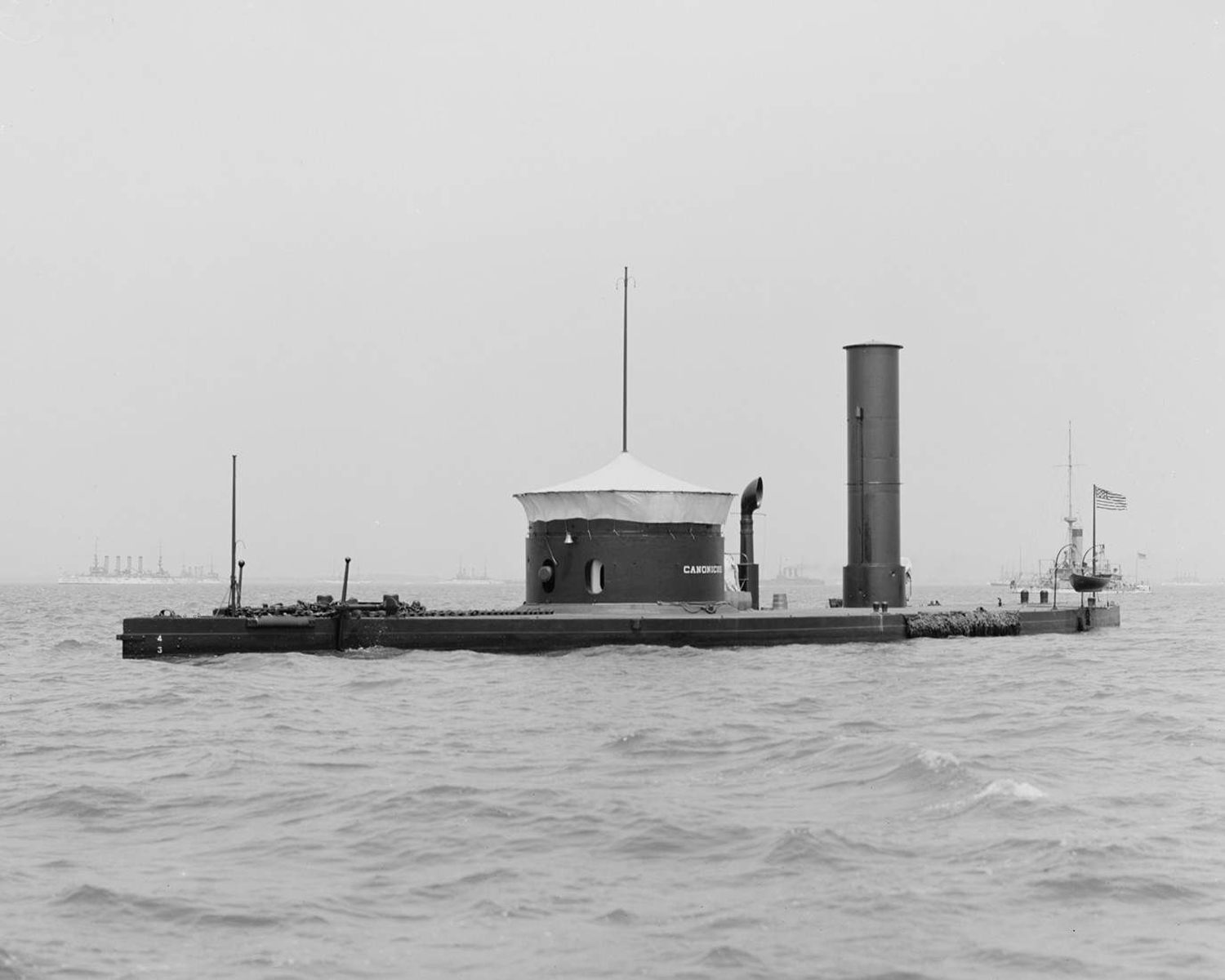
The Jamestown Exposition in 1907 was filled with many sights to see. From the vendors selling souvenirs along the "War Path" to the Baby Incubator Exhibit to the popular "Merrimac-Monitor" building, guests had many options to fill their visit. But a significant focus of the exposition was on the modern fleet that had been built up under the guidance of Teddy Roosevelt. Indeed, it was from Hampton Roads that the Great White Fleet would begin their grand round-the-world tour. Several of these ships were anchored off Sewells Point, showcasing the Navy's modernity. Yet one Navy vessel was in stark contrast to the new white ships surrounding it. The odd one out was the last remaining Civil War monitor, USS Canonicus
USS Canonicus at the Jamestown Exposition in 1907. Note the many naval vessels in the background (Library of Congress photo)
Over 40 years old by that point, USS Canonicus had seen better days, but was an approximate example of Ericsson's invention that had made history on March 9, 1862 in the waters of Hampton Roads. In fact, some souvenir photographs claimed that this was one in the same craft, both forgetting history and pointedly ignoring the bold white letters displayed on Canonicus' side (perhaps this was simply for profit as the pictures were from an angle that hides the lettering). But to confuse this monitor with the original one was shortchanging Canonicus' own exploits. 


Built in Boston as the first in her class, USS Canonicus was sent to join the James River Flotilla in the spring of 1864. The crew of the ironclad spent over six months patrolling and engaging Confederate defenses with their dual 15-inch Dahlgren guns, often coordinating with sister ships such as the ill-fated USS Tecumseh. In December 1864, Canonicus was sent to join the North Atlantic Blockading Squadron as it prepared to assault Fort Fisher in North Carolina. 

During the first attack on Fort Fisher (December 24-25, 1864), Canonicus fired nearly 150 shots, receiving only a handful in return from the Confederate defenders. The attempt to capture this formidable fort failed, largely due to poor coordination between the Army and naval forces, as well as overconfidence in the effectiveness and accuracy of the shore bombardment. 
The second assault on the fort started on January 13, 1865. The naval part of this attack was a massive armada of over 40 ships on the firing line, with over a dozen more in reserve. While all ships were moved in closer to achieve better accuracy, Canonicus and three other monitors were positioned nearest to the fort. The gun crews on Canonicus fired nearly 300 shells during the three days of battle, with most being expended on the 13th. However, due to its proximity to the Confederate batteries, the monitor was hit nearly 40 times. While no significant damage or casualties occurred, the ship's flag was shot down twice. Both times, Quartermaster Daniel Stevens replaced the colors under the heavy fire from Fort Fisher's guns. He was awarded the Medal of Honor for these actions. 
An illustration from 1907 showing Stevens' actions. The caption is a bit confusing, but perhaps should read "For the third time the flag was raised" as Stevens only replaced it twice, but it was originally raised for battle. 
Near the end of the war, Canonicus and a handful of other ships were sent to Cuba in search of the feared oceangoing Confederate ironclad ram CSS Stonewall. However by the time the ships arrived, the Confederate vessel had been surrendered to the Cuban government as the war had ended. Serving off and on until the late 1870s, the monitor was put into reserve until its last moment to shine at the Jamestown Exposition came in 1907. Canonicus, the last remaining Civil War monitor, was scrapped in 1908, finally closing that chapter of naval history.
The monitor shown sandwiched between the "ABCD ship" Dolphin and Admiral Dewey's flagship Olympia in this 1898 poster hanging in the museum's gallery. (photo by HRNM educator Joseph Miechle)

Tuesday, April 1, 2014

Old Man Graham Tells Richmond Kids to Get Off His Lawn...err...Ships, 1891

USS Manhattan on the James River, 1880s
In the years following the American Civil War, the Navy placed its monitor-type ironclad warships in a reserve status. In its search for a suitable place to lay up these ships, the Navy decided that City Point, Virginia, on the James River would be a good place for six of the monitors.

The squadron consisted of Ajax, Canonicus, Catskill, Lehigh, Mahopac, and Manhattan. The squadron was not a "ghost fleet" per se because the Navy assigned a small contingent of officers and sailors to watch over the ships. In charge of this squadron was Commander Felix McCurley of Baltimore, Maryland. At 74 years old, McCurley entered the Navy as one of the hundreds of "volunteer" naval officers at the beginning of the Civil War and experienced his fair share of combat and diplomatic standoffs (in the Kingdom of Hawaii, for example). McCurley possessed an easygoing personality.

While at City Point, McCurley's sailors became restless and openly expressed their displeasure at being assigned to such a backwater location where there was nothing for them to do while off-duty. To accommodate them, McCurley received permission to move the squadron closer to Richmond.

The change of base piqued the curiosity of the locals. The public wanted to walk the decks of the historic warships, even if they were Yankee warships against which their fathers had fought. All of the ships in the squadron had been in battle during the late war. McCurley welcomed excursion boats that frequently passed by the ships and he was happy to have visitors on board. One newspaper report commented that the visitors had made the monitors "a resort," implying that they did more than just walk the decks of the ship.

Lehigh's turret with battle scars caused by Confederate
guns guarding Charleston, South Carolina.
In 1891, McCurley received orders to take command of League Island (Philadelphia) Navy Yard. His relief was Commander James Duncan Graham and the fun came to a sudden end. A member of the U.S. Naval Academy's class of 1857 and a veteran of many battles on the Mississippi River during the late war, Graham had a much more serious view of his duties. He proclaimed to the press that he was issuing a strict policy regarding ship visitation. The result was a revolt among the local boaters. As Graham described the situation to a local reporter, "The good people of Richmond have no idea of the indignities, insults and other annoyances the officers and men on board the monitors are subjected to, particularly on Sundays and holidays. People come down the river in boats and insist upon coming directly abreast the monitors, and using the most vile language, shouting at the tops of their voices, and jeering at the men aboard ship." Fearing for his own family's safety, he moved his wife and children north.

After a quick fix at Norfolk Naval Shipyard, the
Navy moved the James River monitors to League
Island (Philadelphia) Navy Yard.
Navy leadership saved everyone additional trouble by ordering all six monitors to be taken to Norfolk Naval Shipyard for minor repairs and then to League Island for their new permanent station. It is not clear whether public threats made by Richmond boaters had anything to do with the transfer. The Navy would later mobilize the squadron for the Spanish-American War.

But in the opinion of Graham, one thing was for sure: these were ships of war. A newspaper commented, "The foundation of adverse feeling in [Graham] is simply owing to the fact that he had never considered it commensurate with his duty to permit the monitors to be used as a public museum or a Pleasure Resort."