Showing posts with label animals and mascots. Show all posts

Thursday, August 11, 2022

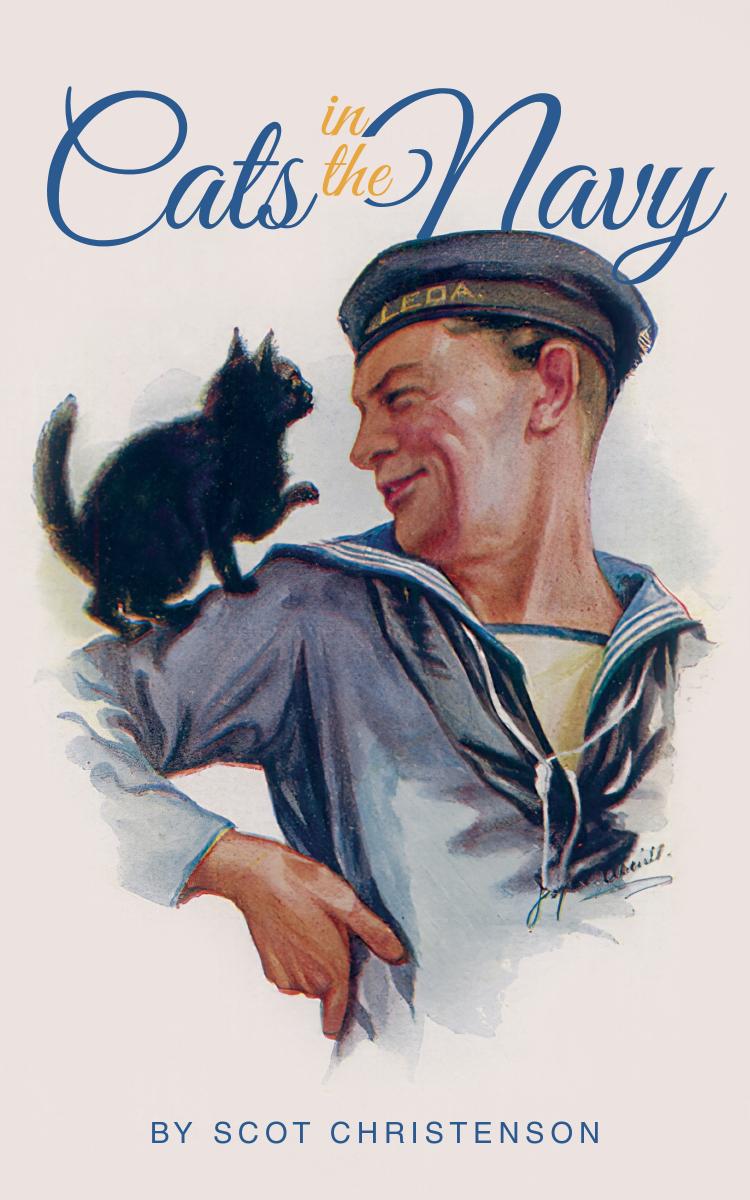
Book Review: Cats in the Navy

By Scot Christenson
Reviewed by Lee Duckworth
HRNM Docent
Cats in the Navy is published by Naval Institute Press. Find out more at: https://www.usni.org/press/books/cats-navy 
Cats in the Navy is a short, whimsical book filled with photographs that cat lovers will enjoy. Each photo is accompanied with a short write-up about that specific cat and a more detailed paragraph on the facing page that describes that cat’s role in the Navy. The author is obviously a cat-lover as several photos are from his own personal collection.

The first chapter of the book provides an overview of the history of cats at sea, going back over 3,000 years to ancient Egyptian seafarers. The author focuses most of his book on United States and British Navy ships with cats embarked during WWI and WWII and the inter-war period. 

The next portion of the book explains the various tasks assigned to the ship’s cat (e.g., elimination of rodents that spread disease, storm warning, crew morale, and companionship). Just the right amount of information is given to each of the highlighted cats. A short paragraph highlights a unique characteristic of that feline and is accompanied with a photograph of the cat and its often humorous interaction with the crew.
One page from Cats in the Navy, showing the types of images and writing included in this book (Naval Institute Press)
The final section of the book is devoted to some “heroic” cats and is fetchingly titled “Claws of Fame.” Their heroic actions (at least in the eyes of their shipmates) deal mainly with cats being viewed as “good luck charms,” especially after surviving a ship’s collision, engagement with the enemy, battle damage, or sinking.

The author includes a few ‘catchy’ phrases but doesn’t go overboard with naval terms such as aircraft carrier bow and waist cats, catenary in refueling lines, or cat’s paws on the water. All-in-all, this is a fun book for pet lovers of all ages and there is sufficient research to suggest that those interested in naval history will also enjoy the read.

Friday, May 18, 2018

New Prince's Namesake a Naval Hero in Hampton Roads

Anglophiles around the world are abuzz over all the goings-on with the British Royal Family, from the recent wedding of Prince Harry to Meghan Markle to the new son recently born to Prince William and his wife Catherine, who they named Prince Louis Arthur Charles.  Many of them know that the name Louis (pronounced without the "s") has a long history in the family, and that the baby prince was most likely named for Lord Louis Mountbatten, the last Viceroy of India who was killed by terrorists in 1979.  Unfortunately, many news reports only mentioned Mountbatten's tragic death, yet he was a man whose amazing life impacted the destinies of millions around the globe.

Not many know that Mountbatten, a cousin of King George VI and son of a German prince, spent over 50 years in service to the Royal Navy and that he was never more at home than when commanding a warship.  Fewer still know that the seasoned combat veteran took charge of the largest ship he would ever command, the aircraft carrier HMS Illustrious, right here in Hampton Roads, months before the American entry into the Second World War
.  But almost no one alive today knows what important attribute he shared with the ship's mascot.

Although it was common knowledge among residents of Portsmouth and Norfolk, Virginia, that the British aircraft carrier Illustrious was being completely refurbished at Norfolk Naval Shipyard after being nearly destroyed by German dive bombers, this fact was only publicly acknowledged when Captain Lord Louis Mountbatten took command. (Sargeant Memorial Collection, Norfolk Public Library)
Stories about the event appeared in newspapers from coast to coast, largely taking the American public by surprise. Until just a few days before Mountbatten's arrival, it was forbidden to report that British warships were even visiting American ports, much less undergoing major repair work in the U.S. Navy's shipyards. Many at the time wondered why such an important event would take place hundreds of miles from the nearest Royal Navy outpost.
That story is indeed obscure, but we can now shed some light upon it. 


Royal Blood and Seawater

The destinies of the United States and the United Kingdom drew closer throughout 1941. One reason for this is that when the year began, the Royal Navy was in one of the most precarious positions in its long history.

When the war began in September 1939, the German Kriegsmarine had been vastly outnumbered by the British and French navies in terms of battleships (3 vs. 22), cruisers (8 vs. 83), and virtually every other kind of warship and auxiliary. Moreover, it had no viable fleet air arm of its own to counter the Royal Navy’s, not to mention Germany's two planned aircraft carriers were nowhere near completion.  Despite this, the well-organized and coordinated German war machine managed to force the French navy out of the war and put the Royal Navy on the defensive in the North Sea, the Atlantic, and the Mediterranean during the first year of the war.

The Royal Navy had lost its first carrier to the Germans only two weeks after the war began. U-29 struck HMS Courageous with two torpedoes on September 17, 1939.  She sank in 15 minutes with a loss of 519 of her crew of 1,260. In the midst of its violent wake toiled Captain Lord Louis Mountbatten, commander of the 5th Destroyer Flotilla, helping pick up survivors aboard his flagship, HMS Kelly.

Although Lord Mountbatten’s great-grandmother was Queen Victoria, he had been rising through the ranks on his own merit since joining the Royal Navy in 1916.  Although royal blood coursed through his veins, so did seawater.  His father, Prince Louis of Battenberg, had served as First Sea Lord during the First World War’s outbreak over 20 years before.

With every major setback that the British armed forces and those of its allies faced in those early months of the war, Mountbatten acted fearlessly to defray disaster. In April 1940, his flotilla had taken heavy casualties while guarding the evacuation of British troops from Norway. The following month, HMS Kelly was torpedoed off the Dutch coast, after which Mountbatten moved his flag to HMS Javelin, which subsequently had both her bow and stern shot clear away by German torpedoes and gunfire off France.  He again assumed command of his original flagship after her return to service at the end of 1940, but while supporting the withdrawal of British forces from Crete in May 1941, Kelly took a direct hit from a German Stuka dive-bomber and capsized within two minutes. While Mountbatten escaped from under the destroyer, half of his crew did not.

After enduring wave after wave of German planes, which strafed the survivors with every pass, Mountbatten recalled:

“I thought it would be a good thing to start singing and so I started that popular song ‘Roll Out the Barrel’ and the others joined in, which seemed to help.”


Triumph at Taranto, Trial at Malta 

An artist's depiction of the surprise attack upon the Italian navy at Taranto, near the southern end of the Italian peninsula. (Royal Navy)

As it became obvious in June 1940 that France’s defeat was imminent and its fleet could no longer be counted upon by the Royal Navy, Italy committed its navy against Great Britain when it declared war on June 10.  Confronted by a former ally that it then had to fight and attacked by an opportunistic new foe in its home waters, the Royal Navy was rapidly running out of refuges in the Mediterranean.  Out of the depths of this crisis, however, a brilliant plan was hatched.  On November 11, 1940, the new British aircraft carrier Illustrious made history by launching the first raid by carrier-borne torpedo planes against ships in a protected harbor.  During Operation Judgment, just two waves of 21 antiquated Swordfish biplanes put half of Italy's battleships out of action at Taranto, at a cost of two aircraft.  Although behind schedule and more modest than was originally conceived, the operation stunned Italy and captured the attention of the world's navies, including the Japanese.
As seen from an unspecified Royal Navy warship, HMS Illustrious sustains a near miss right along her starboard bow on December 10, 1941, near the Italian island of Pantelleria. (Admiralty Official Collection/ The Imperial War Museum)
While protecting a merchant convoy reinforcing Malta on January 10, 1941, between 40 and 50 Junkers 87 Stuka dive bombers found Illustrious about 85 miles off the besieged island.  In just six minutes, she sustained six direct hits. One of the bombs scored a direct hit on the carrier's centrally located aft elevator, which was bringing up a Fairey Fulmar fighter and its pilot from the hangar deck. The twisted 300-ton lift platform crashed back into the hangar bay, spreading burning debris and fuel over the four fully-loaded Fulmars and nine Swordfish torpedo planes awaiting their turn to take off. Then another 1,000-pound bomb struck ten feet from the lift entrance, smashing through the buckled deck and exploding in the hangar bay. Another bomb crashed though the flight deck and exploded as yet another wave of Stukas reached the carrier. A seventh 1,000-pound bomb smashed through an antiaircraft gun platform and exploded alongside the hull, tearing shrapnel holes along her side.
Looking aft from Illustrious's island, the results of precision dive bombing can be clearly seen, with smoke from hangar bay fires erupting from fissures and bomb holes in the armored flight deck, as well as the upended aft aircraft lift. (Admiralty Official Collection/ The Imperial War Museum)
She was left a smoking ruin, adrift and without steering or electrical power, aflame from bow to stern, hangar deck to the flight deck. Any other carrier made before her would probably have been destroyed, but, after three more aerial attacks that yielded yet another direct hit near the remains of her aft elevator, Illustrious reached Malta's Grand Harbor, still on fire. Miraculously, only 126 men were killed and 91 were wounded out of her crew of 1,400.  Her mascot, a black cat named Taranto, had survived unscathed.  Her aircraft had also managed to shoot down eight of the attackers.

A photograph taken aboard Illustrious after she reached Malta shows the tremendous damage done to her forward elevator by German Stuka dive bombers. (Courtesy of Marcus Robbins/ Norfolk Naval Shipyard)
 Illustrious withstood several more bomb attacks while under emergency repairs at Malta, including another direct bomb hit, but on January 23, she slipped out of the harbor unbeknownst to the Germans and began an arduous trip back to the Atlantic by way of the Suez Canal, taking the long way around Africa.  Known but to a few on the nearly three-and-a-half-month journey that lay ahead, the tide of the war was about to change.  She was heading for Norfolk, Virginia.

Long Before War's Beginning, Neutrality Ends

In a fireside chat broadcast on December 29, 1940, entitled “On National Security,” President Franklin D. Roosevelt declared to millions of his radio listeners, “If Great Britain goes down, all of us in the Americas would be living at the point of a gun.” He finished his speech to the nation by declaring, “We must be the great arsenal of democracy.”

On March 11, 1941, despite considerable isolationist resistance in Congress, President Franklin D. Roosevelt signed the Lend-Lease bill, and war materials began streaming forth to Britain from East Coast ports, including Hampton Roads.  Within the Lend-Lease program was a provision for the repair of allied ships.  As a result, American naval shipyards began active war work many months before the rest of the Navy.  Norfolk Naval Shipyard would perform major work on British warships for the first time since it served as a base of operations for Virginia’s last colonial governor during the Revolutionary War.


The 23,000-ton Secret 

HMS Illustrious, photographed sometime between her arrival in Hampton Roads in May 1941 and her dry-docking at Norfolk Naval Shipyard. Note the fragment holes on her starboard bow. (Courtesy of Marcus Robbins/ Norfolk Naval Shipyard)
The port bow of HMS Illustrious, photographed after her dry-docking at Norfolk Naval Shipyard. Note the dozens of temporary patches that had to be applied before she left Malta. (Courtesy of Marcus Robbins/ Norfolk Naval Shipyard)
Illustrious had only been commissioned into the Royal Navy the year before she entered Norfolk Naval Shipyard on May 12, 1941 but she did not look it. Many of the initial survey photos made by shipyard photographers, many published here for the first time online, were kept secret because they showed just how effective the German attacks had been.


Shipyard workers get a look at the destruction wrought upon the aft elevator well of HMS Illustrious, which was located in the center of the aft part of the flight deck. (Courtesy of Marcus Robbins/ Norfolk Naval Shipyard)
Despite the fact that Illustrious had an armored flight deck, which probably saved the ship during the January attack, the entire flight deck would have to be replaced, along with much of the topside and hangar deck equipment. One bomb which had passed through the flight deck, hangar deck and wardroom, exploded in the aft breaker room, putting electrical power for most of the ship out of commission. As a result, most of the carrier's electrical system would have to be replaced at the yard. Some special cable fixtures and machinery that could not be fabricated at the yard had to be shipped over from England.

Today, the international press would certainly turn out to witness, record, and broadcast a heavily damaged British warship's arrival, but Navy Secretary Frank Knox had impressed the importance of secrecy upon his fellow press barons (Knox was publisher of the Chicago Daily News), and they maintained voluntary censorship, acting in concert to deny such information to the Germans. 

“I was in Norfolk when the British plane carrier, Illustrious, was in the yards suffering from every known ailment that an airplane carrier can suffer,” wrote correspondent Henry McLemore that October. “I saw the Illustrious with my own eyes, talked to officers who told me what had happened to her and was all but run over in the streets of Norfolk by Illustrious sailors. But, according to the Navy’s censorship code, I couldn’t write a word about the Illustrious.”

“The Board of Censors is firm in its belief that a 30,000 or 50,000-ton battleship can sneak into a harbor in broad daylight, tie up at a busy dock, disembark hundreds of its crew and undergo riveting repairs without even the cat on the clock noticing that a thing is going on.”

And so it was that the British government decided in mid-August to lift the veil of secrecy from the “riveting repairs,” revealing to the world not only where Illustrious had been for over a year, but also that a member of the royal family was to take command of the rejuvenated carrier. The American press quickly followed suit.

The British were not only happy to show the dramatic transformation the warship had undergone in Norfolk, but also prove to the Germans that her new commander, a man who had two ships torpedoed out from under him already, was equally ready to rejoin the fight.

Just before officially assuming command of HMS Illustrious at Norfolk Naval Shipyard in August 1941, Captain Lord Louis Mountbatten conducts an inspection of junior ratings as shipyard workers watch the proceedings from above. (Courtesy of the Sargeant Memorial Collection, Norfolk Public Library)
Lord Louis Takes Command

“Mountbatten, who looks like the Hollywood version of a dashing naval hero, was piped aboard the battle-scarred Illustrious shortly after 9:30 a.m. today and immediately went about the business of officially taking command of the vessel,” wrote Norfolk Ledger-Dispatch reporter Charles Reilly on August 27, 1941.

“Mountbatten walked leisurely among the men, stopping frequently to chat with some gob or petty officer,” wrote Reilly. “He [sic] deevoted considerable time to talking with crew members who have been singled out for [sic] deecorations for their conduct when the ship was under fire.”

“I get a genuine thrill out of being associated with a ship that has done so much good and which has such a wonderful record,” Mountbatten told the crew after taking the podium. “I am anxious, as you are, to get her back in action and give the Germans and Italians a few knocks.”


Nine Lives


Royal Navy Captain Lord Louis Mountbatten meets three of Illustrious's nine mascots, the nearest to him held by Seaman Glyn Ellis (center). (Hampton Roads Naval Museum file)
While meeting with some of the junior sailors, Mountbatten was introduced to Taranto, the ship’s mascot, along with several other kittens rescued from other warships lost in action.

Three sailors aboard the British aircraft carrier Illustrious pose with one of the nine feline mascots purportedly living aboard her during her refit at Norfolk Naval Shipyard.  It is unclear whether the cat pictured is "Taranto." (Courtesy of the Sargeant Memorial Collection, Norfolk Public Library)
“Taranto is quite somebody aboard the Illustrious,” wrote Reilly. “She was on board during all the fighting and her calm conduct under fire won her the admiration of the crew and officers alike.”

Shirley Hogge, an artist in the shipyard’s safety office, created a rendering of the introduction, which depicted both the captain and the cat as seasoned combat veterans with nine lives.  A framed copy was presented to Captain Mountbatten on October 13 by Rear Admiral Felix X. Gygax, commandant of the yard. Mountbatten immediately left after the presentation for Washington DC, where he was to meet with President Roosevelt.

An editor at the Virginian-Pilot newspaper wrote, "The cat in the cartoon will be remembered as one of several which are mascots of the Illustrious.  Reference in the two lines of verse perhaps go to Lord Mountbatten, since he is hale and hearty despite having had vessels torpedoed out from under him in the current conflict." The cat is leaning upon the original ship's bell of the carrier, which was heavily damaged during the January 1941 attack.  A replacement was cast by Norfolk Naval Shipyard in August and presented to the Illustrious crew in September.  (Courtesy of Marcus Robbins/ Norfolk Naval Shipyard
Captain Lord Louis Mountbatten, RN, accepts the cartoon of him and "Taranto," the mascot of HMS Illustrious, from Rear Adm. Felix Gygax, Norfolk Naval Shipyard commandant.  (Courtesy of Marcus Robbins/ Norfolk Naval Shipyard)
Winston Churchill's Orders

Mountbatten had just arrived in Washington when he was shown an urgent message from London.

Prime Minister to Lord Louis Mountbatten: we want you to home here at once for something that you will find of the highest interest.

He departed for England, where Prime Minister Winston Churchill offered him a new post: Advisor on Combined Operations.  Mountbatten was visibly nonplussed.  He had only been commander of Illustrious for two months. The carrier was more combat capable than she was when she was first launched, yet the finishing touches had not yet been made.  He had not yet even taken her out for sea trials.

Outraged by Mountbatten’s lack of enthusiasm for the post he had been hand-picked for, Churchill exploded.

"Have you no sense of glory?"

"Here I give you a chance to take part in the higher leadership of the war, and all you want to do is go back to sea. What can you hope to achieve, except to be sunk in a bigger and more expensive ship?"

Churchill had more than a special interest in Mountbatten for the job.  He had originated the idea for an advisor on combined operations before he even became prime minister.  The disastrous Gallipoli campaign had happened on his watch as First Lord of the Admiralty during World War I. The lack of coordination between the Commonwealth forces and the Royal Navy factored into the failure to defeat the Ottoman Turks in the Dardanelles a generation ago, yet Churchill knew they were no better prepared to work together in 1941 than they were in 1915.  Britain's armed forces needed a multi-service command dedicated to coordinating the raids, and, ultimately, invasions to come. He needed a proven combat veteran to lead what would essentially be an organization dedicated to ending the defensive phase of the war. With the Americans coming in on their side, the time was ripe to begin making preparations to, in Churchill’s words, "develop a reign of terror" along the enemy's coastline.

Despite Mountbatten’s initial reluctance to relinquish command of Illustrious, the implications of his new position, along with the realization that he could not turn it down anyway, forced a change of heart. He took up the new post on October 27, determined to carry out Churchill's orders to "turn the south coast of England from a bastion of defense to a springboard of attack." Despite some initial setbacks, most notably at Dieppe in August 1942, Mountbatten would lead a diverse group of some of the Commonwealth’s greatest unconventional warriors and thinkers, along with those from America, to create the vessels, equipment, tactics and doctrine required to invade Africa, Italy, and, ultimately, France. 


Illustrious First of Many

With her new commanding officer, Captain Arthur George Talbot, Illustrious departed Norfolk Naval Shipyard on November 25, 1941, just two weeks before the Japanese attack on Pearl Harbor, after which the United States officially entered the war.

HMS Illustrious was the first of six battle-damaged vessels to receive extensive repairs and even complete overhauls at the yard during 1941. Also included were the battleship HMS Royal Sovereign; two fleet carriers, HMS Formidable and HMS Indomitable; the cruiser Daytonian, and the escort carrier ArcherFormidable, which arrived on August 26, underwent the most extensive repairs after Illustrious.

In all, approximately 140 British vessels would be handled at Norfolk Naval Shipyard during the war under the Lend-Lease program. Although many of these were smaller vessels such as the Landing Ship, Tank (LST) that were commissioned into the Royal Navy in droves (yet another big idea credited to Winston Churchill), the repair of those first heavily damaged capital ships made the most meaningful impact during Britain's darkest hours of the war.

Great Britain finally made the last Lend-Lease repayment back to the United States on December 29, 2006.


Friday, March 17, 2017

Survivor: The Tidewater Industrial Tiger

Recently, bloggers and meme-makers around the world were saddened by the loss of an Indonesian tiger who served as the mascot of Subdistrict Military Command (Koramil) 1123 under the Siliwangi Military Command in West Java. It can be said that an army fears ridicule just as much if not more than an actual attack, and this case was no exception. Because the tiger elicited so much more laughter than the reverance or even fear that he was intended to inspire, the order was given to destroy him.

Maj. Gen. Herindra of the Siliwangi Military Command told the BBC that other similar mascots would be inspected to determine whether they are, in his words, “consistent with the original [military] emblem.”

Lest I lead you to believe that real animals are being destroyed during this army purge, I should clarify that these are statues; three-dimensional representations of unit emblems. It is with this in mind that I introduce you to the "Tidewater Industrial Tiger," who wrapped up a successful career as Naval Aviation Depot (NADEP) Norfolk’s mascot at Naval Air Station Norfolk over 20 years ago.  


Although the facility has long been closed, its mascot lives on.

Once the largest single employer in Norfolk, Virginia, Naval Air Rework Facility (NARF) Norfolk's name was changed to Naval Aviation Depot (NADEP) Norfolk in 1987.  In 1993, the Base Realignment and Colsure Commission (BRAC) voted to close the facliity, which was carried out in 1996. (Hampton Roads Naval Museum)
His three-dimensional counterpart played a prominent role, in two-dimensional form, within a recent commemorative exhibit at the Hampton Roads Naval Museum about the closing of NADEP Norfolk in 1996.  

The exhibit, "Without Us, They Don't Fly: The Story of NADEP Norfolk," ran from September 2016 to March 2017. (Photograph by M.C. Farrington)

The Tidewater Industrial Tiger, on display at a public event sometime during the 1980s. (Hampton Roads Naval Museum file photo)
Similar to his ill-fated Indonesian cousin, the wooden statue, created by workers at the facility that overhauled and repaired naval aircraft for most of the 20th century, was not the spitting image of its namesake emblem.  Nevertheless for thousands of attendees of airshows, parades, and open houses over the years, he was the embodiment of the facility. The tiger's image actially started out 50 years ago as a hand-painted sign at the entrance to Naval Air Rework Facility (NARF) Norfolk, as it was known at the time.  

The entrance to the Naval Air Rework Facility (NARF) Norfolk, which gained that name in 1967, featured an early version of The Tidewater Industrial Tiger. (Hampton Roads Naval Museum file photo)  
Although he was never accessioned into the collection of the Hampton Roads Naval Museum, the former Tidewater Industrial Tiger is safe from harm, and, at least until the writing of this post, has never appeared in a meme.  He currently serves as the mascot of a high school in Southeast Virginia.  

The former Tidewater Industrial Tiger as he appears today, sans globe, at Oscar Smith High School in Chesapeake, Virginia, home to one of the top ten high school football teams in the state. (Photograph by M.C. Farrington

Tuesday, January 3, 2017

Remembering the Battle of Hampton Roads-- With Cats!

By Joseph Miechle
Hampton Roads Naval Museum Educator
In this composite, one of the thousands of cats created by Ruth and Rebecca Brown of Civil War Tails handles a line aboard the Hampton Roads Naval Museum's model of USS Monitor. (Photo Illustration by M.C. Farrington)
A couple of years ago, The Daybook (Volume 18, Issue 2) contained an article about how the Battle of Hampton Roads was remembered in vastly different ways by Civil War veterans and the public. Here we are, nearly 155 years after the battle, and yet how we remember the battle continues to evolve. In a way, the way we display the battle reflects how our modern culture continues to change. With this in mind, we present a most unusual, yet highly entertaining and informative museum in Gettysburg, Pennsylvania, which was recently labeled "[P]ossibly America's most whimsical war museum," by the Washington Post.
The ironclad Monitor fires a round against CSS Virginia within the Battle of Hampton Roads diorama within the Civil War Tails museum in Gettysburg, Pennsylvania.  (Courtesy Civil War Tails)
Gettysburg is not generally considered a must-see destination for students of American naval history, but a recent National Public Radio story piqued our interest when it showcased Civil War Tails at the Homestead Diorama Museum. The museum’s hand crafted dioramas depict some of the American Civil War’s most important moments: Fort Sumter in 1861; The Angle and Little Round Top at Gettysburg in 1863; the USS Housatonic; and Andersonville Prison. They also feature the 1862 Battle of Hampton Roads. While the displays are certainly what some would consider a folk art creation, they still reflect the large amount of research that went into their creation. Meticulous craftsmanship has gone into representing actual people, topography, and hardware. Only upon closer examination do you realize the displays contain no people, but over 2,000 anthropomorphic cats.
Inside the Monitor turret we find nearly two dozen hand-made Union Navy felines, showing the cramped working conditions during the battle. (Photograph by Joseph Miechle)
The Civil War Tails Museum is the creation of Rebecca Brown and her sister Ruth. Their study of the Civil War merged with their love of cats, and the modeling of clay figures that they had been doing from the age of 11. By 2015, it had culminated in the opening of their museum. They use cats as opposed to people because, according to their web site, “Cats are easier to make and after all, history doesn’t have to be boring." It seems oddly appropriate that our modern society's fascination with online cat videos only naturally embraces a venue that merges people's fascination of the Civil War with cats.
John L. Worden and his junior officers prior to getting underway. Can you guess which one is Lt. Worden? (Courtesy Civil War Tails)
While the museum certainly displays levity with the use of cats, they also capture some otherwise underappreciated stories of the actions they depict. The diorama of the Battle of Hampton Roads is an excellent example. While the cardboard ships contain clay cats they also very accurately tell the story of the battle. The top of USS Monitor's turret can be removed and packed inside the detailed homemade model are 19 soot-covered cats representing Lt. Greene and the actual gun crews during the battle.
This image shows injured crew members sprawled across the floor of CSS Virginia after taking a point blank shot from USS Monitor (Photograph by Joseph Miechle)
The side of CSS Virginia may be removed, and the inside contains the gun crews commanded by Lt. John Wood and goes so far as to accurately depict his crew “bleeding from the nose or ears,” as Wood himself described it, after being struck by close range shots from USS Monitor. The diorama also has the benefit of “portholes” drilled into the sides below the waterline, so that a visitor might see the dramatic difference in draft between the two ships. The author is of the opinion that, despite lacking the refined details of what most consider “museum quality” models, the diorama at Civil War Tails makes up for in character and storytelling. The museum has made accessible a pivotal moment of American history to audiences who may never have been inclined to learn about it, thus adding to the legacy of how we “remember” the Battle of Hampton Roads.

Thursday, January 21, 2016

The Cyclops and the Lion

By Joseph Miechle
Hampton Roads Naval Museum Educator


When the Great White Fleet departed Norfolk in 1907 on its around the world voyage, an immense amount of planning was necessarily involved. The new battleships were steam powered and required massive amounts of coal. A battleship traveling at 16 knots required 338 pounds of coal per minute to maintain speed, and the fleet generally consumed roughly 7,200 tons of coal per day. The supply ships of the era could not provide this type of replenishment at sea and the Navy relied on friendly ports of call to meet demands. The Navy concluded that should a global conflict emerge, its ships would be vulnerable should they run out of fuel in unfriendly waters.

In response to these logistical challenges, the Navy developed the Proteus-class of colliers to address the growing demand for fuel for a global fleet and in doing so, unintentionally helped generate some of the greatest nautical mythology of the 20th century. Enter the infamous USS Cyclops (AC-4). She was launched in 1910 and saw service prior to World War I with the Naval Auxiliary Service. The ship's first and only captain was Lieutenant Commander George Worley. Cyclops supplied US warships with the coal they needed throughout the Atlantic area until the United States entered World War I on April 6, 1917.  She was officially commissioned as a US Navy vessel less than a month later but continued to serve the Navy rather ordinarily until sometime after departing Barbados for Baltimore, Maryland on March 4, 1918.  Somewhere along her route she seemingly vanished from the earth.  Speculation about what could have become of the ship and Worley began almost immediately.  
  
Because the United States had officially entered World War I, and Worley was thought to be of German descent and a known German sympathizer, some speculated that he had sailed his ship (laden with manganese ore) to waiting German agents and surrendered it to them. There were also stories that the collier may have been sunk by German U-boats operating in the Atlantic Ocean or by a bomb being smuggled aboard in Brazil. These theories disintegrated when no U-boats claimed to sink the ship and neither the crew nor ship emerged from Germany after the war.  There was also a theory that the crew had mutinied against Worley because of his abrasive command.  Cyclops was also carrying a few prisoners, and some stories included a prisoner uprising. These theories all failed to hold water. 
USS Cyclops was featured in the movie The Bermuda Triangle (1978). 
Postwar theories as to what happed to Cyclops evolved from the mysterious to the absurd. These included natural phenomena such as cyclones, rogue waves, extreme weather, and methane bubbles from the ocean floor affecting the ship’s buoyancy.  The supernatural theories were some of the most spectacular because the ship was presumed to have been lost in the infamous maritime anomaly known as the Bermuda Triangle.  Theories include alien abductions, gigantic sea monsters, time travel, and capture by citizens of the Lost City of Atlantis. There is little evidence to support such outlandish hypotheses, so what really happened to the Cyclops? No trace of the ship nor crew has ever been found.

When Cyclops departed Bahia, Brazil in February 1918, it is known that one of the ships' engines was not operational.  The ship was also loaded (perhaps improperly) with an unfamiliar, and much denser, load of manganese ore as opposed to the coal it was designed to transport.  Merchant captains operating near the Bahamas, where Cyclops is thought to have been operating, reported heavy seas and a sudden cyclone.  As the Proteus-class ship was reported to list excessively in heavy seas, rough seas and an unstable load probably caused the ship to completely roll over at night and quickly plunge beneath the sea. The theory of rapid sinking is strengthened by the fact that no distress call was ever heard from the ship. The storms might also explain why no flotsam from Cyclops was found, as sailors would have lashed most everything down.
The mysterious George W. Worley.  
To perpetuate the strange history of Cyclops we should mention that all four Proteus-class ships built were lost to extraordinary circumstances.  USS Proteus and USS Nereus were both sold to Canada and disappeared without a trace in the Atlantic Ocean less than a month apart in 1941. The fourth ship of the class, USS Jupiter, was converted to the U.S. Navy's first aircraft carrier, USS Langley, in 1920 and after her conversion to a seaplane tender was lost to enemy action in the Pacific Ocean in 1942.
 

In 1973, a former Navy diver claimed that while diving in search of USS Scorpion (SSN-589) in 1969, he stood on the deck of USS Cyclops off the coast of Virginia. Was this an exaggeration? Was it Cyclops or perhaps one of her sister ships? The verdict is still open as USS Scorpion was later located at another location and the U.S. Navy ceased recovery operations in the area. This only added fodder to the mystery of Cyclops’ ultimate fate.
Fascination with the Bermuda Triangle and the craft associated with its mysteries continues to grow.  But what has any of this to do with a lion?  To add further controversy to the already epic stories surrounding USS Cyclops, we are presented a fascinating sidebar to history. 


At the time, it was not unusual for U.S. Navy ships to have mascots.  Cats, dogs, and goats typically filled these roles.  There were, however, more exotic mascots representing our warships and shore stations a century ago.  USS Langley featured a honey bear (also known as a kinkajou), a turkey kept watch with a goat named Billy aboard USS Louisiana, and a black bear going by the name of Whiskey could once be found at Naval Air Station Norfolk.  But perhaps the most outrageous ship mascot of them all sailed aboard USS Cyclops.  Lt. Cmdr. Worley apparently obtained a lion names Teddy in Rio de Janeiro at some point prior to December 1910, which he then brought aboard ship.  The Navy did not approve and Worley advertised in newspapers for a zoo to take custody of the 150 pound beast that, “[P]lays with the men like a kitten would.”  The fate of the lion, like the Cyclops, remains unknown.